Genetic Scorecard Indicator - Hazel Gloves
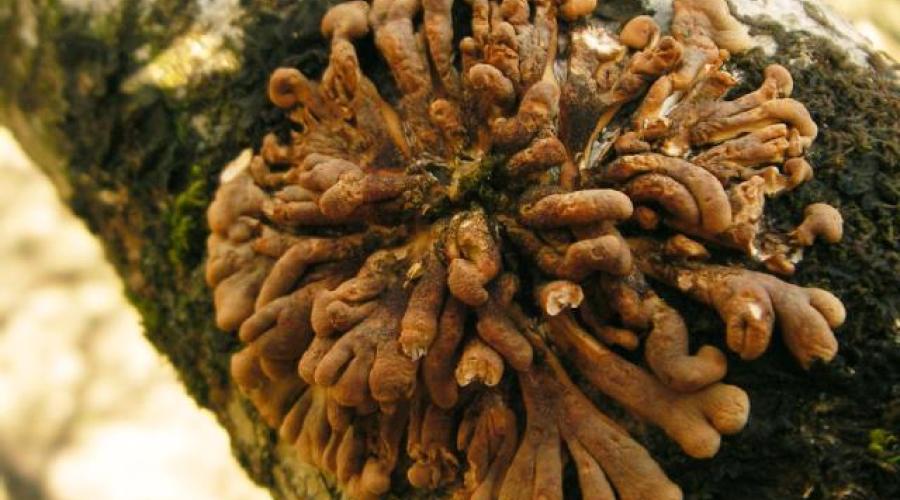
Hazel Gloves (Hypocreopsis rhododendri)

IUCN Category:
- Great Britain: Not Assessed (indicated above)
- Europe: Not Assessed
- Global: Not Assessed

Genetic Health Status:
- Scottish Risk: Negligible (indicated above)
- UK Risk: Negligible
- Scottish Mitigation status: Effective
- UK Mitigation status: Effective
Background
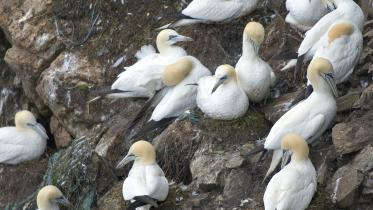
Hazel Gloves is an ascomycete fungus parasitic on the wood-decay 'glue fungus' Pseudochaete corrugata (Grundy et al., 2012). Within Europe it is restricted to Atlantic hazel woodland (Dahlberg et al., 2010), and in North America to understory shrubs in the Appalachian woodlands (Grundy, 2014). It is a flagship species for Atlantic woodland (Coppins & Coppins, 2010).
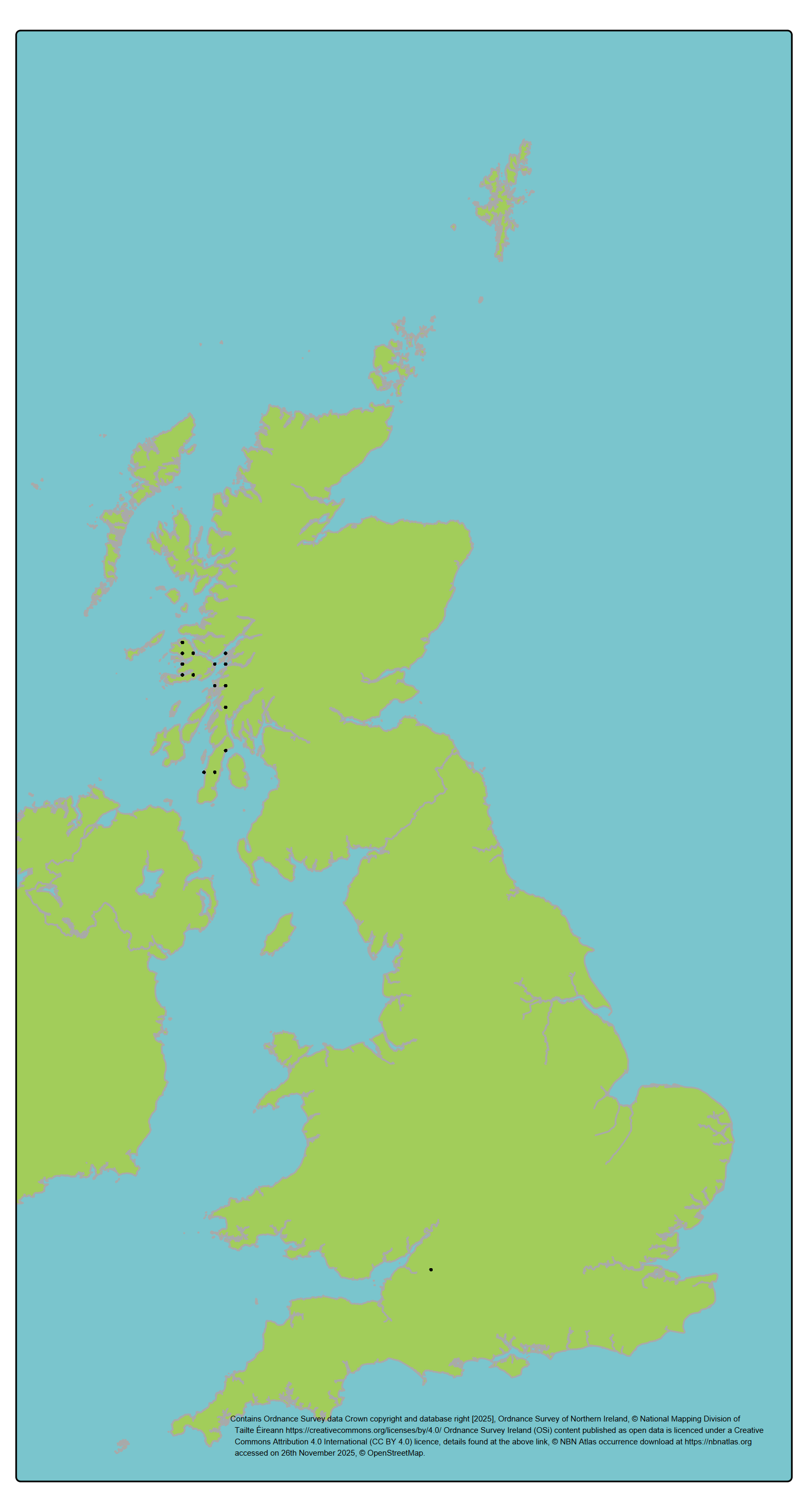
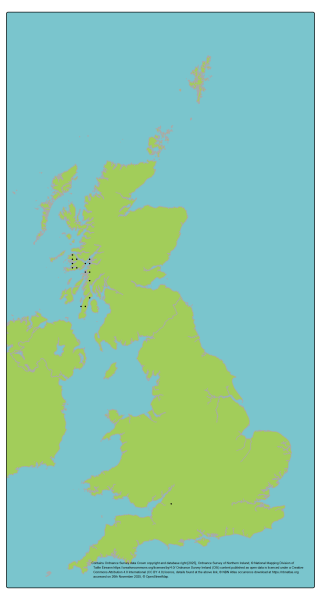
View a larger version of the distribution map for Hazel Gloves.
Current Threats
The main threats it faces in Scotland and elsewhere are fragmentation and loss of habitat; for example, as a result of scrub clearance (Dahlberg et al., 2010). These issues have been exacerbated by direct habitat loss and declines in the quality of habitat from the negative impacts of coppicing, overgrazing and the incursion of invasive species such as R. ponticum.
Contribution of Scottish/UK population to total species diversity
Scottish and European populations show evidence of a recent population bottleneck, with source populations and higher genetic diversity in North America (Grundy, 2014).
Genetic risks
Diversity loss: population declines
Heavy grazing, concentrated grazing, coppicing and historic scrub clearance has led to a reduction in the old-growth hazel habitat suitable for this species (Acton, 2016). Invasive species, particularly R. ponticum, also threaten the habitats. However, efforts are underway to restore its rainforest habitat (ASR, 2025). The species is considered to be well dispersed, which should slow loss of genetic diversity due to habitat fragmentation. In addition, European populations overall show very low levels of genetic variation compared to North American populations – essentially meaning that there is limited genetic variation in the first place to be lost in Scotland.
Global Biodiversity Framework Indicators
Population definitions:
Populations are defined by ecological and biogeographic proxies. Hazel Gloves is confined to areas of suitable temperate rainforest, a habitat that is fragmented across much of the UK. There is a population in Cornwall/Devon which probably has gene flow over the water into South Wales. There is another population spread across West Scotland, where the habitat is more continuous. Given that there has been genetic mixing between continents, the distance between the fragments unlikely to be significant.
Ne500: The proportion of populations that have an effective population size of more than 500.
- Proportion of populations with Ne > 500 in Scotland = Not meaningfully calculable.
- Proportion of populations with Ne > 500 in UK = Not meaningfully calculable.
PM: Proportion of populations that existed in 2000 that still exist in 2025.
- Proportion of populations maintained in Scotland = 1/1
- Proportion of populations maintained in UK = 2/2
Diversity loss: functional variation
Functional variation
Considered negligible risk as the habitat for this species is relatively homogenous, and there are no identified concerns about populations in atypical habitat that would be candidates for supporting important adaptive genetic variation.
Divergent lineages
Considered negligible risk as the existing data suggest that Scottish populations contain a subset of genetic variation found elsewhere.
Hybridisation/Introgression
No evidence of risk of hybridisation/introgression (Grundy, 2014).
Low turnover - constraints on adaptive opportunities
There is relatively high population turnover, with reproductive stromata living only for about two years. These rely on abundant populations of their host fungus (Grundy, 2014).
Cumulative Risk Summary
Overall Genetic Health Status
Scotland
- Risk: Negligible
- Mitigation: Effective
Great Britain/UK
- Risk: Negligible
- Mitigation: Effective
Overall Genetic Health status explanation
The overall low levels of genetic diversity in the species may constrain evolutionary potential, but there is no explicit evidence of genetic problems for the species to-date.
In situ genetic threat level
In situ genetic threat level
- In situ Risk for Scotland: Negligible
- In situ Risk for UK: Negligible
Relatively uncommon but well-dispersed species benefiting from favourable management which should limit future declines.
Confidence in in situ threat level
- Confidence score for Scotland: High
- Confidence score for UK: High
High - assessment based on recent genetic and ecological research.
Ex situ representation
Attempts to establish the species ex situ have been unsuccessful.
Current conservation actions
Interventions to favour the species as part of the Species Action Plan (2007-2012) led to increased awareness of the species and appropriate management of its habitat (Genney et al., 2016). The Alliance for Scotland’s Rainforest has developed and is implementing an action plan to meet the needs of this and other rainforest species including control of invasive species and habitat continuity.
| Ex situ | Translocation | Habitat management | Legal protection of habitat or species | Regulation of exploitation | Control of INNS/pests/pathogens |
|---|---|---|---|---|---|
| - | - | X | X | - | X |
Population assessment/monitoring
Population
Demographic
N pops assessed/monitored in Scotland = 1/1
N pops assessed/monitored in UK = 2/2
Genetic
N pops assessed/monitored in Scotland = 0/1
N pops assessed/monitored in UK = 1/2
References
Acton, A. 2016. Hazel gloves fungus (Hypocreopsis rhododendri) survey of Mid Argyll. Scottish Natural Heritage Commissioned Report No. 887.
ASR. 2025. ASR Saving Scotland’s Rainforest Progress Report
Dahlberg A, Genney DR, Heilmann-Clausen J. 2010. Developing a comprehensive strategy for fungal conservation in Europe: current status and future needs Fungal Ecology Volume 3, Issue 2, May 2010, pp 50-64
Grundy KC, Woodward S, Genney DR, Taylor AF. 2012. A molecular approach to explore the extent of the threatened fungus Hypocreopsis rhododendri within wood. Fungal Biology. 116(3):354-62.
Grundy, K. C. 2014. Ecology of Hypocreopsis rhododendri. PhD Thesis. University of Aberdeen.
Assessor:
- David Genney, NatureScot
- Kat O’Brien, NatureScot
Reviewer: Rebecca Yahr, Royal Botanic Garden Edinburgh