Genetic Scorecard Indicator - Great Crested Newt
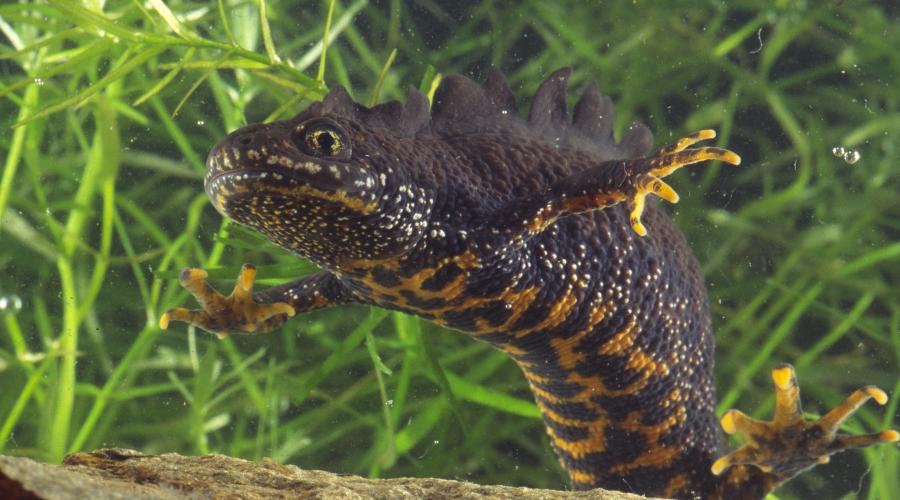
Great crested newt (Triturus cristatus)

IUCN Category:
- Great Britain: Least concern (indicated above)
- Europe: Least concern
- Global: Least concern

Genetic Health Status:
- Scottish Risk: Serious (indicated above)
- UK Risk: Moderate
- Scottish Mitigation status: Partially effective
- UK Mitigation status: Partially effective
Background
Largest newt species within the UK whose ecology has been studied intensively, being a focal point of protection within the UK and EU (Beebee & Griffiths, 2000; Jehle et al., 2011).
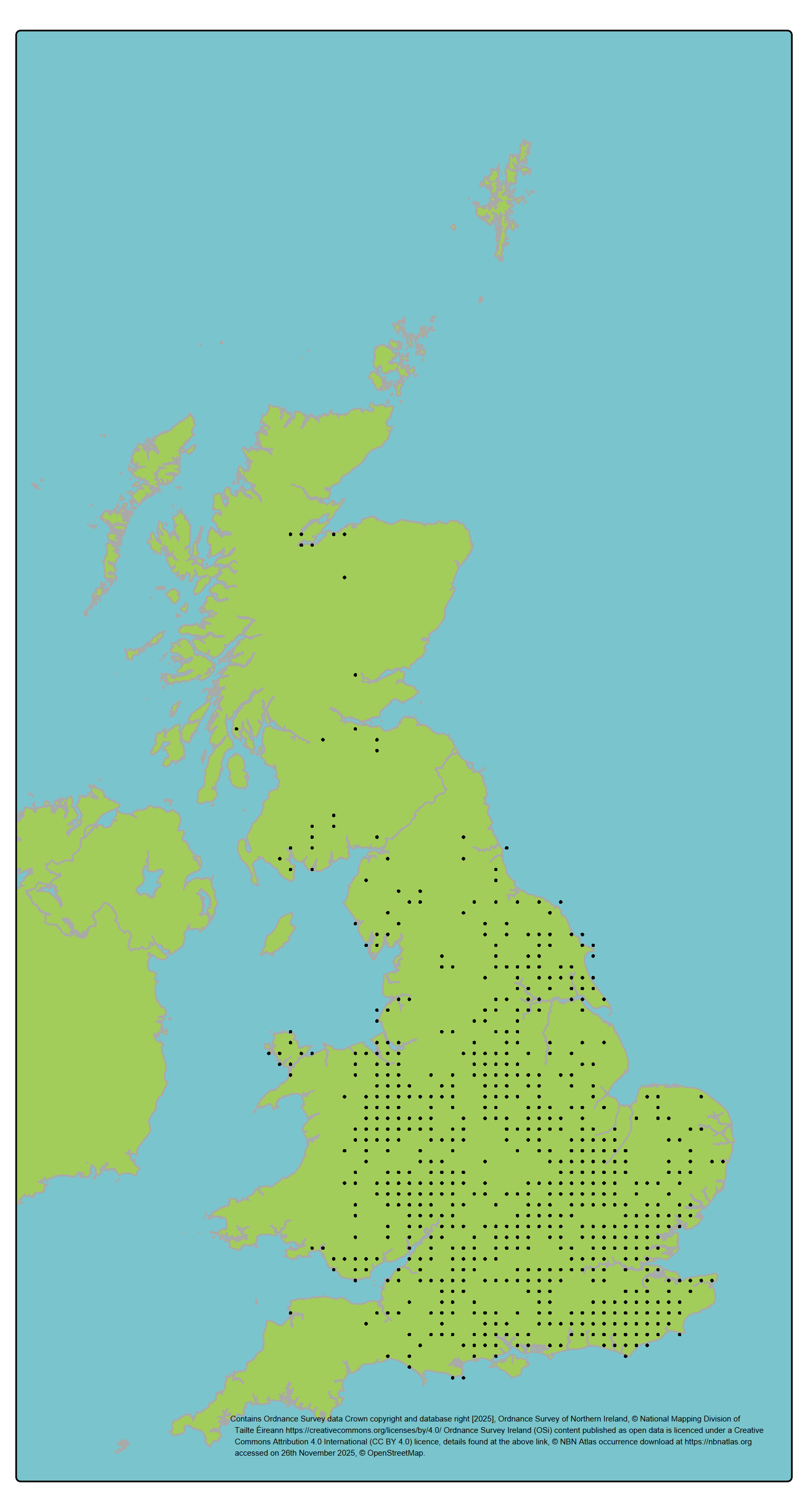
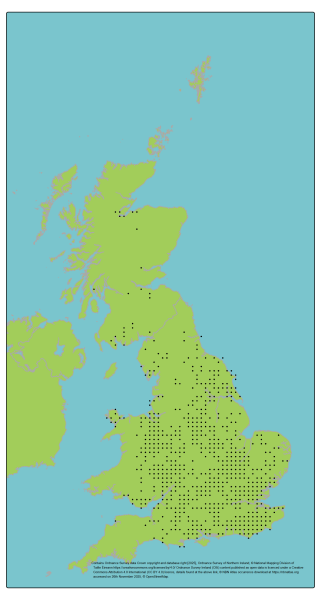
The great crested newt is found throughout England and Wales, with some populations localised near the borders and central belt of Scotland with a population present within the Scottish Highlands.
The species experienced a significant decline within the UK between 1950 and 2000 and is currently believed to be continuing to decline within its global range. Found throughout northern and central Europe, southwestern Siberia, southern Scandinavia (IUCN SSC Amphibian Specialist Group, 2023).
View a larger version of the distribution map for the Great Crested Newt.
Current Threats
Destruction and fragmentation of habitat, pollution, shallowing and overgrowth within ponds, predatory fishes and disease. The pathogens Batrachochytrium salamandrivorans (Bsal) and Batrachochytrium dendrobatidis (Bd) (IUCN, 2023) found currently in captive bred species of amphibians as of 2021. However, these diseases have not been currently linked to population declines.
Contribution of Scottish/UK population to total species diversity
The UK population of great crested newt is often considered one of the strongholds of its global population (Beebee & Griffiths, 2000) and the core population has levels of neutral variation equal or higher than central and western Europe (O’Brien et al 2015). The UK populations are nested in the western European lineage which ranges from Poland to the species’ western limits.
Genetic risks
Diversity loss: population declines
The Highland population is known to be distinct from the rest of the British population (O’Brien et al., 2015). Recent studies suggest that the number of occupied sites in the Highlands has increased by around 25% due to targeted interventions incorporating genetic knowledge (O’Brien et al., 2021).
Global Biodiversity Framework Indicators
Population definitions:
Populations are defined based on biogeography and genetic evidence. There is a wide and near continuous distribution of great crested newts within England, Wales and Southern Scotland. To allow for local adaptation, this has been assessed based on the four zones that form the basis of UK seed zones. The disjunct and genetically distinct population the Scottish Highlands has been considered as a separate population.
Ne500: The proportion of populations that have an effective population size of more than 500.
- Proportion of populations with Ne > 500 in Scotland = 2/3
- Proportion of populations with Ne > 500 in UK = 4/5
PM: Proportion of populations that existed in 2000 that still exist in 2025.
- Proportion of populations maintained in Scotland = 3/3
- Proportion of populations maintained in UK = 5/5
Diversity loss: functional variation
Functional variation
The Highland population within Scotland shows some functional variation from the rest of its British range (Miró et al., 2017). The population has limited numbers and the distance between it and the main population is far enough to effectively prevent geneflow between the two. This coupled with the small population size makes it vulnerable.
Divergent lineages
There is a genetically distinct lineage found within the Highlands and due to interventions, it has experienced an increase in population size (O’Brien et al., 2021). Should this population be lost, the overall UK population would lose genetic diversity.
Hybridisation/Introgression
Within the UK, there is evidence of hybridisation with the introduced Italian crested newt (Triturus carnifex) in southern England leading to some introgression (Beebee & Griffiths, 2000; Brede 2015).
Low turnover - constraints on adaptive opportunities
The species typically produces over 200 eggs in a breeding season. Although egg and larval mortality are high, in the absence of introduced fish and other pressures T. cristatus is able to establish large populations quickly (Jehle et al., 2011; O’Brien et al., 2021).
Cumulative Risk Summary
Overall Genetic Health Status
Scotland
- Risk: Moderate
- Mitigation: Partially effective
Great Britain/UK
- Risk: Moderate
- Mitigation: Partially effective
Overall Genetic Health status explanation
For most of the great crested newt population, the risk of loss of genetic diversity is negligible except for the Highland population which holds fewer than the Ne 500 threshold. There are multiple protections in place for the species, however there are still declines and at-risk populations.
In situ genetic threat level
In situ genetic threat level
- In situ Risk for Scotland: Serious
- In situ Risk UK: Moderate
Small isolated populations within Scotland being genetically distinct.
Confidence in in situ threat level
- Confidence score for Scotland: High
- Confidence score UK: Medium
The species is well-recorded and studied.
Ex situ representation
There is a negligible ex situ population found within two institutions in the UK of an estimated five individuals according to the IUCN Red List 2023 report.
Current conservation actions
Great crested newts are fully protected under the following acts and legislation: Schedule 5 of the Wildlife and Countryside 1981 Act, The Habitats Regulation 1995, and the Habitats Directive 1992.
| Ex situ | Translocation | Habitat management | Legal protection of habitat or species | Regulation of exploitation | Control of INNS/pests/pathogens |
|---|---|---|---|---|---|
| - | X | X | X | X | - |
Population assessment/monitoring
Population
Demographic
- N pops assessed/monitored in Scotland = 2/2
- N pops assessed/monitored in UK = 4/4
National Amphibian and Reptile Monitoring Programme (UK).
Genetic
- N pops assessed/monitored in Scotland = 2/2
- N pops assessed/monitored in UK = 4/4
Useful links
References
Beebee, T. J. C., & Griffiths, R. A. (2000). Amphibians and Reptiles: A Natural History of the British Herpetofauna: Vols. 87 The New Naturalist Library. HarperCollins.
IUCN SSC Amphibian Specialist Group. 2023. Triturus cristatus. The IUCN Red List of Threatened Species 2023: e.T22212A89706893. Accessed on 31 July 2025.
Jehle, R., Thiesmeier, B. and Foster, J., 2011. The crested newt: a dwindling pond-dweller. Bielefeld: Laurenti.
Miró, A., O’Brien, D., Hall, J., & Jehle, R. (2016). Habitat requirements and conservation needs of peripheral populations: the case of the great crested newt (Triturus cristatus) in the Scottish Highlands. Hydrobiologia, 792(1), 169–181.
O’Brien, C. D., Hall, J. E., Orchard, D., Barratt, C. D., Arntzen, J. W., & Jehle, R. (2015). Extending the natural range of a declining species: genetic evidence for native great crested newt (Triturus cristatus) populations in the Scottish Highlands. European Journal of Wildlife Research, 61(1), 27–33.
O’Brien, D., Hall, J. E., A. Miró, K. O'Brien, M. Falaschi, & Jehle, R. (2021). Reversing a downward trend in threatened peripheral amphibian (Triturus cristatus) populations through interventions combining species, habitat and genetic information. Journal for Nature Conservation, 64, 126077.
Assessor: Abigail Sikes, Edinburgh Napier University
Reviewer: David O’Brien, NatureScot