Genetic Scorecard Indicator - Flame Shell
Flame Shell (Limaria hians)

IUCN Category:
- Great Britain: Not assessed (indicated above)
- Europe: Not assessed
- Global: Not assessed

Genetic Health Status:
- Scottish Risk: Negligible (indicated above)
- UK Risk: Negligible
- Scottish Mitigation status: Effective
- UK Mitigation status: Effective
Background
Flame Shells can be found across the Northeast Atlantic, from their northern extent of Lofoten isles, Norway, to the Canary Islands at the southern extent, and throughout the Mediterranean. Flame Shells can be solitary but can be found living in aggregations, creating nests using byssal threads and debris from the sea floor such as seaweed, maerl and shells. These nests come together to stabilise and raise the sea floor, creating Flame Shell beds (Trigg, 2009; Sloan et al., 2021). The vast majority of these beds have been recorded in Scotland, ranging from Orkney in the North, to Arran in the South. More beds are still being discovered, so this is subject to change.
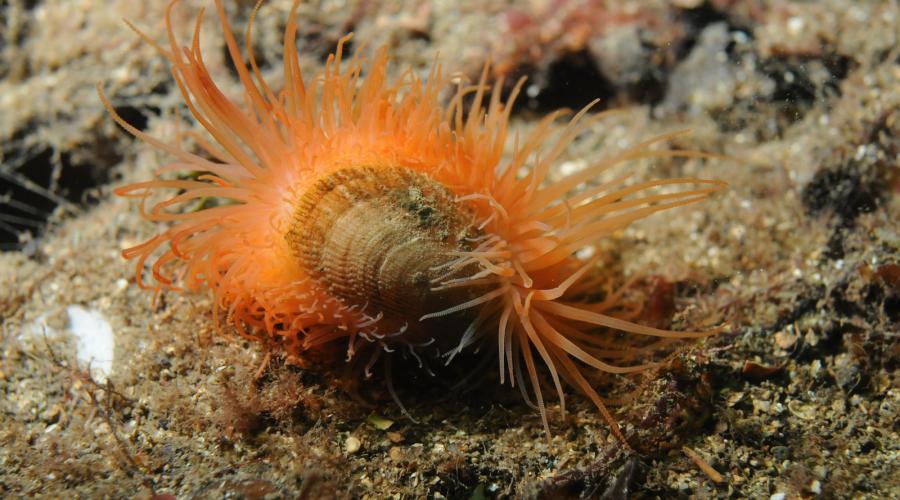
Flame Shells typically grow up to around 4cm in length, and they have distinctive bright orange pallial tentacles lining the mantle of their shells which cause them to remain permanently agape. They are believed to live to around 10 years in the wild, and are broadcast spawners with likely protandry, exhibited by an increase in females with increasing shell length (Trigg, 2009).
Scotland's Flame Shell beds are genetically well connected, while being genetically differentiated from a bed off the north coast of the Republic of Ireland (McGill, 2025).
Flame Shells are considered to be keystone species due to their beds, which act as biogenic reefs for hundreds of other species to live on, within, and underneath. Historically, Flame Shell beds were much more continuous across the Scottish west coast, while they are now found in patches.
Current Threats
Flame Shells are sensitive to dredging due to their thin, fragile shells, and dredging pulls up and destroys areas of Flame Shell bed, which can damage the population. This is primarily a threat to unknown Flame Shell beds (those which we have not located) because known beds are a priority marine feature in Scottish waters and thus protected. Flame Shells are known to be sensitive to changes in water quality and will leave their nests/swim away, and cease nest building, when the water quality drops below a threshold. As a broadcast spawner, connectivity can be affected by changes in currents, salinity, temperature, etc, which are expected to alter under climate change, because this can alter pelagic larvae movements and thus inhibit settlement on the correct habitat types/disrupt connectivity between habitat patches.
Contribution of Scottish/UK population to total species diversity
Scotland is home to a number of Flame Shell beds, which hold significant populations of Flame Shells. Such beds are rare and outside of Scotland, Flame Shells are mostly found living alone. A genetic study of Scottish Flame Shell beds found these beds to be well connected genetically, while being genetically differentiated from a bed located off the north coast of the Republic of Ireland (McGill, 2025). This may be indicative of a genetically distinct population of Flame Shells in Scotland.
Genetic risks
Diversity loss: population declines
Previously, Flame Shells have been described as extremely common in shallow water and were reported in areas where they are currently no longer found (Trigg, 2009). This suggests that there have been population declines, and potentially fragmentation of the wider Scottish population. Given that the recent genetic study found Scotland’s Flame Shell beds to be genetically homogenous, this is likely not having an effect on the genetic health of the species in Scotland, currently. Continued decline could change this, with fragmentation leading to isolation of populations.
Global Biodiversity Framework Indicators
Population definitions:
Population defined on the basis of genetics. The recent genetic study of Flame Shell beds in Scotland revealed strong genetic connectivity across Scotland, equating to one genetic population. As Flame Shells in the UK are found almost exclusively in Scotland, this will be considered as one UK population.
Ne500: The proportion of populations that have an effective population size of more than 500.
- Proportion of populations with Ne > 500 in Scotland = 1/1
- Proportion of populations with Ne > 500 in UK = 1/1
PM: Proportion of populations that existed in 2000 that still exist in 2025.
- Proportion of populations maintained in Scotland = 1/1
- Proportion of populations maintained in UK = 1/1
Diversity loss: functional variation
Functional variation
Due to the high genetic connectivity of Flame Shells across Scotland, it is unlikely that they have experienced any loss in functional diversity.
Divergent lineages
The historic accounts of Flame Shells in locations where they can no longer be found means divergent/distinct lineages could have been lost. This is quite unlikely, however, due to the high genetic connectivity of the species across Scotland. Individuals from these areas were most likely a part of the wider population.
Hybridisation/Introgression
There is another Limaria species present in the UK, Limaria loscombi, which could bring hybridisation into question. Despite the presence of a species within the same genus, there is no evidence to suggest that the two species hybridise and it is not considered to be a risk.
Low turnover - constraints on adaptive opportunities
For broadcast spawners, recruitment success depends on factors like larval dispersal, survival from predation and food limitation, and the presence of suitable settlement habitat. The high genetic connectivity found between Flame Shell beds in Scotland indicates that successful recruitment is taking place. High genetic connectivity limits adaptive divergence of different Flame Shell beds across Scotland, but provides a larger gene pool for adaptive potential should the environment undergo change.
Cumulative Risk Summary
Overall Genetic Health Status
Scotland
- Risk: Negligible
- Mitigation: Effective
Great Britain/UK
- Risk: Negligible
- Mitigation: Effective
Overall Genetic Health status explanation
Strong genetic connectivity across the range in Scotland/UK, paired with protection of Flame Shell beds, indicates good genetic health which should be maintained through protection.
In situ genetic threat level
In situ genetic threat level
- In situ Risk for Scotland: Negligible
- In situ Risk for UK: Negligible
High number of individuals and high genetic connectivity across the Scotland/UK range indicates good genetic health of the species here. Coupled with protection of the flame shell bed priority marine feature, the threat of their genetic status changing is low, for now, subject to environmental change.
Confidence in in situ threat level
- Confidence score for Scotland: High
- Confidence score for UK: High
Assessment based on recent genetic evidence of high quality.
Ex situ representation
Previous studies have kept Limaria hians individual's ex situ, but they are extremely difficult to keep in aquariums due to their specialised habitat and sensitivity to environmental factors. It is not known if any ex-situ individuals remain.
Current conservation actions
Six Nature Conservation Marine Protected Areas (NCMPA) have been designed to protect Flame Shell beds:
- Loch Creran NCMPA
- Loch Sunart NCMPA
- Lochs Duich, Long and Alsh NCMPA
- Upper Loch Fyne and Loch Goil NCMPA
- Wester Ross NCMPA
- Loch Carron NCMPA
Most human activities with the potential to have adverse effects on protected sites, such as construction and dredging, are managed through a licensing and consents process. For fishing activity, management measures have been implemented in some sites, with further measures being considered for consultation in 2025/26.
The Flame Shell bed habitat is recognised as a priority marine feature (PMF) in Scotland’s seas, which means that National Marine Plan General Policy GEN 9b applies. This ensures that development and use of the marine environment do not have a significant effect on their national status.
The Scottish Biodiversity Strategy to 2045, the Scottish Biodiversity Duty and UK Marine Strategy Good Environmental Status provide further drivers to ensure biological diversity is restored, and ecosystems are safeguarded.
| Ex situ | Translocation | Habitat management | Legal protection of habitat or species | Regulation of exploitation | Control of INNS/pests/pathogens |
|---|---|---|---|---|---|
| - | - | X | X | - | - |
Population assessment/monitoring
Population
Demographic
NatureScot have undertaken assessments of condition for flame shell beds in 2 areas; Loch Carron and Loch Creran (Moore et al. 2018; Moore et al. 2020).
N pops assessed/monitored in Scotland = 1/1
N pops assessed/monitored in UK = 1/1
Genetic
A genetic study was conducted on 5 flame shell beds from across the Scottish/UK range, and one bed from Republic of Ireland. This indicated the presence of one genetic population in Scotland/UK.
N pops assessed/monitored in Scotland = 1/1
N pops assessed/monitored in UK = 1/1
Further Research
- More surveying should be done to locate any currently unknown Flame Shell beds on the Scottish west coast, as currently they are mostly found incidentally after dredging rips up part of the bed.
- A broader genetic assessment of Flame Shells across the northeast Atlantic would also be beneficial, as it would help us to understand the relationship between the Scottish/UK population and the species throughout it’s range. So far, we know that Scotland is genetically differentiated with Ireland. A broader study could indicate whether Scotland holds a genetically distinct population, or if they are genetically connected with Flame Shell from elsewhere.
References
McGill, L. (2025). Population Genomics for Management and Conservation of Scotland’s Important Marine Bivalves. PhD Thesis, University of the Highlands and Islands. (Awaiting the University making the thesis available online, but a copy of the thesis can be requested from Lydia McGill: [email protected])
Moore, C.G., Harries, D.B., James, B., Cook, R.L., Saunders, G.R, Tulbure, K.W., Harbour, R.P. & Kamphausen, L. 2018. The distribution and condition of flame shell beds and other Priority Marine Features in Loch Carron Marine Protected Area and adjacent waters. Scottish Natural Heritage Research Report No. 1038
Moore, C.G., Harries, D.B., Tulbure, K.W., Cook, R.L., Saunders, G.R., Lyndon, A.R., Kamphausen, L., & James, B. 2020. The current status of serpulid reefs, horse mussel beds and flame shell beds in Loch Creran SAC and MPA. Scottish Natural Heritage Research Report No. 1156.
Sloan, D., Jones, C. S., Noble, L. & Rabe, B. (2021). ‘Flame shell beds: A protected keystone biogenic bivalve habitat’, in DellaSala, D. A. & Goldstein, M. I. (eds.) Imperiled: The encyclopedia of conservation. Elsevier. pp. 693-699.
Trigg, C. (2009). Ecological studies on the bivalve Limaria hians (Gmelin). PhD Thesis, Heriot-Watt University.
Assessor: Lydia McGill, NatureScot
Reviewer: Eunice Pinn, NatureScot
Last updated: