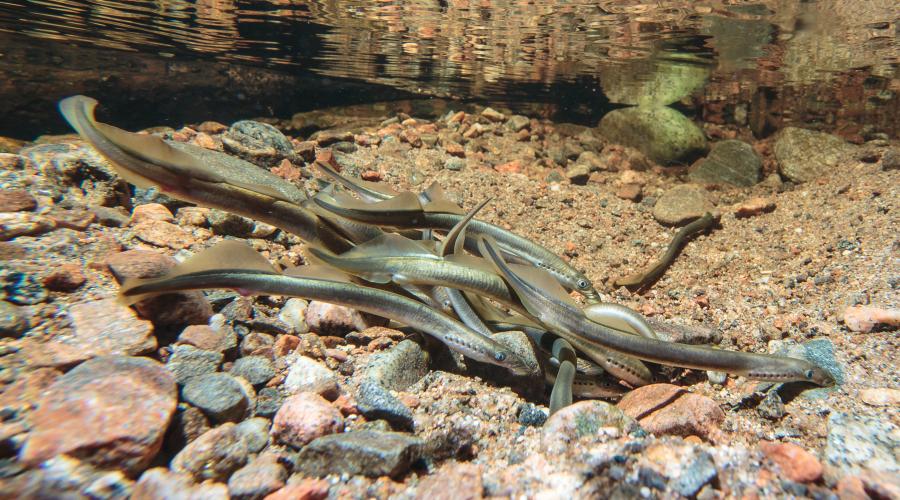
Genetic Scorecard Indicator - European River Lamprey
European River Lamprey (Lampetra fluviatilis)

IUCN Category:
- Great Britain: Not Assessed (indicated above)
- Europe: Near Threatened
- Global: Near Threatened

Genetic Health Status:
- Scottish Risk: Moderate (indicated above)
- UK Risk: Moderate
- Scottish Mitigation status: Partially Effective
- UK Mitigation status: Partially Effective
Background
The River Lamprey (Lampetra fluviatilis) is an anadromous or potadromous jawless fish species that breeds in running freshwaters across Europe (Maitland, 2003). Adults, which are polygamous and fertilize externally, spawn in April-June in over sandy gravels. The resulting eyeless larvae (‘ammocoetes’) spend the next 4-5 years buried in soft substrate and filter-feeding on algae, bacteria and detritus. They then metamorphose into an eyed pre-adult form and migrate to the ocean or lake, where they attach to and feed on other fishes. Marine-phase River Lampreys primarily use estuarine or coastal habitats. After 1-2 years they return to running freshwater as 30-50cm adults, arriving in autumn-winter before spawning in April-May and then dying.
Genetic studies show low inter-population differentiation among L. fluviatilis populations breeding in different rivers across northern Europe, and a pattern of isolation-by-distance, indicating weak or absent natal homing (reviewed in Mateus et al., 2021). Despite this, there is regional variation in time spent at sea and associated size at breeding, with e.g. an earlier maturing 'praecox' form described from the Teme and North Esk rivers (Maitland, 2003). River Lamprey interbreed with stream-resident brook lamprey (Lampetra planeri), which, based on genetic and behavioural studies is more accurately described as a conspecific ecotype and gene flow between them is limited by migration barriers (including distance from sea) and different adult phenotypes (Bracken et al., 2015; Tsimbalov et al., 2018; Rougemont et al., 2021; Hume et al., 2018). Only the L. fluviatilis form is considered in this assessment.
Current Threats
European River Lamprey declined dramatically in the mid-20th century due to pollution, river engineering and likely over-harvesting; however, they have made a partial recovery. They remain threatened by loss of spawning and larval rearing habitat (e.g. from pollution including nutrient inputs or river engineering) and migration barriers such as dams and hydropower facilities that can obstruct both upstream and downstream passes. Fish passes installed to benefit other anadromous species, and 'fish friendly' hydropower systems may not be suitable for migrating lamprey (Bracken, 2014; Albright, 2020). While River Lamprey were once a larger fisheries target in the UK, legal commercial fishing is currently small-scale and limited to one or two English rivers (Almeida et al., 2021). However, bycatch, potential fishery re-expansion, and impacts to estuarine and coastal feeding habitats remain additional threats.
Contribution of Scottish/UK population to total species diversity
UK populations represent approximately 10% of the total L. fluviatilis distribution.
The L. fluviatilis population using Loch Lomond ('dwarf River Lamprey') is one of very few documented potadromous forms and is genetically distinct from UK anadromous populations (Hume et al., 2018).
Genetic risks
Diversity loss: population declines
L. fluviatilis has been lost from several parts of its historical range (Maitland, 2003), and some diversity has likely been lost as a result despite evidence for a partial reversal of this decline due to improvements in water quality and removal of migration barriers. Declines in distinct populations (e.g. Loch Lomond) would risk diversity loss.
Global Biodiversity Framework Indicators
Population definitions:
Based on population genetic evidence, there is a single panmictic anadromous population, with one geographically isolated potadromous population occurring in Loch Lomond.
Ne500: The proportion of populations that have an effective population size of more than 500.
- Proportion of populations with Ne > 500 in Scotland = Unknown
- Proportion of populations with Ne > 500 in UK = Unknown
PM: Proportion of populations that existed in 2000 that still exist in 2025.
- Proportion of populations maintained in Scotland = 2/2
- Proportion of populations maintained in UK = 2/2
Diversity loss: functional variation
Functional variation
The potadromous Loch Lomond population represents unique functional diversity. Absence of natal homing means that anadromous populations are unlikely to be locally adapted to specific rivers. It is unknown whether observed regional variation in marine phase duration reflects phenotypic plasticity or underlying adaptive genetic diversity that could be at risk of loss.
Divergent lineages
Genetically and functionally unique Loch Lomond population likely only breeds in one river and is therefore vulnerable.
Hybridisation/Introgression
No known risk.
Low turnover - constraints on adaptive opportunities
There is little data but given the panmictic behaviour of L. fluviatilis local recruitment failures are unlikely to impact the species.
Cumulative Risk Summary
Overall Genetic Health Status
Scotland
- Risk: Moderate
- Mitigation: Partially Effective
GB/UK
- Risk: Moderate
- Mitigation: Partially Effective
Overall Genetic Health status explanation
Mainly exists as a large, partly panmictic population which is partly but not fully recovering from previous declines. Data is limited regarding intrapopulation functional diversity. One additional genetically and ecologically unique population which is more vulnerable due to very restricted geographical range.
In situ genetic threat level
In situ genetic threat level
- In situ Risk for Scotland: Moderate
- In situ Risk for UK: Moderate
Negligible threat level for anadromous populations due to substantial genetic mixing and likely high effective population size. Moderate threat level for Loch Lomond potadromous population due to very restricted distribution.
Confidence in in situ threat level
- Confidence score for Scotland: Medium
- Confidence score for UK: Medium
Limited monitoring.
Ex situ representation
There are no ex-situ populations.
Current conservation actions
L. fluviatilis is partly protected under Annexes II and IV of the European Commission Habitats Directive and Annex III of the Bern Convention, the Salmon & Freshwater Fisheries Act, 1975 (as amended) and Schedule 3 of the Conservation (Natural Habitats, &c.) Regulations 1994 (as amended). It is a Priority Species under the UK Post-2010 Biodiversity Framework, and a Priority Marine Feature in Scottish territorial waters. Eleven UK Special Areas of Conservation (SAC) have been established specifically for lamprey protection and the species is a feature of 10 other SACs.
Conservation actions focus on habitat protection and restoration and the removal of barriers to migration. L. fluviatilis harvesting is licensed and heavily restricted.
| Ex situ | Translocation | Habitat management | Legal protection of habitat or species | Regulation of exploitation | Control of INNS/pests/pathogens |
|---|---|---|---|---|---|
| - | - | X | X | X | - |
Population assessment/monitoring
Population
Demographic
N pops assessed/monitored in Scotland = 2/2
N pops assessed/monitored in UK = 2/2
Very limited fisheries catch data, some local surveys.
Genetic
N pops assessed/monitored in Scotland = 2/2
N pops assessed/monitored in UK = 2/2
Some genetic studies of both anadromous and potadromous forms.
Further Research
Genetic basis of known phenotypic diversity and role of gene flow between L. planeri and L. fluviatilis on the adaptation and persistence of both species is not well understood.
References
Albright AJ (2021) Aspects of the conservation biology of an exploited population of migratory European River Lamprey (Lampetra fluviatilis). Masters thesis, Durham University;
Almeida PR, Arakawa H, Aronsuu K, Baker C, Blaire S, Beaulaton L, Belo AF, Kitson J, Kucheryavyy A, Kynard B, Lucas M, Moser M, Potaka B, Romakkaniemi A, Staponkus R, Tamarapa S, Yanai S, Yang G, Zhang T, Zhuang P (2021) Lamprey fisheries: history, trends and management J Great Lakes Res 47, S181-S195;
Bracken FS (2014) The evolutionary and behavioural ecology of a European lamprey species pair (Lampetra fluviatilis and L. planeri): conservation concerns and anthropogenic impacts. Doctoral thesis, Durham University;
Bracken FS, Hoelzel AR, Hume JB, Lucas MC. (2015) Contrasting population genetic structure among freshwater-resident and anadromous lampreys: the role of demographic history, differential dispersal and anthropogenic barriers to movement. Mol Ecol. 24:1188-204.;
Foulds WL, Lucas MC (2014) Paradoxical Exploitation of Protected Fishes As Bait for Anglers: Evaluating the Lamprey Bait Market in Europe and Developing Sustainable and Ethical Solutions. PLoS ONE 9(6): e99617.
Hume JB, Recknagel H, Bean CW, Adams CE, Mable BK. (2018) RADseq and mate choice assays reveal unidirectional gene flow among three lamprey ecotypes despite weak assortative mating: Insights into the formation and stability of multiple ecotypes in sympatry. Mol Ecol. 27: 4572–4590.;
Maitland, P. S. (2003). Ecology of the river, brook and sea lamprey. Conserving Natura 2000 Rivers Ecology Series No.5. English Nature, Peterborough;
Mateus CS, Docker MF, Evanno G, Hess JE, Hume JB, Oliveira IC, et al. (2021) Population structure in anadromous lampreys: Patterns and processes. Journal of Great Lakes Research 47: S38–58;
Rougemont Q, Dolo V, Oger A, Besnard AL, Huteau D, Coutellec MA, Perrier C, Launey S, Evanno G. (2021) Riverscape genetics in brook lamprey: genetic diversity is less influenced by river fragmentation than by gene flow with the anadromous ecotype. Heredity126:235-250;
Tsimbalov IA, Kucheryuavyi AV & Pavlov DS (2018) Results of Hybridization between Anadromous and Resident Forms of European River Lamprey Lampetra fluviatilis. J. Ichthyol. 58, 122–125.
Assessor: Victoria Pritchard, UHI Inverness.
Reviewer: Linda Neaves, Murdoch University, Rob Ogden, University of Edinburgh
Image: ©Tiit Hunt, Wikimedia Commons


.jpg)