Genetic Scorecard Indicator - Common Blue skate
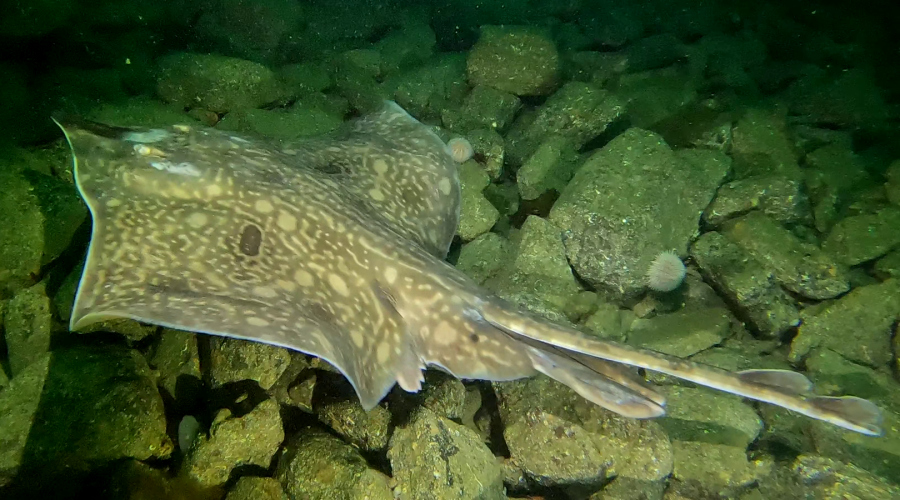
Common Blue skate (Dipturus batis)

IUCN Category:
- Great Britain: Not assessed (indicated above)
- Europe: Not assesed
- Global: Critically Endangered

Genetic Health Status:
- Scottish Risk: Serious (indicated above)
- UK Risk: Serious
- Scottish Mitigation status: Unknown if mitigation is effective
- UK Mitigation status: Unknown if mitigation is effective
Background
Common blue skate is part of the historic ‘common skate complex’ (Clark, 1926) but recent molecular and morphological studies resolved this complex into two cryptic species; the flapper skate (D. intermedius) and the common blue skate (D. batis) (Iglésias et al., 2010; Griffiths et al., 2010). Historically widespread across the Northeastern Atlantic, the common blue skate has suffered steep declines, and current populations are fragmented and largely concentrated around the British Isles (notably western Scotland and Ireland), extending from Iceland, Rockall to the Celtic Sea and Bay of Biscay. Declines across its range has resulted in its disappearance from many former strongholds, though the accuracy of is uncertain due to previous identification problems. The species is demersal, feeding on invertebrates and other demersal fish, on sandy/muddy substrates on continental shelf and slope habitats (Last et al., 2016) and deep offshore seamounts and banks.
Genetic studies continue to refine the distribution of common blue skate (Frost et al., 2020; Bache-Jeffreys et al., 2021; Garbett et al., 2023). Complete mitochondrial genomes for D. batis provide reference data for species identification (Delaval et al., 2020). Direct, comprehensive genetic surveys for D. batis across Scotland/Great Britain are sparse, though recent population genomics using genome-wide single nucleotide polymorphisms indicates fragmented populations, with patchy genetic structuring apparent across NE Atlantic (Delaval et al., 2022a). This seascape genomic research indicates the possibility of locally distinct lineages (such as Rockall), but whole-range genomic baselines remain incomplete.
Regional, fragmented demes across NE Atlantic; likely discrete subpopulations are associated with shelf/stock units around the British Isles, Rockall, Iceland, Celtic Sea. The slow life-history traits, restricted adult movements, and evidence of localized aggregations support this regional structuring.
Only the Rockall population is identified as genetically distinct, allowing UK samples to be divided into three major populations, with the Celtic Sea, West Coast Scotland, and Northern Scotland comprising the British Shelf, while Faeroe Bank and Faeroes Shelf comprise the Faeroes population (See Delaval et al., 2022a).
Current Threats
Historical targeted fishing and ongoing bycatch in demersal fisheries using bottom trawls, gillnets and mixed demersal gears remain principal drivers are major threats. Additionally, habitat degradation from bottom trawling and seabed disturbance reduces egg-laying habitat and juvenile nursery areas, with population resilience to exploitation further reduced by this species´ slow life-history. Climate change has the potential to induce range shifts and alter prey communities impacting nursery habitats and the extent of areas experiencing suitable temperature ranges, increasing the cumulative effect of fisheries pressure.
Contribution of Scottish/UK population to total species diversity
Scotland hosts some of the most important remaining NE Atlantic occurrences (western Scotland, Rockall waters), likely contributing disproportionately to regional representation of remnant populations and genetic diversity; an internationally significant portion of the extant NE Atlantic distribution. It is difficult to estimate the exact contribution due to a lack of quantitative abundance estimates.
Recognised as a Priority Marine Feature the Scottish populations are globally important. Fishing continues in the Celtic Sea and declines are noted off Norway. The Rockall Bank population remains the largest population (see Delaval et al., 2022a).
Genetic risks
Diversity loss: population declines
Blue skate have experienced steep historic declines, and present low abundances imply a substantial loss of genetic diversity, probably through population collapse and local extinctions. Direct measures of allelic richness and heterozygosity for Scottish/Great British populations are limited; however demographic collapse and fragmentation strongly suggest elevated genetic risk.
Low numbers recovered from the British Shelf (see Delaval et al., 2022a) suggest the major strongholds of Celtic Sea and Rockall have potential to become disconnected, perhaps due to historical fishing of this species – formerly identified with D. intermedius as the Common Skate prior to 2010, invalidating all data collated before this date
Global Biodiversity Framework Indicators
Population definitions:
Populations are based on geographic boundaries and dispersal buffer.
Ne500: The proportion of populations that have an effective population size of more than 500.
- Proportion of populations with Ne > 500 in Scotland = 3/3
- Proportion of populations with Ne > 500 in UK = 3/3
PM: Proportion of populations that existed in 2000 that still exist in 2025.
- Proportion of populations maintained in Scotland = 3/3
- Proportion of populations maintained in UK = 3/3
Diversity loss: functional variation
Functional variation
There is a potential risk to functional diversity with a loss of locally adapted ecotypes (see Delaval et al., 2022a), given range contraction and fragmentation. Direct evidence of adaptive variants remains incomplete.
Very little that can be reported presently, although a reference genome is now under construction. Rockall and Celtic are regarded as separate populations, with some evidence of gene flow.
Divergent lineages
Possible loss of divergent or locally adapted lineages due to extirpations historically. Some genetic structuring was inferred in recent studies (see Delaval et al., 2022a). Loss of any divergent endemic lineages would be of high conservation concern. Direct, comprehensive lineage mapping remains incomplete, but identification of population specific single nucleotide polymorphisms outliers associated with environmental parameters suggests their decline may accelerate loss of genetic diversity.
Hybridisation/Introgression
There is no evidence of introgression in blue skate and risks are considered low; species within skate complexes can be misidentified
Low turnover - constraints on adaptive opportunities
Common bule skate have a low annual fecundity and late maturity (~11 years) substantially reduce evolutionary potential in the short term and limit capacity to recover lost genetic diversity. Recruitment constraints in multiple populations are likely, exacerbated by late maturity and low fecundity.
Cumulative Risk Summary
Overall Genetic Health Status
Scotland
- Risk: Serious
- Mitigation: Partially in place / Not fully effective — protections reduce exploitation but fragmentation and limited genetic monitoring mean genetic risk remains high.
Great Britain/UK
- Risk: Serious
- Mitigation: Partially in place / Not fully effective
Climate change may impact blue skate: as an oceanic species it is vulnerable to temperature changes (Frost et al., 2020).
Currently genetic diversity is not particularly low but could be exacerbated by climate change. There is some gene flow between the two major populations (Delaval et al., 2022a).
Mitigation partial – fisheries measures (high mortality in bycatch).
Overall Genetic Health status explanation
Historic collapses and present fragmentation imply a serious risk of loss of genetic diversity, local extirpations and loss of distinct lineages. Existing legal protections and partial habitat measures help but do not yet fully mitigate genetic risk; targeted genetic monitoring and ex situ representation are lacking.
In situ genetic threat level
In situ genetic threat level
In situ Risk
- In situ Risk for Scotland: Serious (steep declines, fragmentation and slow life history imply high risk to genetic diversity. At present there is limited genetic monitoring).
- In situ Risk for UK: Serious (remnant populations represent a high risk of genetic erosion, with populations declining globally).
Confidence in in situ threat level
- Confidence score for Scotland: Medium (demographic and distributional evidence strong; direct genetic metrics limited).
- Confidence score for UK: High (good consensus between genetic and fisheries data on declines of fished stocks in the Celtic Sea (Delaval et al., 2022b), but incomplete genetic data for many populations).
Ex situ representation
There are no ex situ populations. There are few documented captive breeding or large-scale ex situ genetic repositories for skates like D. batis. Egg-case or live-holding programs for mitigation are minimal; no comprehensive genome bank covering range-wide diversity is publicly reported.
Current conservation actions
Current conservation actions
Historic and ongoing protections include EU landing prohibitions (Common skate complex), OSPAR listing as a threatened & declining species, inclusion in UK Priority Marine Features. These measures have reduced targeted exploitation and landings. Blue skate are protected, with bycatch mitigation measures and landing bans for the complex.
Some spatial protections/MPAs overlap skate habitats, though coverage may be insufficient or specifically targeted to critical nursery/egg-laying sites.
Monitoring of blue skate occurs through fisheries observer programs, scientific surveys record occurrences, but comprehensive genetic monitoring is limited.Targeted research, species action planning and stakeholder engagement ongoing in regional programs.
| Ex situ | Translocation | Habitat management | Legal protection of habitat or species | Regulation of exploitation | Control of INNS/pests/pathogens |
|---|---|---|---|---|---|
| - | - | - | X | X | - |
Population assessment/monitoring
Population
Demographic
Occurrence and abundance data from trawl surveys, fisheries observer data, and targeted elasmobranch surveys. Monitoring is fragmented and patchy; many records are historic and refer to the common skate complex.
- N pops assessed/monitored in Scotland = 0/3
- N pops assessed/monitored in UK = 0/3
Genetic
Limited targeted genetic or genomic monitoring. Some recent population genomic/seascape (see Delaval et al., 2022a) studies indicate structuring; however routine genetic surveillance across populations is lacking.
An ad hoc - baseline exists with increased interest since the separation of the common skate complex in 2010. Tools are now becoming available for continued population monitoring (Kompetitive Allele Specific PCR, KASP assays) producing legacy data (Jones, 2024).
Stock abundance in the Celtic Sea was assessed using fisheries data and genomic approaches (CKMR - see Delaval 2022b). These data suggested steady levels of stock abundance in this area.
- N pops assessed/monitored in Scotland = 3/3
- N pops assessed/monitored in UK = 3/3
References
Bache-Jeffreys, M., de Moraes B.L.C., Ball, R.E., Menezes, G., Pálsson, J., Pampoulie, C., Steven, J.R. & Griffiths, A.M. (2021) Resolving the spatial distributions of Dipturus intermedius and Dipturus batis—the two taxa formerly known as the ‘common skate’. Environmental Biology of Fishes 104, 923-936.
Clark, R.S. (1926). Rays and skates. A revision of the European species. Fisheries, Scotland, Scientific Investigations 1, 1-66.
Delaval, A., Schwanck, T., Kopp, M. E. L., Hoarau, G., Jones, C. S., & Noble, L. R. (2020). The complete mitochondrial genome of the blue skate Dipturus batis. Mitochondrial DNA Part B Resources, 5(3), 2488–2489.
Delaval, A., Frost, M., Bendall, V., Hetherington, S.J., David Stirling, D., Hoarau, G., Jones, C.S. & Noble, L.R. (2022a) Population and seascape genomics of a critically endangered benthic elasmobranch, the blue skate Dipturus batis. Evolutionary Applications 15, 78–94.
Delaval, A., Bendall, V., Hetherington, S.J., Skaug, H.J., Frost, M., Jones, C.S. & Noble, L.R. (2022b). Evaluating the suitability of close-kin mark-recapture as a demographic modelling tool for a critically endangered elasmobranch population. Evolutionary Applications, 16 (2), 461–473. doi: 10.1111/eva.13474
Frost, M., Neat, F.C., Stirling, D., Bendall, V., Noble, L.R. & Jones, C.S. (2020). Distribution and thermal niche of the common skate species complex in the north-east Atlantic. Marine Ecology Progress Series 656, 65–74.
Garbett, A., Loca, S.L., Barreau, T., Biscoito, M., Bradley, C., Breen, J., Clarke, M., Ellis, J.R., Griffiths, A.M., Hannon, G., Jakobsdóttir, K., Junge, C., Lynghammar, A., McCloskey, M., Minos, G., Phillips, N.D., Prodöhl, P.A., Roche, W., Iglésias, S.P., Thorburn, J., Collins, P.C. (2023). A holistic and comprehensive data approach validates the distribution of the critically endangered flapper skate (Dipturus intermedius). Journal of Fish Biology, 103(3), 516–528.
Griffiths, A.M., Sims, D.W., Cotterell, S.P., El Nagar, A., Ellis, J.R., Lynghammar, A., McHugh, M., Neat, F.C., Pade, N.G., Queiroz, N., Serra-Pereira, B., Rapp, T., Wearmouth, V.J. & Genner, M.J. (2010) Molecular markers reveal spatially segregated cryptic species in a critically endangered fish, the common skate (Dipturus batis). Proceeding of the Royal Society B: Biological Sciences 277, 1497–1503.
Iglésias, S.P., Toulhoat. L. & Sellos, D.Y. (2010). Taxonomic confusion and market mislabelling of threatened skates: Important consequences for their conservation status. Aquatic Conservation, 20,319–333.
Jones, C.S. (2024). Genetic monitoring tool for North-east Atlantic elasmobranchs to assist conservation and management. Save Our Seas Foundation final grant report.
Last, P., White, W., de Carvalho, M., Seret, B., Stehmann, M. & Naylor, G. (2016). Rays of the World. CSIRO Publishing, Clayton
Assessor:
- Leslie Noble, Nord University
- Catherine S Jones, University of Aberdeen
- Emily Humble, Royal Dick Vet School Edinburgh
- Eunice Pinn, NatureScot
Reviewer:
- Linda Neaves, Murdoch Unversity
- David O’Brien, NatureScot
Common Skate image ©Orkney Skate Trust