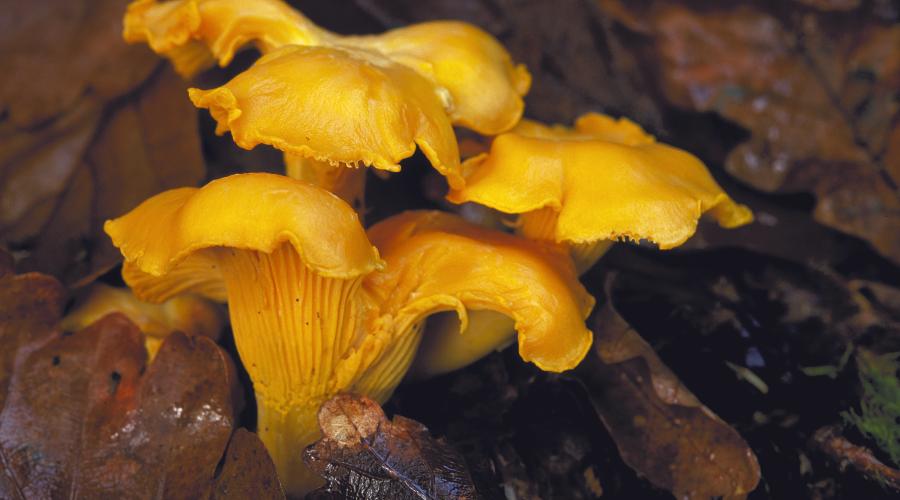
Genetic Scorecard Indicator - Chanterelle
Chantarelle (Cantharellus cibarius)

IUCN Category:
- Great Britain: Least Concern (indicated above)
- Europe: Least Concern
- Global: Least Concern

Genetic Health Status:
- Scottish Risk: Negligible (indicated above)
- UK Risk: Negligible
- Scottish Mitigation status: Not required
- UK Mitigation status: Not required
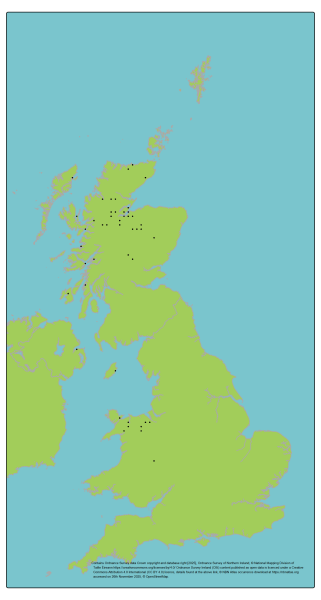
Background
A locally common and widely distributed native ectomycorrhizal basidiomycete. Associated with woodland containing Betula, Fagus and Quercus species, occasionally reported in conifer plantations. Dispersal occurs via spores and vegetative growth. It is one of eight European species of Cantharellus recorded in Scotland, and it is currently considered genetically distinct from similar species in North America. It is highly prized as an edible mushroom. Cantharellus cibarius can be considered a species complex, with separate species or subspecies in America and East Asia. It is likely the European population is a single species.
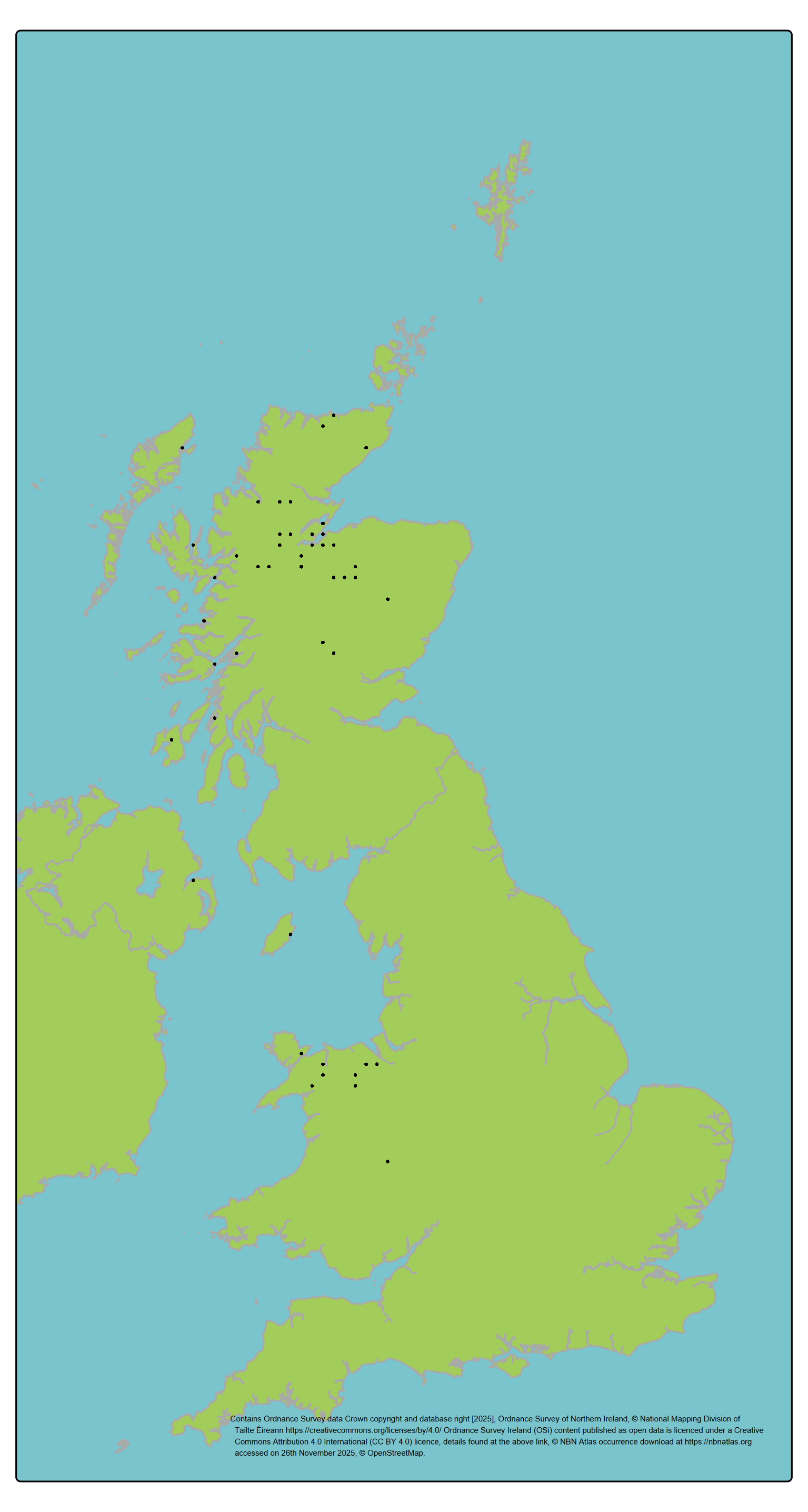
View a larger version of the distribution map for Chanterelle.
Current Threats
Not currently considered threatened although negatively impacted by loss of habitat and nitrogen deposition in parts of Europe (Pilz et al., 2003). There is a perceived localised threat from trampling resulting in soil compaction, and over-harvesting of fruit bodies, however, the impact of overharvesting is not substantiated (Egil et al., 2006). Neither would be significant at a Scottish or UK scale.
Contribution of Scottish/UK population to total species diversity
Research over the past decade has demonstrated that this is a European species distinct from North American populations, which were previously classified as C. cibarius (Buyck et al., 2016), and sequence diversity in public databases suggests divergent lineages even within Europe. However, there is no evidence that Scottish populations are distinct from those elsewhere in Europe
Genetic risks
Diversity loss: population declines
No evidence for recent declines.
Global Biodiversity Framework Indicators
Population definitions:
The populations are defined by ecological and biogeographic proxies. This species is likely to have spores moving freely between sites, even where there is not habitat connectivity. The four GB Regions of Provenance (Herbert et al., 1999) were selected here to represent the major population groupings / management units (treating Northern Ireland as an additional region) as they broadly reflect the environmental variation across which the species is distributed and are likely to capture major patterns of genetic structure.
Ne500: The proportion of populations that have an effective population size of more than 500.
- Proportion of populations with Ne > 500 in Scotland = 2/2
- Proportion of populations with Ne > 500 in UK = 5/5
PM: Proportion of populations that existed in 2000 that still exist in 2025.
- Proportion of populations maintained in Scotland = 2/2
- Proportion of populations maintained in UK = 5/5
Diversity loss: functional variation
Functional variation
There is no information on functional diversity within Scotland but because C. cibarius is widely distributed across Scotland, with a large population, loss of functional diversity is unlikely at present.
Divergent lineages
No clear information available, but no evidence for divergent lineages.
Hybridisation/Introgression
There is no evidence of hybridisation or introgression, but research is extremely limited.
Low turnover - constraints on adaptive opportunities
Extent and persistence of underground mycelium is not well studied, and turnover is therefore poorly understood. Sexual reproduction appears to occur on a regular basis with the faithful annual production of basidiomes/fruiting bodies at well-known locations. It has been suggested that intensive harvesting of the fruiting bodies may cause localised suppression of long-distance dispersal, but this is not substantiated by evidence (Egil et al., 2006). Population sizes are inferred to be large and well connected.
Cumulative Risk Summary
Overall Genetic Health Status
Scotland
- Risk: Negligible
- Mitigation: Not required
GB/UK
- Risk: Negligible
- Mitigation: Not required
Overall Genetic Health status explanation
This fungus is widespread, with large populations in Scotland and the UK. No evidence for genetic distinctiveness and no evidence of population declines.
In situ genetic threat level
In situ genetic threat level
- In situ Risk for Scotland: Negligible
- In situ Risk for UK: Negligible
The wide distribution of the fungus across a number of woodland habitats with no perceived evidence of ongoing decline leads to this assessment.
Confidence in in situ threat level
- Confidence score for Scotland: Medium
- Confidence score for UK: Medium
The lack of understanding of trend data in Scotland and the UK is likely to be outweighed by its wide distribution and likely increasing population trajectory given native woodland expansion targets.
Ex situ representation
The fungus can be cultured, with difficulty, on agar. It is likely that isolates are maintained in a number of mycology labs around the world, but no survey of the number or provenence of such culture collections exists. Re-synthesis of mycorrhizal plants is fraught with difficulty and is not currently practical for reintroduction into the wild.
Current conservation actions
Scottish and UK targets to increase woodland extent are likely to benefit this species.
| Ex situ | Translocation | Habitat management | Legal protection of habitat or species | Regulation of exploitation | Control of INNS/pests/pathogens |
|---|---|---|---|---|---|
| - | - | X | - | - | - |
Population assessment/monitoring
Population
Demographic
N pops assessed/monitored in Scotland = 0/2
N pops assessed/monitored in UK = 0/5
Genetic
N pops assessed/monitored in Scotland = 0/2
N pops assessed/monitored in UK = 0/5
Further Research
Not required.
References
Buyck B., Hofstetter V. & Olariaga I. 2016. Setting the record straight on North American Cantharellus. Cryptogamie, Mycologie 37(3): 405-417
Egil, S., Peter, M., Buser, C., Stahel, W. & Ayer, F. 2006. Mushroom picking does not impair future harvests–results of a long-term study in Switzerland, Biological Conservation, 129 (2), pp. 271-276
Herbert, R., Samuel, S., & Patterson, G. (1999). Using Local Stock for Planting Native Trees and Shrubs. Forestry Commission Practice Note.
Pilz, D., Norvell, L., Danell, E. & Molina, R. 2003. Ecology and management of commercially harvested chanterelle mushrooms. Gen. Tech. Rep. PNW-GTR-576. Portland, OR: U.S. Department of Agriculture, Forest Service, Pacific Northwest Research Station. 83 p
Assessors:
- David Genney, NatureScot
- Kat O’Brien, NatureScot
Reviewer: Rebecca Yahr, Royal Botanic Garden Edinburgh