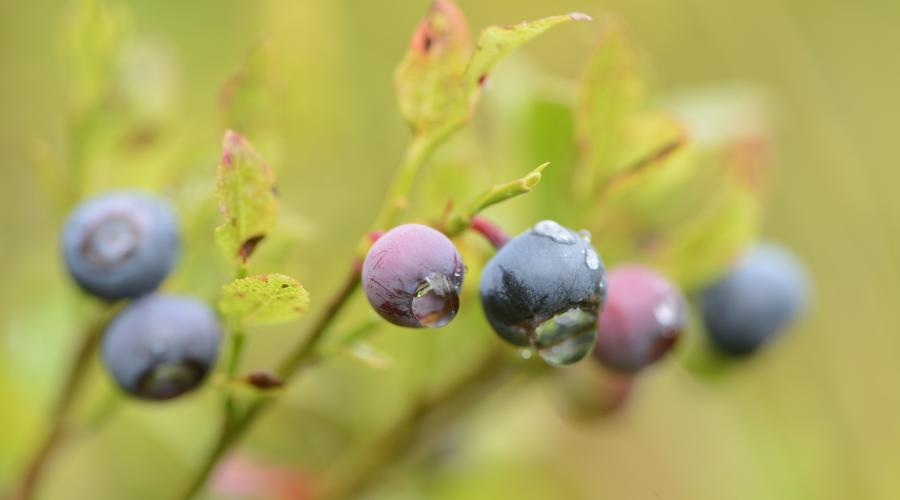
Genetic Scorecard Indicator - Blaeberry/Bilberry
Blaeberry/Bilberry (Vaccinium myrtillus )

IUCN Category:
- Great Britain: Not Assessed (indicated above)
- Europe: Least Concern
- Global: Least Concern

Genetic Health Status:
- Scottish Risk: Negligible (indicated above)
- UK Risk: Negligible
- Scottish Mitigation status: Not required
- UK Mitigation status: Not required
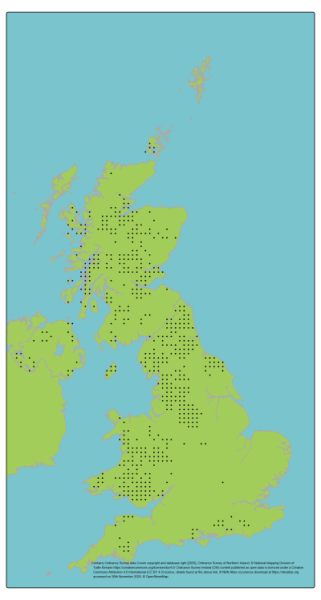
Background
Perennial, rhizomatous hermaphrodite shrub, common and locally dominant across boreal Europe and Asia, in heaths, bogs, and woodland. Pollination by insects, spreads by rhizomes; animal-dispersed outcrossed seeds rarely result in seedlings in Scotland (Ritchie, 1956). Economically important wild berry.
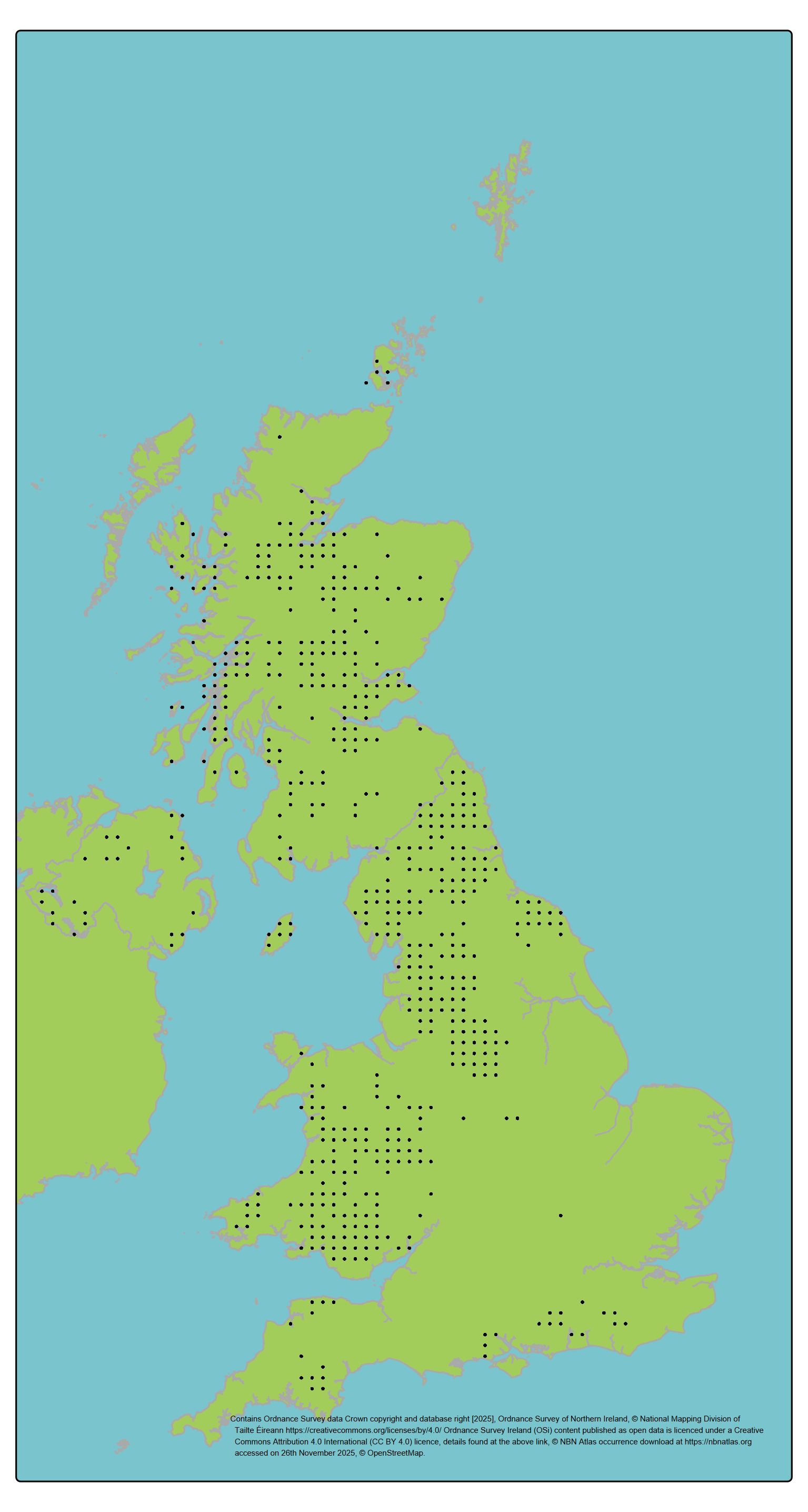
View a larger version of the distribution map for the Bilberry/Blaeberry.
Current Threats
Continued gradual habitat loss of heath in lowlands and potential changes to upland vegetation from increased nitrogen deposition remain important pressures (APIS, 2019; Braithwaite et al., 2006; Norton et al., 2009). Declines have been occurring since the 1960s and continue to be evident comparing BSBI surveys between 1987-1999 and 2000-2019 but largely represent population losses at range edges and loss of habitat (Stroh et al., 2023). The species is highly susceptible to the Phytophthora pathogens P. ramorum and P. kernoviae (Beales et al., 2009). In 2012, 22 cases have been reported in England (FERA, 2012) and two cases affecting V. myrtillus have been found in Scotland (Scottish Government, 2015), and other cases have been detected in British nurseries (Green et al., 2025). Blaeberry may be susceptible to other diseases, such as Pucciniastrum minimum which have been detected in nurseries (Latham et al., 2022).
Contribution of Scottish/UK population to total species diversity
Several close relatives and subspecies are found in Europe and North America (Ritchie, 1956), all with similar life-history and regionally distinct gene pools (Bjedov et al., 2015; Carvalho et al., 2024; Gailite et al., 2020). Although data is limited, similar regionally distinct gene-pools have been identified in Scotland, potentially associated with woodlands (MacCallum et al. 2023). In addition, these data suggested higher altitude sites contained greater diversity. No unique Scottish or UK plastid DNA haplotypes have been identified (Tikhomirov et al., 2022). Geographic and ecotypic variation in morphology and in common garden experiments (Ritchie, 1956) suggest locally adapted gene pools may be present.
Genetic risks
Diversity loss: population declines
Low risk. While some localised population declines (especially at range margins) have been recorded, the species remains abundant overall in the UK and so any near-term loss of genetic diversity is unlikely. Nonetheless, limited seedling recruitment and ongoing habitat pressures warrant continued monitoring.
Global Biodiversity Framework Indicators
Population definitions:
Populations are defined based on management units. This species is widely and continuously distributed across UK in large numbers (Stroh et al., 2023; NBN, 2025). The four Great British Regions of Provenance (Herbert et al., 1999) were selected here to represent the major population groupings / management units (treating Northern Ireland as an additional region) as they broadly reflect the environmental variation across which the species is distributed and are likely to capture major patterns of genetic structure.
Ne500: The proportion of populations that have an effective population size of more than 500 (Demographic - using the ratio Nc 5000 = Ne 500)
- Proportion of populations with Ne > 500 in Scotland = 2/2
- Proportion of populations with Ne > 500 in UK = 5/5
PM: Proportion of populations that existed in 2000 that still exist in 2025.
- Proportion of populations maintained in Scotland = 2/2
- Proportion of populations maintained in UK = 5/5
Diversity loss: functional variation
Functional variation
Range edge losses often correlate with losses of genetically differentiated populations (Eckert et al., 2008), but no evidence of losses in functional variation, and high-elevation populations are within stable core of distribution.
Divergent lineages
Negligible risk. No evidence of divergent lineages being under threat. However, UK genetic sampling remains limited, and the only current study has shown differences among ecosystem types, so further work could reveal previously unrecognised lineages or unique variants whose status might warrant attention.
Hybridisation/introgression
Vaccinium x intermedium is a hybrid with V. vitis-ideae, found uncommonly in UK and elsewhere, but probably limited by staggered flowering times (Ritchie, 1956; Stace et al., 2015).
Low turnover - constraints on adaptive opportunities
Regeneration from seed in wild Vaccinium myrtillus populations appears to be very limited. Soil seedbanks are small, seedling establishment is rare, and buried seed viability declines rapidly over time, while vegetative (clonal) growth from rootstocks predominates (Welch et al., 1994; Welch et al., 2000; Ranwala & Naylor, 2004). These constraints reduce opportunities for recruitment of new genotypes and may slow adaptive response under changing environmental conditions. More generally, ericaceous species with transient seedbanks, such as blaeberry, show similar limitations on sexual recruitment (Nin et al., 2017).
Cumulative Risk Summary
Overall Genetic Health Status
Scotland
- Risk: Negligible
- Mitigation: Not required
GB/UK
- Risk: Negligible
- Mitigation: Not required
Overall Genetic Health status explanation
Core populations in Scotland are stable. Should demographic situation change (e.g. major Phytophthora outbreak), risk should be revisited.
In situ genetic threat level
In situ genetic threat level
- In situ Risk for Scotland: Negligible
- In situ Risk for UK: Negligible
Losses are currently restricted to lowlands, with Scottish populations largely intact and no evidence of unique variation.
Confidence in in situ threat level
- Confidence score for Scotland: Medium
- Confidence score for UK: Medium
Assessment based on good distribution data supported by BSBI and CEH repeat surveys; but little direct UK genetic evidence.
Ex situ representation
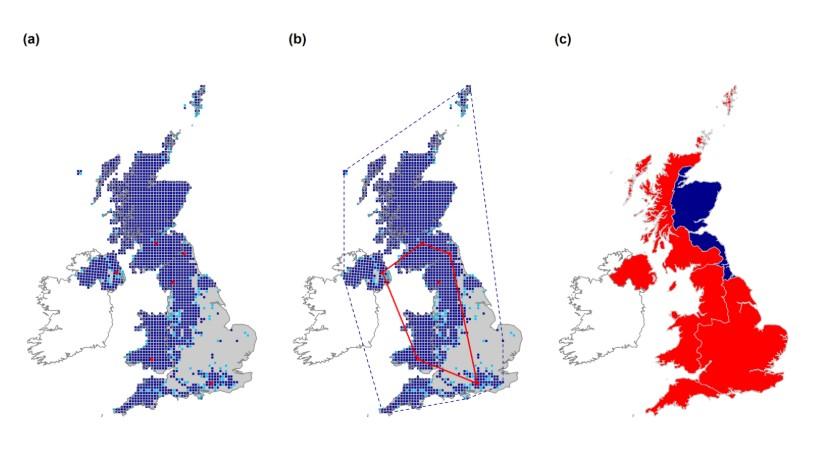
Map - Seed collections in the Millenium Seed Bank (MSB) cover
Click for a full description
Dark blue = species distribution, red = represented in ex situ collection, light blue = pre 2000 records.
- (a) 6 of 1889 occupied 10-km squares (<1%)
- (b) an EOO of 99,061 km² out of 513,392 km² occupied (19%)
- (c) 4 out of 5 Regions of Provenance (80%)
Current conservation actions
Widespread and well-characterized threats to heath from nitrogen deposition mean that actions to limit nitrogen are ongoing.
| Ex situ | Translocation | Habitat management | Legal protection of habitat or species | Regulation of exploitation | Control of INNS/pests/pathogens |
|---|---|---|---|---|---|
| X | - | X | - | - | - |
Population assessment/monitoring
Population
Demographic
N pops assessed/monitored in Scotland = 2/2
N pops assessed/monitored in UK = 5/5
Genetic
N pops assessed/monitored in Scotland = 1/2
N pops assessed/monitored in UK = 1/5
Further Research
Although some data on genetic variation is available (from six sites) in Scotland, information from additional locations, including comparison to areas outside Scotland would improve our understanding of the distribution of diversity and potentially local adaptations. There is now an available genome assembly of V. myrtillus from a Norwegian sample (Wu et al 2021) which provides a resource to underpin genetic surveys.
References
APIS, 2019. Nitrogen deposition - dwarf shrub heath.
Beales, P.A., Giltrap, P.G., Payne, A. and Ingram, N. 2009. A new threat to UK heathland from Phytophthora kernoviae on Vaccinium myrtillus in the wild. Plant Pathology, 58: 393-393
Bjedov, I., Obratov-Petković, D., Mišić, D., Šiler, B. & Aleksić, J.M. 2015. Genetic patterns in range-edge populations of Vaccinium species from the central Balkans: implications on conservation prospects and sustainable usage. Silva Fennica, 49(4), 1283.
Braithwaite, M.E., Ellis, R.W. & Preston, C.D. 2006. Change in the British Flora 1987-2004. Botanical Society of the British Isles, London.
Carvalho, M., Matos, M., Crespí, A., Lopes, V.R., & Carnide, V. 2024. Genetic diversity and identification of Vaccinium species through microsatellite analysis. Plants 2024, 13, 3488
Eckert, C.G., Samis, K.E. & Lougheed, S.C. 2008. Genetic variation across species’ geographical ranges: the central–marginal hypothesis and beyond. Molecular Ecology, 17(5), 1170-1188.
FERA (Food and Environment Research Agency). 2012. Phytophthora ramorum and Phytophthora kernoviae diseases on bilberry (Vaccinium myrtillus) A threat to our woodlands, heathlands and historic gardens
Gailīte A., Gaile A., Ruņģis D. E. 2020. Genetic diversity and structure of wild Vaccinium populations - V. myrtillus, V. vitis-idaea and V. uliginosum in the Baltic States. Silva Fennica, 545,10396
Green, S., Cooke, D.E.L., Barwell, L., Purse, B.V., Cock, P., Frederickson-Matika, D. et al. 2025. The prevalence of Phytophthora in British plant nurseries; high-risk hosts and substrates and opportunities to implement best practice. Plant Pathology, 74, 696–717
Herbert, R., Samuel, S., & Patterson, G. (1999). Using Local Stock for Planting Native Trees and Shrubs. Forestry Commission Practice Note.
Latham, R.L., Beal, E.J., Clarkson, J.P. & Nellist, C.F. 2022. First report of Pucciniastrum minimum (syn. Thekopsoraminima) causing leaf rust on Vaccinium corymbosum (blueberry) in the United Kingdom and pathogenicity on Vaccinium myrtillus (bilberry). New Disease Reports, 45, e12057
McCallum, S., MacKenzie, K., Williamson, S., Jorgensen, L., Graham, J., & Montano, V. 2023. Genetic variation in European blueberry (Vaccinium myrtillus L.) and the potential for exploitation in Scotland. The Journal of Horticultural Science and Biotechnology, 99(3), 289–297
Nin, S., Petrucci, W. A., Del Bubba, M., Ancillotti, C., & Giordani, E. (2017, 2017/12/19/). Effects of environmental factors on seed germination and seedling establishment in bilberry (Vaccinium myrtillus L.). Scientia Horticulturae, 226, 241-249
Norton, L.R., Murphy, J., Reynolds, B., Marks, S. & Mackey, E.C. 2009. Countryside Survey: Scotland Results from 2007. NERC/Centre for Ecology & Hydrology, The Scottish Government, Scottish Natural Heritage, 83pp.
Ranwala, S. M. W., & Naylor, R. E. L. (2004). Production, survival and germination of bilberry (Vaccinium myrtillus L.) seeds. Botanical Journal of Scotland, 56(1), 55–63
Ritchie, J. 1956. Vaccinium myrtillus. Journal of Ecology, 44, 291-299.
Scottish Government. 2015. Phytophthora ramorum and Phytophthora kernoviae in Scotland: A Status Report, Spring 2015.
Stace, C.A., Preston, C.D. & Pearman, D. 2015. Hybrid Flora of the British Isles. Botanical Society of Britain & Ireland, Bristol.
Stroh P.A., Humphrey T. A., Burkmar R.J., Pescott O.L, Roy D.B., & K.J. Walker. 2023. BSBI Online Plant Atlas 2020
Tikhomirov, N. P., Volkova, P. A., Trávníček, P., Kashin, S., & Schanzer, I. A. 2022. The poor cousin: Contrasting patterns of intraspecific variation among co-occurring species of Vaccinium L. Flora, 293, 152103
Welch, D., Scott, D., Moss, R. & Bayfield, N. 1994. Ecology of blaeberry and its management in British moorlands. Grange-over-Sands, Institute of Terrestrial Ecology
Welch, D., Scott, D., & Doyle, S. (2000). Studies on the paradox of seedling rarity in Vaccinium myrtillus L. in NE Scotland. Botanical Journal of Scotland, 52(1), 17–30
Wu, C., Deng, C., Hilario, E., Albert, N. W., Lafferty, D., Grierson, E. R. P., Plunkett, B. J., Elborough, C., Saei, A., Günther, C. S., Ireland, H., Yocca, A., Edger, P. P., Jaakola, L., Karppinen, K., Grande, A., Kylli, R., Lehtola, V.-P., Allan, A. C., Espley, R. V., & Chagné, D. (2022). A chromosome-scale assembly of the bilberry genome identifies a complex locus controlling berry anthocyanin composition. Molecular Ecology Resources, 22(1), 345-360
Assessor:
- Rebecca Yahr, Royal Botanic Garden Edinburgh
- Alicia Mastretta-Yanes, Royal Botanic Garden Kew
- Linda Neaves, School of Environmental and Conservation Sciences, Murdoch University
Reviewer:
- Jim McIntosh, Botanical Society of Britain & Ireland
- Pete Hollingsworth, Royal Botanic Garden Edinburgh