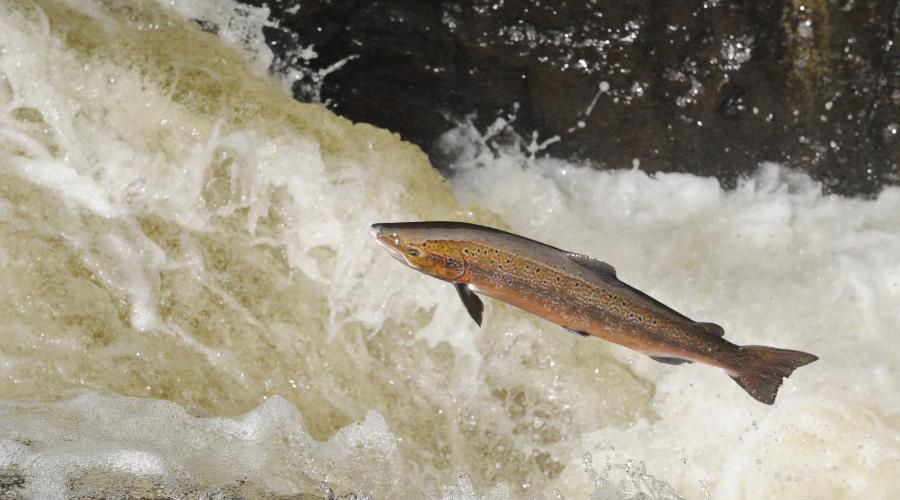
Genetic Scorecard Indicator - Atlantic Salmon
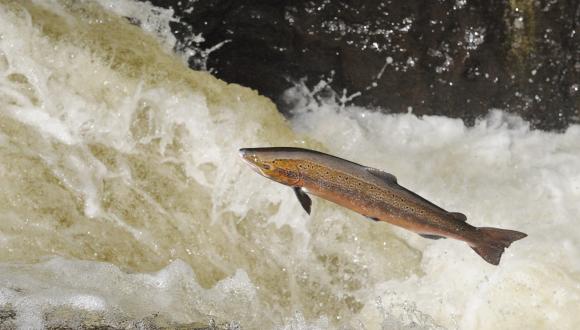
Atlantic Salmon (Salmo salar)

IUCN Category:
- Great Britain: Endangered (indicated above)
- Europe: Vulnerable
- Global: Near Threatened

Genetic Health Status:
- Scottish Risk: Moderate (indicated above)
- UK Risk: Moderate
- Scottish Mitigation status: Not effective
- UK Mitigation status: Not effective
Background
Globally significant and culturally important anadromous fish species found in the temperate and arctic regions of the northern hemisphere. Wild stocks support commercial fishing and recreational angling, while domestic stocks are used in aquaculture. In the UK, wild juveniles spend 1-4 years in freshwater before migrating to sea (‘smolt migration’). They then return to their natal site to spawn as ‘grilse’ (following one winter at sea) or ‘salmon’ (following 2-4 winters at sea). Males, but not females, may also breed before their marine migration. There is wide variation in the seasonal timing and age at return, which has a genetic basis. There is an ongoing UK-wide decline in the number of returning adult salmon. Early and late returning fish (‘Spring’ and ‘Autumn’ runs) appear particularly affected.
Atlantic Salmon genetics is well studied at the population and functional level, however there are few published genetically based estimates of Ne for UK populations.
Atlantic Salmon are an anadromous fish species with natal homing, meaning that adults spawning in different rivers can be treated as genetically semi-independent populations. Annual catch numbers of returning adults are recorded for individual management units (‘Fisheries Districts' in Scotland), which encompass either single entire river drainages or multiple small adjacent rivers. For the purposes of this report, different management units are defined as separate populations. We caution that there is genetic evidence of further population subdivision within some management units (e.g. Ness, Tweed, Tay) and conversely that some rivers in different management units could be considered part of the same metapopulation. However, data are not immediately available to assess populations at this level of detail.
Current Threats
Mortality in the marine environment has increased and is now over 95%. Climate change and by-catch of post-smolts by marine fisheries are key factors, alongside the impact of pathogens from aquaculture along smolt migratory routes. In freshwater, climate change, water quality and quantity, barriers to migration, loss of suitable spawning areas, and invasive non-native species are key threats. Predation can also be a local problem. Exploitation may threaten individual populations. Stocking, to compensate for declining returns, and introgression from aquaculture escapees, may result in the loss of locally adapted traits and reduce fitness in some populations. Emerging threats include expansion of Atlantic Salmon aquaculture to offshore areas, offshore wind power development, and construction of pumped-storage hydropower systems along migration routes.
Contribution of Scottish/UK population to total species diversity
Scottish Atlantic Salmon populations make up over 34% of the European Atlantic stock (ICES, 2025) and therefore represent a substantial proportion of its overall genetic diversity. Analyses confirm genome-wide patterns of geographical divergence across its global (Bourret et al., 2013) and national (Gilbey et al., 2016) range.
Genetic risks
Diversity loss: population declines
There is a high risk of loss, with catch statistics indicating a reduction in adult population size of 55% over the past 50 years (Environment Agency, 2023; Scottish Government, 2023).
Global Biodiversity Framework Indicators
Population definitions:
Populations defined by geographic boundaries and genetic clusters.
Ne500: The proportion of populations that have an effective population size of more than 500.
- Proportion of populations with Ne > 500 in Scotland: 38/101 = 38/100
- Proportion of populations with Ne > 500 in UK:52/169 = 52/169
This assessment is based on 2020-23 catch data using the following broad assumptions:
Nc: 15% exploitation rate used to convert catch numbers to annual Nc, from mean known rate across 11 Great Britain's rivers 2020-2024. Note that this estimate does not include non-migrating male spawners (‘precocious parr’), which may comprise 30% or more of the breeding population.
Ne: Conversion is from Yates et al. (2017), a meta-analysis of six studies that estimated Nb/Nc ratios in Atlantic salmon. Fitted model was Nb = 3.705 + 0.195Nc. There was very high variation in Nb/Nc estimates across the source studies, meaning that this model had very little predictive power, however for the purposes of this assessment it supports a rule-of-thumb approximation of Nb = 0.2Nc. Assuming a mean UK Atlantic salmon generation time of 3.5 years, and one breeding event per lifetime, generational Ne can then be approximated as 3.5*harmonic mean (Nb) (Waples 2002).
Catch data were not available for Northern Ireland.
PM: Proportion of populations that existed in 2000 that still exist in 2025.
- The proportion of populations maintained in Scotland = 101/101
- The proportion of populations maintained in UK = 169/169
Based on populations monitored; some historical population losses have recently been reversed.
Diversity loss: functional variation
Functional variation
Moderate risk. Studies of Atlantic Salmon across the range (e.g. Cauwelier et al., 2018a) suggest that populations can be genetically adapted to their local conditions. Atlantic Salmon habitats across the UK vary widely, meaning that population loss may result in overall loss of adaptive diversity. Variation in Atlantic Salmon life histories (e.g. age at maturity and seasonal migration timing, Cauwelier et al., 2018b, Barson et al., 2015) are known to have a genetic basis, however it is unclear whether observed population-level changes in these traits reflect underlying genetic changes or phenotypic plasticity (e.g. Raunsgard et al., 2024).
Divergent lineages
Moderate risk. Scottish populations are part of the widespread Atlantic lineage of Atlantic Salmon (Bourret et al., 2013), however there is evidence of post-glacial recolonisation from > 1 refugium and evidence of genetic differentiation both within and between natal rivers (Cauwelier et al., 2018; Gilbey et al., 2016). The genetically distinct chalk-stream spawning lineage (5 populations, all in England) is at particular risk of loss.
Hybridisation/Introgression
Moderate risk of introgression with aquaculture escapees and stocked fish, leading to loss of adaptive traits and reduced fitness in wild salmon (Gilbey et al., 2021). Current risk is greatest in the north and west of Scotland where Atlantic Salmon aquaculture is concentrated.
Low turnover - constraints on adaptive opportunities
Low adult survival to reproduction currently affecting all populations may constrain adaptive opportunities.
Cumulative Risk Summary
Overall Genetic Health Status
Scotland
- Risk: Moderate
- Mitigation: Moderate
Great Britain/UK
- Risk: Not effective
- Mitigation: Not effective
Overall Genetic Health status explanation
Atlantic Salmon are heavily monitored and managed but threats to genetic diversity persist, due to poor marine survival, impacts on breeding habitats, hybridisation with aquaculture escapees and stocking. Current mitigation efforts appear unsuccessful, and the long-term future of some genetically based stock components is uncertain.
In situ genetic threat level
In situ genetic threat level
- In situ Risk for Scotland: Moderate
- In situ Risk for UK: Moderate
Relatively widespread species but multiple potential threats create the potential for genetic diversity loss.
Confidence in in situ threat level
- Confidence score for Scotland: High
- Confidence score for UK: High
Good demographic data and direct genetic data.
Ex situ representation
Very limited ex situ representation of wild stocks. Farmed fish are plentiful, but do not represent wild genetic diversity, the majority having a Norwegian broodstock origin.
Current conservation actions
Atlantic Salmon is a well-known species that is the target of intensive monitoring and a wide range of conservation actions and national/international research aimed at understanding and mitigating its decline. Exploitation is managed through national and cross-national legislation and local management plans. Impacts of infrastructure projects and aquaculture development are managed through national legislation. Freshwater habitat restoration projects are widely being undertaken. There is a move towards conservation-focused stocking programmes/ live gene-banking, but the usefulness of these approaches is unproven. The major threats appear to be at the marine stage and are not fully characterised, limiting the ability of individual countries to halt population declines.
| Ex situ | Translocation | Habitat management | Legal protection of habitat or species | Regulation of exploitation | Control of INNS/pests/pathogens |
|---|---|---|---|---|---|
| - | X | X | X | X | X |
Population assessment/monitoring
Population
Demographic
Centralised Scotland and UK-wide species monitoring programmes that estimate juvenile density and adult returns (from catch data and counts).
N pops assessed/monitored in Scotland = 101/101
N pops assessed/monitored in UK = 169/169
Genetic
Previous Scotland-wide studies of aquaculture introgression and population genetic diversity (Scottish Government); other smaller scale ad-hoc assessments.
N pops assessed/monitored in Scotland = Unknown, likely > 50/101
N pops assessed/monitored in UK = Unknown, likely > 70/169
Further Research
Consolidation and re-analysis of existing, disparate, genetic datasets plus genetic analysis of historical tissue archives would improve overall understanding of trends in genetic diversity and Ne.
References
Barson NJ, Aykanat T, Hindar K, Baranski M, Bolstad GH, Fiske P et al. (2015). Sex-dependent dominance at a single locus maintains variation in age at maturity in salmon. Nature, 528(7582), 405– 408;
Cauwelier E, Gilbey J, Sampayo J, Stradmeyer L, Middlemas SJ (2018) Identification of a single genomic region associated with seasonal river return timing in adult Scottish Atlantic Salmon (Salmo salar), using a genome-wide association study. Can. J. Fish. Aquat. Sci. 75: 1427-1435;
Cauwelier E, Stewart DC, Millar CP, Gilbey J, Middlemas SJ (2018), Across rather than between river genetic structure in Atlantic Salmon Salmo salar in north-east Scotland, UK: potential causes and management implications. J Fish Biol, 92: 607-620;
Environment Agency, Salmon Stocks and Fisheries in England & Wales 2023, and supplementary data
Gilbey J, Cauwelier E, Coulson MW, Stradmeyer L, Sampayo JN, Armstrong A, et al. (2016) Accuracy of Assignment of Atlantic Salmon (Salmo salar L.) to Rivers and Regions in Scotland and Northeast England Based on Single Nucleotide Polymorphism (SNP) Markers. PLoS ONE 11(10): e0164327.
Gilbey J, Sampayo J, Cauwelier E, Malcolm I, Millidine K, Jackson F Morris DJ (2021) A national assessment of the influence of farmed salmon escapes on the genetic integrity of wild Scottish Atlantic Salmon populations. Scottish Marine and Freshwater Science Vol 12 No 12.
Ikediashi CI, Paris JR, King RA, Ibbotson A, Stevens JR (2018). Atlantic Salmon (Salmo salar L.) in the chalk streams of England are genetically unique. J. Fish Biol. 92
Raunsgard A, Persson L, Czorlich Y, Ugedal O, Thorstad EB, Karlsson S, Fiske P, Bolstad GH (2024). Variation in phenotypic plasticity across age-at-maturity genotypes in wild Atlantic Salmon. Molecular Ecology, 33, e17229.
Scottish Government Scottish Salmon & Sea Trout fishery statistics 2023 and Supplementary Data
Waples RS (2002) The effective size of fluctuating salmon populations. Genetics 161:783–791.
Yates MC, Bernos TA, Fraser DJ. (2017) A critical assessment of estimating census population size from genetic population size (or vice versa) in three fishes.
Assessors:
- Victoria Pritchard, UHI Inverness
- Colin Bean, University of Glasgow
Reviewer: Isa-Rita Russo