All about beavers
Beavers are native Scottish animals that live in and around freshwater such as rivers, streams and lochs.
They were common in Scotland for many years until they were hunted to extinction about 400 years ago.
Beavers are now back in Scotland and are a legally protected species.
They are known as a ‘keystone species’ because their presence and activities have many benefits for other wildlife, plants and habitats.
While they bring ecological benefits, in some situations their behaviour can have an impact on areas including land management and infrastructure. As a result, their activities sometimes need to be managed.
Beaver facts
- Beavers are semi-aquatic animals with waterproof outer fur, webbed back feet and a large, flat tail which acts like a rudder when swimming.
- They can hold their breath under water for up to 15 minutes.
- Beavers are the second largest rodent in the world. An adult beaver is longer than 1m, up to 0.5m in height, and weighs over 20kg.
- They live in freshwater such as rivers, streams and lochs. But they can travel via saltwater.
- Beavers live in family groups typically of two to five animals but sometimes up to 10.
- Young beavers, called kits, will stay with their parents until they are two or three years old. They’re usually born in late spring or early summer around May time and can swim 24 hours after birth.
- Beavers are herbivores, eating inner bark of trees as well as shoots, leaves and roots. They have large, very strong teeth which they use to fell trees for food and building.
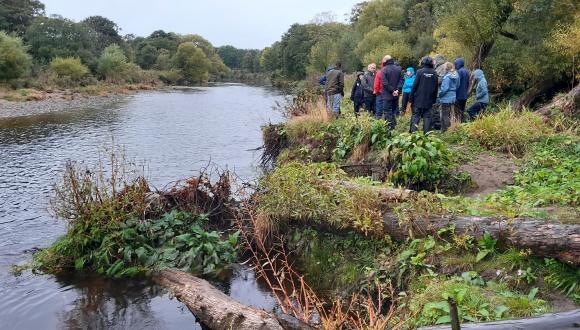
- Beavers build ‘lodges’ to live in with underwater entrances and exits, or burrows which may not be visible from above. They also build dams to create deep water ponds to protect themselves. They feel safest in water.
- They use logs, sticks, mud, stones and vegetation as building materials.
- Beavers also use their large tail as a warning system, slapping it off the water’s surface to alert other beavers to danger.
Scotland’s beaver history
- 16th Century - Beavers hunted to extinction for their meat, fur and oils for perfumes and medicines.
- 2000s - Decision to trial reintroduction of beavers in Scotland at Knapdale Forest in Argyll. Around this time, beavers were also confirmed in Perthshire due to accidental or illegal release.
- 2009 – 2015 - Scottish Beaver Trial at Knapdale.
- 2016 - It is announced that the beaver populations in both Knapdale and Tayside can stay, with the populations allowed to spread naturally from these areas.
- 2019 - Beavers legally recognised as a European Protected Species in Scotland.
- 2021 - Policy changes to actively expand the beaver population through planned releases into new catchment areas, including Scotland’s two National Parks.
- 2021 - Survey of beavers finds that the population has more than doubled to around 1,000 animals, as beavers spread out from Tayside.
- 2022 - Scotland's Beaver Strategy 2022-2045 is published supporting a vision of beaver restoration, allowing translocations (movements from one area to another) while at the same time managing any negative impacts.
- 2023 – 2025 - More than 150 beavers have been released to the wild including releases to Loch Lomond, the Forth catchment, the Cairngorms National Park, Knapdale, Tayside, the Trossachs and the Beauly catchment.
Beavers in Scotland now
The beaver population is growing and will continue to spread across Scotland.
This is partly through planned releases to new suitable areas, as well as through natural expansion as young beavers grow up, leave their family units and start families of their own.
As beavers are wild animals, no individual or organisation is responsible for beavers.
The Scottish Beaver Advisory Group (SBAG), which is made up of a wide range of partner organisations, guides delivery of Scotland's Beaver Strategy which sets out a vision and actions for the beaver population being actively expanded into appropriate areas, maximising the benefits of beavers while minimising negative impacts.
Responsibility for managing beaver impacts is shared by many organisations and communities that manage land, water resources, and assets.
NatureScot has a particular role in licensing and supporting mitigation.
Any beaver release to the wild requires a licence from NatureScot.
Why are beavers protected?
Beavers have been given protected species status across several European countries, including Scotland. This aims to protect and restore their populations to a ‘favourable conservation status’ as part of wider protections of endangered, vulnerable and valuable species and habitats.
Beavers have many benefits for climate and nature. They are known as ‘ecosystem engineers’ because their activities shape and create wetland areas that benefit many other animals and plants. They can also reduce flooding, improve water quality, and bring socio-economic benefits such as providing tourism business opportunities.
Myth busting
Beavers don’t eat fish. They live on plants found in and around water, bark, and young tree shoots.
Beavers don’t usually kill trees. Their preferred foods are willow, aspen and poplar, which can re-sprout in response to beavers cutting them down.
Beavers don’t breed a lot. They have one litter of kits a year, usually born in May. A pair will have an average of three kits per year which usually emerge from the burrow in June or July.
Beavers can be hard to see. You are more likely to see the signs of beaver activities such as dams and felled trees, than to see beavers themselves. This is because they are mainly active at night.
Beavers don’t carry significant risk of disease. Long-term health monitoring of Scottish beavers has shown the risk of introducing significant disease to humans, domestic animals or wildlife from captive bred or wild beavers was low. Beavers undergo disease screening and health checks as part of the translocation process.
Beavers won’t keep increasing indefinitely. As beavers are territorial animals and strongly defend their territory, there will be a limit to the number of beavers found in one area of water. The size of the population will also be controlled by the availability of suitable habitats.
Beavers won’t eventually fell all trees. While beavers will change woodland structure, their activity is normally limited to within 20m of freshwater, is patchy and selection for different areas over time allows regrowth of felled stumps.
Living with beavers
Beavers lived alongside people for thousands of years in Scotland and continue to do so in other countries across Europe, where they have always existed or where they have also been reintroduced.
With beavers now back in Scotland it is important that we learn about them, how to live alongside them, and also how and when to manage any impacts.
Beaver behaviour
Learning about beaver behaviour can help us understand them, what to expect, and how their impacts could be mitigated.
Why do beavers fell trees?
Beavers fell trees for building material as well as bark for food. They prefer trees with soft wood such as willow, birch, alder, aspen, ash, poplar and hazel, but what they will eat is relative to what is available.
The felling of native trees stimulates the growth of new shoots and root growth, which can extend the life of some species and result in the strengthening of riverbanks.
Tree felling also opens up woodland canopy, allowing more light to reach the ground, enabling the regeneration of vegetation, increasing the diversity of plants and improving feeding opportunities for other wildlife.
Why do they build dams?
Beavers build dams to create deep water ponds to protect themselves. They feel safest in water. They also build ‘lodges’ to live in with underwater entrances and exits, or burrows which may not be visible from above. Beavers also build dams to create safe access to larger areas of habitat for feeding.
Where do beavers look for food?
Beavers mostly look for food and building materials close to the water’s edge (within around 20m or so).
Beaver impacts
While beavers bring benefits to land and the environment, in some situations they can have negative impacts such as damaging property and infrastructure, causing problems for land management or other important species. Beavers are strong animals and they can be persistent.
Common impacts include:
- Tree felling – Sensitive or important trees may require protection to prevent them from being felled, such as fencing around areas of trees or wrapping individual trees with wire mesh.
- Burrowing – Burrowing can undermine and weaken structures, including river
- Damming – Damming can cause localised flooding problems for land managers and people and in some situations affect the habitats and passage of migratory fish.
Many of these impacts have potential cost implications for land managers if land used for agriculture is affected, or they need to install mitigation measures.
Free advice is available from NatureScot to help manage the impacts of beavers. In some cases, funding may be available to support mitigation works or projects that trial new mitigation approaches.
How to manage impacts of beaver behaviour
There are several ways to manage the impacts of beavers, but it’s important to choose the right approach for each location and situation to avoid further problems.
It’s important to remember that beavers are a legally protected species. This means there are very specific rules around removal of beavers or their dams.
When beavers became a protected species in Scotland, a hierarchy for beaver management was put in place. This follows these steps:
- Accommodation (wherever possible)
- Mitigation/management (when required)
- Translocation (if necessary)
- Lethal control (as a last resort)
If mitigation measures are in place, it is important not to tamper with these as this can create further or prolonged issues and you may be committing an offence.
Anyone experiencing negative impacts caused by beavers should seek advice.
Where to find information and advice
NatureScot will provide free expert advice to all on living with beavers and where appropriate, how to manage beaver activity. Licences for translocation of beavers and removal of dams must be obtained from NatureScot.
The Beaver Trust provides a range of advice on beavers and how to live alongside them including educational advice and activities.
Farm Advisory Service and NFUS can provide advice for land managers.