Conservation of the wildcat (Felis silvestris) in Scotland
Review of the conservation status and assessment of conservation activities

Wildcat (Felis silvestris) male meets domestic cat female, © L. Geslin.

Authors: Urs Breitenmoser, Tabea Lanz and Christine Breitenmoser-Würsten February 2019
In spring 2018, the Scottish Wildcat Conservation Action Plan Steering Group commissioned the IUCN SSC Cat Specialist Group to review the conservation status of the wildcat in Scotland and the implementation of conservation activities so far. The review was done based on the scientific literature and available reports. The designation of the geographical entities in this report, and the representation of the material, do not imply the expression of any opinion whatsoever on the part of the IUCN concerning the legal status of any country, territory, or area, or its authorities, or concerning the delimitation of its frontiers or boundaries.
The SWCAP Steering Group contact point is Martin Gaywood ([email protected]).
Please note, some of the images on this document may not be fully accessible, but all are described in the caption and within the body of the document. Should any users require an accessible version please contact us using the email above and this can be arranged.
Contents
- Summary
- Introduction
- History and present status of the wildcat in Scotland – an overview
- Recent conservation initiatives and projects
- Evaluation of the conservation efforts for the wildcat in Scotland
- Conclusions and recommendations
- References
- Appendix 1
Abbreviations and Acronyms
- AFC - Aigas Field Centre
- BASC - The British Association for Shooting & Conservation
- CITES - Convention on International Trade in Endangered Species of Wild Fauna and Flora
- CNP - Cairngorms National Park
- CNPA - Cairngorms National Park Authority
- CRRU - Campaign for Responsible Rodenticide Use
- CWP - Cairngorms Wildcat Project
- ddRAD - double digest RAD sequencing
- FCS - Forestry Commission Scotland
- FCV - Feline calcivirus
- FES - Forest Enterprise Scotland
- FCoV - Feline corona virus
- FeLV - Feline leukaemia virus
- FFV - Feline foamy virus
- FIV - Feline immunodeficiency virus
- HFW - Highland Foundation for Wildlife
- HLF - Heritage Lottery Fund
- HWP - Highland Wildlife Park
- IUCN - International Union for Conservation of Nature
- mtDNA - Mitochondrial DNA
- NBN - National Biodiversity Network
- NCC - Nature Conservancy Council
- NFUS - National Farmers Union Scotland
- NMS - National Museums Scotland
- NTS - National Trust for Scotland
- PAs - Priority Areas
- PTES - People’s Trust for Endangered Species
- RDSV - Royal (Dick) School of Veterinary Studies
- RZSS - Royal Zoological Society of Scotland
- SAF - Species Action Framework
- SAWC - Special Areas for Wildcat Conservation
- SGA - Scottish Gamekeepers Association
- SGP - Sharing Good Practice
- SLE - Scottish Land and Estates
- SMART - Specific, measurable, achievable, relevant, time-bound
- SNH - Scottish Natural Heritage
- SRDP - Scottish Rural Development Programme
- SWA - Scottish Wildcat Action
- SWCAP - Scottish Wildcat Conservation Action Plan
- SWT - Scottish Wildlife Trust
- SWCAPSG - Scottish Wildcat Conservation Action Plan Steering Group
- TNR - Trap-Neuter-Release
- TNVR - Trap-Neuter-Vaccinate-Release
- WildCRU - Wildlife Conservation Research Unit (University of Oxford)
Summary
The isolated Scottish wildcat (a subpopulation of the European wildcat (Felis silvestris)) was once widespread across Great Britain, but restricted to the north-western Highlands in the late 19th century. After a recovery in the first half of the 20th century, the population declined again in recent decades. Today, the wildcat in Scotland is at the brink of extinction. The current population estimation ranges from 30 to 430 individuals, with a further decreasing trend. Threats to the wildcat in Scotland are hybridisation, disease transmission from and competition with (feral) domestic cats, prey number fluctuations, predator control, accidental killing by dogs, in snares or by poisoned baits, road accidents and habitat loss. Hybridisation is considered the major threat to the survival of the wildcat in Scotland and recent data suggest that this threat is accelerating.
To prevent the final disappearance of the wildcat from Scotland, Scottish Wildcat Action (SWA) is implementing the Scottish Wildcat Conservation Action Plan (SWCAP). The work of SWA focusses on five Priority Areas (PAs), where it aims to reduce threats and conserve population nuclei. SWA employs a Trap-Neuter-Vaccinate-Release (TNVR) programme for feral cats, encourages responsible cat ownership, engages with landowners to improve land management practices, collects chance sightings of wildcats, feral cats and hybrids and monitors the remnant populations, mainly by means of camera trap surveys. The most recent winter surveys conducted in all five PAs in the time span of 2015–2018, revealed that only 20% of individuals pictured were wildcats, but 80% (unneutered) hybrids or domestic cats. Research on such an elusive and rare species as the wildcat is difficult and expensive. The low abundance of wildcats and the fact that there is now a continuum from domestic cats to pure wildcats (a hybrid swarm) in Scotland is an additional hindrance to research and monitoring.
Up to now SWA has completed 8 (20.5%) of the total 39 Actions of the SWCAP, 8 (20.5%) Actions have made significant progress, 21 (54%) have been progressed but still need a significant amount of work and 2 (5%) have made only limited progress. We evaluated the achievements of four SWCAP Projects out of 18 as being “good” regarding the progress, ten as being “satisfactory” and four as “not satisfactory”. In October 2018, the SWCAP was revisited and the priority conservation actions were evaluated by the SWCAP Steering Group. We recommend the implementation of an adaptive management scheme with a more consistent monitoring of the progress and the effectiveness of the Projects and Activities of the SWCAP. Based on recent findings, it is crucial to ask the question as to whether the general approach of the SWCAP will enable the saving of the wildcat in Scotland.
Hybridisation was recognised by SWA as the main threat and its mitigation was the most important activity of the SWCAP. In the five PAs surveyed in 2017/18, the total ratio of wildcats to unneutered hybrids was almost 1:6. Hybrids have become so common that wild-living cats in Scotland show a hybrid swarm structure, hence a continuum from domestic cats to pure wildcats. Such a situation has not been observed in any Felis silvestris population in continental Europe, where the domestic cat abundance is also high. Although the biological and ethological aspects of hybridisation of wildcats with domestic cats are not fully understood, it is evident that the situation in Scotland is different.
All the robust information available indicates that the wildcat in Scotland is at the verge of extinction. Based on the available information, we consider the wildcat population in Scotland to be no longer viable. The number of wildcats is too small, the hybridisation too far advanced and the population too fragmented. We therefore conclude that it is too late to conserve the wildcat in Scotland as a standalone population.
But we still recommend that efforts are made to save as much of the gene pool of the Scottish wildcat population as possible. We reason that (1) the recovery of the wildcat in Scotland will only be possible with the support of reintroduction/reinforcement projects, and that (2) the remaining “pure Scottish wildcats” (based on a rigorous genetic protocol) should be combined with wildcats from continental Europe. Both, reintroduction projects or reinforcement of remnant nuclei should be considered. This requires a rigorous suppression of feral cats and hybrids in areas of reinforcements, and the removal of feral cats in areas of potential reintroduction. The SWCAP has already proposed some activities relating to reintroduction and/or reinforcement (e.g. advancing the captive breeding programme and preparing an EU LIFE project that includes conservation breeding). We recommend revising the SWCAP under the paradigm of reinforcement/reintroduction and developing a new spatial concept for the restoration of a viable wildcat (meta-) population in Scotland also including potential wildcat habitats outside existing PAs.
Monitoring and understanding wildcat ecology are important and related activities that should be given higher priority. A better understanding of wildcat ecology and behavior, and their relation to hybrids and feral domestic cats, is crucial and would be best addressed in cooperation with wildcat research and conservation groups from continental European countries, in order to understand the particular situation in Scotland. Appropriate morphological and genetic identification schemes have been developed in the frame of the SWCAP and should become the standard for monitoring of wildcats across Scotland. We recommend conducting surveys based on a robust protocol in all areas where it is speculated that wildcats may still persist, and to continue the monitoring of wildcats, hybrids and feral cats in PAs. We consider the ratio of wildcats : hybrids to be the most important indicator for the constant assessment of the status of the wildcat. Considering the efforts and the achievements so far, responsible cat ownership, the control of feral cats and removing the hybrids especially in the remnant wildcat areas of Scotland, seems to be the major challenge in wildcat recovery across the UK. The history of continental wildcat populations, some of which are presently expanding, demonstrates that wildcats can also maintain their genetic integrity also in landscapes with high densities of domestic cats. However, small remnant or initial reintroduced populations are likely to be much more vulnerable to hybridisation and may require stronger management interventions to prevent hybridisation than a large vital population.
Introduction
The European wildcat Felis silvestris was classified as Least Concern in the regional IUCN Red List assessment in 2007 (Hermann et al. 2007). However, with regard to Scotland, the only region in the British Isles where the species has survived, the authors noted: “The Scottish wildcat is scarce and declining, and is currently listed as Vulnerable on the IUCN Red List of Threatened Species. It may warrant uplisting to a higher category of threat.” Today, the wildcat in Scotland is at the brink of extinction. Scottish Wildcat Action, a multi-partner project supported by Scottish Government is implementing the Scottish Wildcat Conservation Action Plan (SWCAP) to prevent the final disappearance of the wildcat from Scotland. The present SWA programme started in 2015 and will end in 2020. In spring 2018, the SWCAP Steering Group approached the IUCN SSC Cat Specialist Group with regard to an evaluation of the situation of the wildcat in Scotland and the implementation of the conservation activities so far.
The review was done based on the scientific literature and available reports. We are grateful to Alice Bacon (RDSVS, University of Edinburgh), Allan Bantick (SWCAP Steering Group Chair), David Barclay (RZSS/SWA Cat Conservation Project Officer), Peter Cooper (Derek Gow Consultancy Ltd.), Roo Campbell (SWA Priorities Area Manager), Martin Gaywood (Policy & Advice Manager, SNH), David Hetherington (Cairngorms National Park Authority), Kerry Kilshaw (WildCRU), Andrew Kitchener (NMS), Kenny Kortland (FCS/FES) and Helen Senn (RZSS) for providing documents and information or for answering our questions. We are also obliged to the participants of the SWCAP SG workshop in Perth, 10 October 2018, and to our wildcat colleagues Marianne Hartmann and Lea Maronde for comments on the report.
History and present status of the wildcat in Scotland – an overview
History of the wildcat in Great Britain
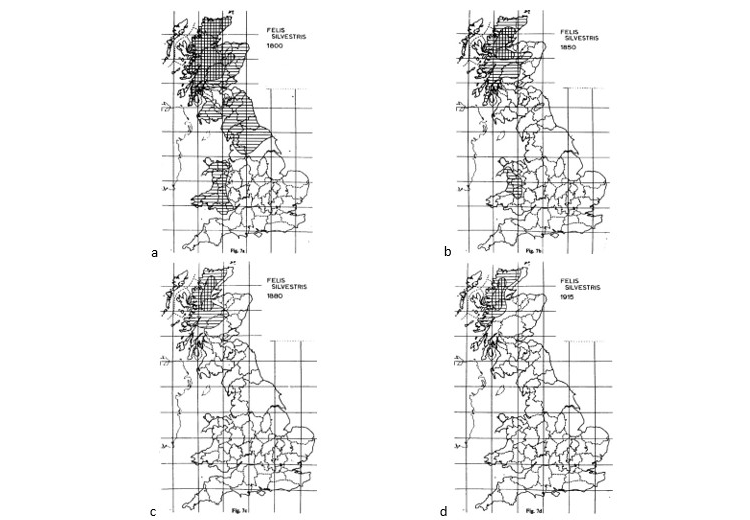
The Scottish wildcat is believed to be a descendant of continental European wildcat ancestors which arrived in Britain via the land bridge to continental Europe approximately 10,000 years ago (Yalden 1982, Easterbee et al. 1991, Kilshaw 2011). In Britain, it has been used in clan heraldry since the 13th century and is part of its mythology (Kilshaw 2011). The wildcat was once widespread across Great Britain except on the larger offshore islands (Taylor 1946, Easterbee et al. 1991, Kilshaw et al. 2015). In the 18th century, its population began to decline, but possibly, the wildcat had disappeared already from southern England already in the 16th century (Langley & Yalden 1977). During the 19th century, the decline of the wildcat population continued and accelerated (Langley & Yalden 1977, Easterbee et al. 1991). From 1800–1870 the wildcat went extinct in Wales, the whole of England and many counties of Scotland. It only persisted at low numbers and never went extinct in remote areas of the counties Invernessshire, Ross and Cromarty, Sutherland, Argyllshire and Caithness, in the northwest of Scotland (Fig. 2.1.; Taylor 1946, Langley & Yalden 1977, Easterbee et al. 1991, Harris et al. 1995). The smallest population size was reached around 1914 just before the First World War (Langley & Yalden 1977, Easterbee et al. 1991).
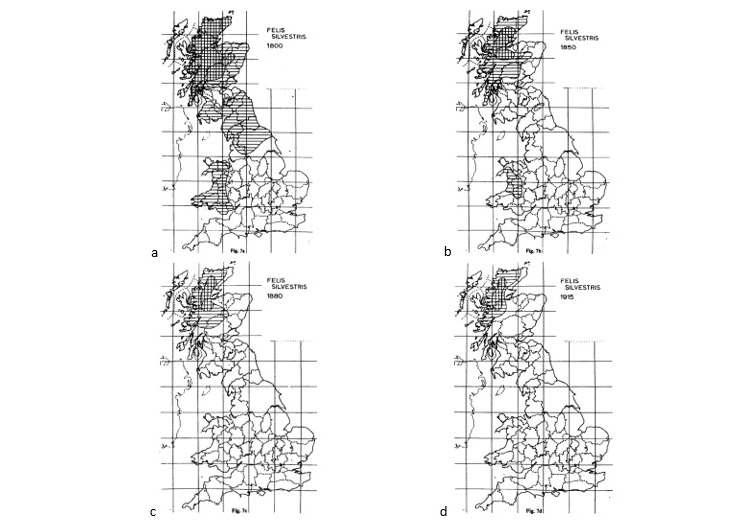
Fig. 2.1. Distribution of the wildcat in Great Britain in a) 1800, b) 1850, c) 1880 and d) 1915
Click for a full description
View a larger version of this image.
- Crosshatching indicates common or widely distributed, horizontal shading indicates rare, declining or localised.
- White areas indicate extinct or data lacking, extinction presumed (Langley & Yalden 1977).
Persecution as vermin (trapping and shooting), hunting for sport and fur and habitat loss were the main causes for the dramatic decline of the wildcat from 1800 onwards (Langley & Yalden 1977, Easterbee et al. 1991, Hubbard et al. 1992, Kitchener 1992a). In many counties of Great Britain, the wildcat was previously hunted for sport during mediaeval times. It also suffered from persecution as it was accused of preying on lambs and chickens (Langley & Yalden 1977). From the mid-19th century many sport hunting estates were established and the number of gamekeepers increased (Easterbee et al. 1991). Gamekeepers persecuted wildcats as part of management to increase numbers of trophy species, such as grouse and pheasant, (Balharry & Daniels 1993, McOrist & Kitchener 1994). This heavy pressure led to local extinctions and was a major threat especially to small, isolated populations (Easterbee et al. 1991). The wildcat may have survived in north-western Scotland because of its remoteness and the lower human population density resulting in low levels of persecution, rather than high habitat quality (Easterbee et al. 1991). As late as 1984-1985, 274 Scottish wildcats were killed according to the Game Conservancy’s Vermin Returns from only 40 estates (Easterbee et al. 1991).
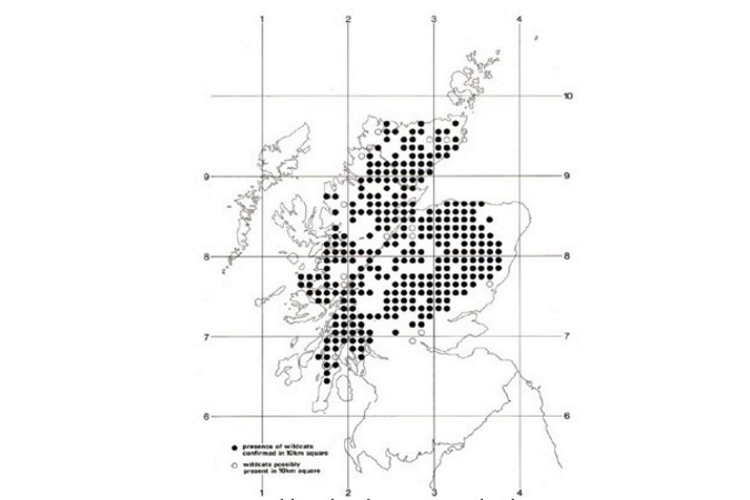
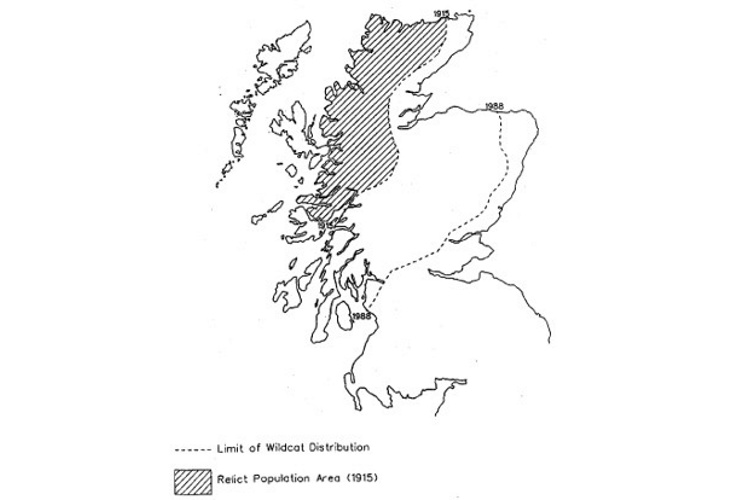
During the First World War 1914–1918, persecution decreased as gamekeepers were conscripted, and reforestation started thereafter (Easterbee et al. 1991). The wildcat population in Scotland responded quickly and started to recover (Taylor 1946, Easterbee et al. 1991, Hubbard et al. 1992, McOrist & Kitchener 1994). From 1919–1935, wildcats recolonised north-central Scotland and by 1946 they had recolonised much of the range known to be occupied today (Langley & Yalden 1977, Easterbee et al. 1991, Kitchener 1992, Hetherington et al. 2016). In the 1960s, the population expansion slowed down and halted as most of the suitable area north of the central industrial belt in Scotland (stretching east-west from Edinburgh to Glasgow) was occupied (Arnold 1984, Easterbee et al. 1991). The Scottish wildcat survey conducted by the Nature Conservancy Council (NCC) from 1983-1987 showed an extensive distribution of the wildcat north of the central belt with no evidence of wildcats further south (Easterbee et al. 1991; Fig 2.2). The high urbanisation and industrialisation of the central belt seems to form a firm boundary and limit further spread towards the south (Anonymous 1990, Easterbee et al. 1991, Hubbard et al. 1992, Kitchener 1992). Habitat loss, persecution and hybridisation with feral cats are further possible reasons for the restriction of the wildcat to northern Scotland (Kilshaw et al. 2015; Chapter 2.3).
Comparing the distribution range from 1988 with historic records indicates a considerable expansion of the occupied area from the assumed “relict” population of 1915 (Balharry & Daniels 1993; Fig. 2.3). The systematic wildcat survey from 1983-1987 by the NCC assessed 34% of the geographically distinct wildcat populations in Scotland to be declining, 58% as stable and 8% to be increasing (Easterbee et al. 1991). Wildcat population density was generally low, even in suitable habitat. The status of the Scottish wildcat was considered best in the northeast, east and south-west, and worst in the north-west of Scotland where the wildcat had persisted in the early 20th century (Easterbee et al. 1991).
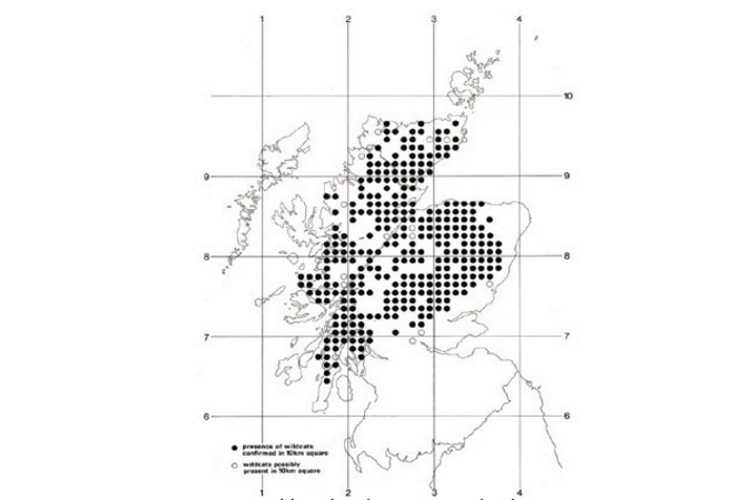
Fig. 2.2. Wildcat distribution in Scotland in 1983-1987.
Click for a full description
View larger version of this image.
Black dots: presence of wildcats confirmed in 10 km square. Circles: wildcats possibly present in 10 km square (Easterbee et al. 1991).
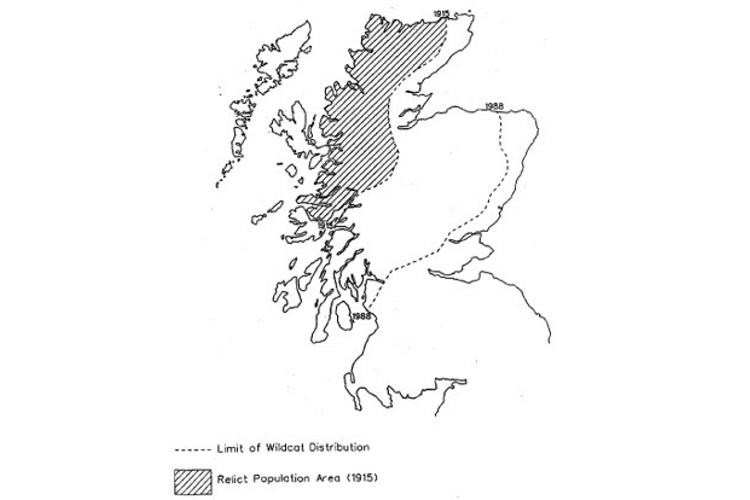
Fig. 2.3. Comparison of the distribution of the wildcat in Scotland from 1915 (relict area) with southern limit of the distribution in 1988 .
Click for a full description
View a larger version of this image.
(after Langley & Yalden 1977 and Easterbee et al. 1991, Balharry & Daniels 1993).
Present status of the wildcat in Scotland
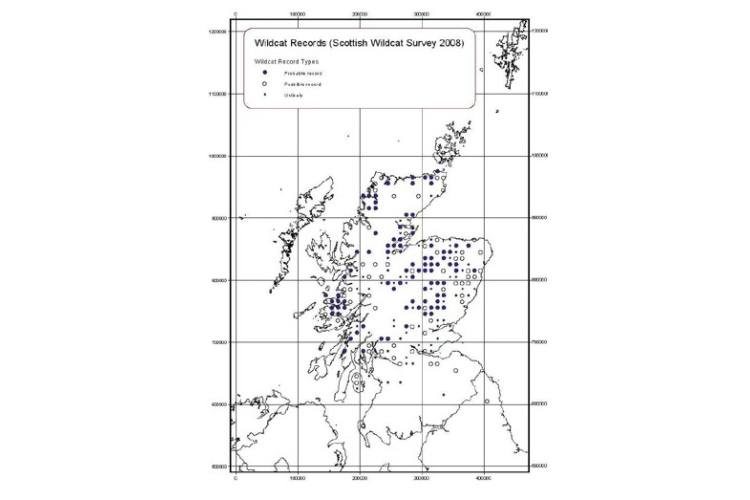
The Scottish wildcat survey conducted by Scottish Natural Heritage (SNH) from 2006-2008 confirmed that ildcats were more abundant in the east than the west of Scotland, as already observed in the 1983-1987 survey (Fig. 2.4.; Davis & Gray 2010).
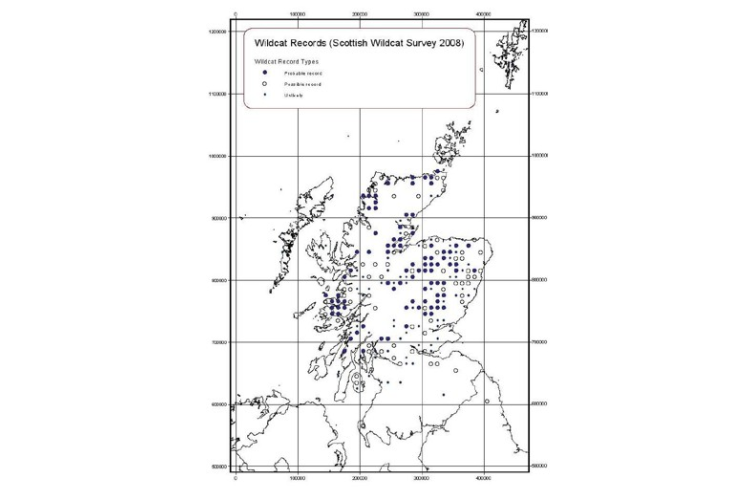
Fig. 2.4. Wildcat distribution in Scotland 2006-2008.
Click for a full description
View a larger version of this image.
- Large blue dots: Probable records (record of a cat containing all key pelage characters or a wildcat iden-tified by an experienced observer),
- Circles: possible record (records without pelage characters, or with limited characters but done by an experienced ob-servers),
- Small dots: unlikely (all other records; Davis & Gray 2010).
The wildcat distribution has changed little since the late 1980s, except in the west of Scotland where it has been decreasing and become increasingly fragmented (Davis & Gray 2010, Yamaguchi et al. 2015). Wildcats were present within the valleys extending from the high plateaux in areas such as the Cairngorms, Sutherland, and central highlands and along coastal areas (Davis & Gray 2010). Most Scottish wildcat records were collected in Aberdeenshire, Invernessshire, Morvern, Perthshire and the central Highlands. Wildcat strongholds were indicated in the Cairngorms, the Black Isle, Aberdeenshire and Ardnamurchan (Davis & Gray 2010). No records were found in areas of the northwest Highlands, Wester Ross, parts of north Stirlingshire and on Scottish islands, except some sightings from Mull, Arran, Orkney and Lewis, which were misidentifications (Davis & Gray 2010). The wildcat appeared to be stable in the north and east of Scotland, with localised populations around Ardnamurchan and Morvern (Davis & Gray 2010). The authors found indications that core areas of “Scottish wildcats” still exist and that the purest Scottish wildcat populations most likely persist in the north and west of Scotland, especially in coastal areas with low pet and feral domestic cat numbers (Davis & Gray 2010). However, recent camera trapping surveys revealed more wildcat-looking cats in the east of Scotland. However, this could possibly be due to higher cat population densities in the east or due to less survey effort taking place in the north and west of Scotland (K. Kilshaw, pers. comm.).
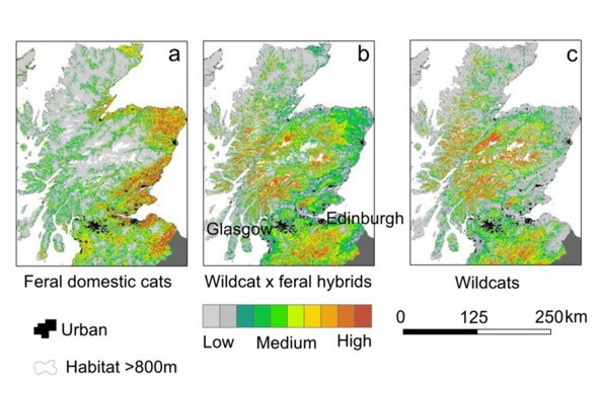
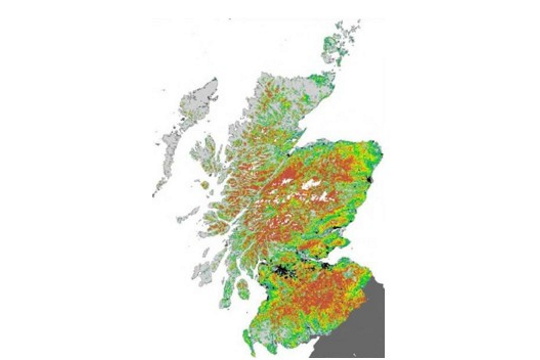
The distribution range of the wildcat was estimated at 43,842 km² based on data from 1980-2003 and the “trend in habitat” assessed as increasing from 1990-1998. However, the amount of inhabited area and the “range trend” were unknown (JNCC 2007). Based on camera trapping throughout northern Scotland, Kilshaw (2015) predicted the occupancy probability of feral domestic cats, hybrids and wildcats based on habitat (Figs. 2.5, 2.6). The habitat model did not make any predictions on wildcat populations or on their current presence.
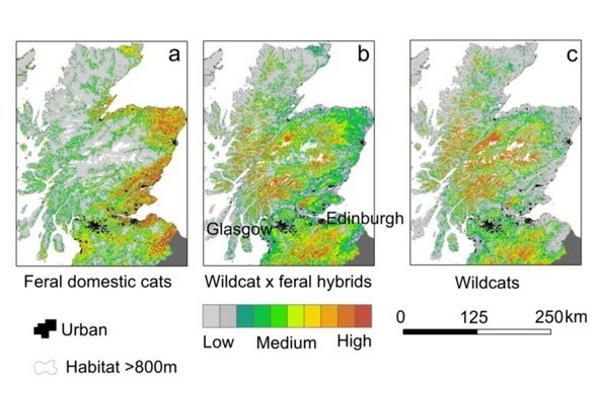
Fig. 2.5. The predicted occupancy probability for ferals (a), hybrids (b), and wildcats (c) as a function of environmental covariates alone (Kilshaw 2015).
Click for a full description
View a larger version of this image.
- Black = urban areas,
- white = habitat over 800 m (unsuitable habitat).
The data shown here represent habitat suitability rather than true occupancy probability (Kilshaw 2015).
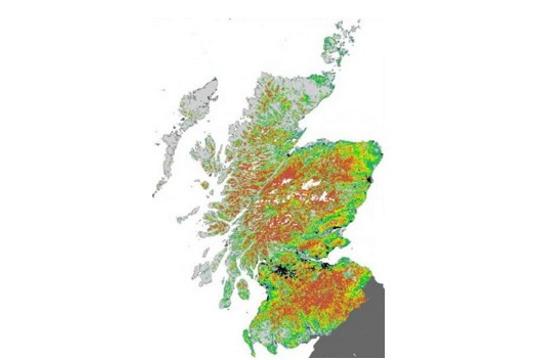
Fig. 2.6. Occupancy probability for wildcats from models incor-porating the predicted occur-rence probability of feral cats and hybrids (Kilshaw 2015).
Click for a full description
View a larger version of this image.
Kitchener et al. (2005) identified seven key pelage characteristics to differentiate domestic cats from wildcats, where each pelage characteristic gets a score of 1 to 3. All cats with a seven pelage score (according to Kitchener et al. 2005; Chapter 2.5) of equal or higher than 14 and no scores of 1 (domestic traits) for any of the pelage characteristics were identified as wildcats (Kilshaw 2015, Kilshaw et al. 2016). Predicted occupancy probability for wildcat occurance was greatest in the central.easten highlands, the edges of the Cairngorms National Park, along the coast of western Scotland and scattered pockets in the far north (Kilshaw 2015). The occupancy probability of wildcats seems to increase when hybrids are added to the model (Fig. 2.6).
Density of wildcats was estimated at 1 individual/100 km² in the west to 68 individuals/100 km² (including wildcats and hybrids) in the north-east (Table 2.1.).
| Population density | Area/region | Method | Reference |
|---|---|---|---|
| 1 (not clear if estimation includes also hybrids ) | West Scotland | Radio tracking | Scott et al. 1993 cited in Kilshaw et al. 2015 |
| 30 (not clear if estimation includes also hybrids ) | E Scotland, Glen Tanar, Deeside | Radioactive scat survey | Corbett 1979 cited in Kilshaw et al. 2015 |
| 68 (Wild-living cats (wildcats and hybrids) | NE Scotland, Seafield and Strathspey Estates | Kilshaw et al. 2015 | |
| 8 | Ardnamurchan, west Scotland | Scott pers. comm. cited in Harris et al. 1995 | |
| 2 | Morvern | Littlewood et al. 2014 | |
| 15 | Angus | Littlewood et al. 2014 | |
| 4 | Gartley (Strathbogie) | Kilshaw 2015 | |
| 3 | Glen Isla (Angus) | Kilshaw 2015 |
Population size estimations of the Scottish wildcat in the recent past varied between 1,000 and 4,000 (Hermann et al. 2007). In the 1990s, the wildcat population in Scotland was estimated at about 3,500 independent individuals by Harris et al. (1995) and at 4,200 by Daniels (1997; cited in Macdonald et al. 2010), although it was acknowledged that a proportion of these were likely to be hybrids (A. Kitchener, pers. comm.). If the wildcat occurred throughout its range at a density of 8/100 km2 or 30/100 km2, its total population would be in the range of 2,800 to 10,700 (Harris et al. 1995). However, Macdonald et al. (2010) relativised such estimates, as many people were unsure of how to distinguish wildcats, feral cats and hybrids. Recent estimates indicate that possibly as few as 400 cats with classical wildcat pelage that also meet the genetic criteria (most distinct from the domestic cat group) may have survived (Macdonald et al. 2004, Kilshaw et al. 2015, Yamaguchi et al. 2015). This figure was based on an extrapolation of subsamples of museum skins of Scottish wildcats applied to the population estimation of Harris et al. (1995). Kilshaw (2015) estimated a wildcat population of 115–314 individuals in Scotland based on camera-trap data across 27 sites, considering a cat to be a wildcat when the pelage score was 14 or more. Based on a population viability analysis, the population was assessed as not viable without the implementation of conservation measures. Alternatively, “(…) the pure wildcat population was estimated between 35 and 400” by Wildcat Haven (20.07.2018). However, the methodology used for this estimate remains unclear. Most recently, the wildcat population in Scotland was estimated at 200 (95% CI = 30–430), but with low reliability and assessed as declining (Mathews et al. 2018). Indeed, the problem of hybridisation and the difficulties of identifying a “Scottish wildcat” is blurring the picture presented above. Hybridisation with domestic cats is considered a major threat to the survival of the wildcat in Scotland, but is a very complex topic that will be reviewed and discussed in following chapters. In fact, owing difficulties in identifying “pure Scottish wildcats”, surveys and population estimates are difficult to conduct or interpret, and no reliable population estimate exists (Macdonald et al. 2010, SNH 2013). Based on data from 1980-2004, the population trend of the Scottish wildcat was assessed as decreasing due to direct human impact and indirect anthropological or zoogenic influence (JNCC 2007). The future prospects for the Scottish wildcat were considered bad and deteriorating by JNCC (2007), and the species likely to become extinct in the biogeographical region. In the IUCN Red List of Threatened Species assessment of Felis silvestris for Europe, the isolated Scottish population was listed as Vulnerable. However, under the assumption that only few (genetically pure) wildcat may remain in Scotland, this “putative subspecies” would have to be considered as Critically Endangered (Hermann et al. 2007). Also in the Scottish Wildcat Conservation Action Plan (SWCAP) it is assessed as declining (SNH 2013).
Threats
“Once widespread across Britain, habitat loss, persecution and hybridization with feral domestic cats have now restricted wildcats to northern Scotland” (Kilshaw et al. 2015; references removed from the citation; see also Macdonald et al. 2004). While the effect of habitat loss and persecution is obvious, the effect of hybridisation on the range decline of the wildcat is not understood. However, hybridisation is nowadays considered the major threat (Kitchener 1992, Macdonald et al. 2004, Driscoll et al. 2011, Kilshaw 2011, Yamaguchi et al. 2015, Hetherington et al. 2016, SWT 2011, SNH 2013). Large-scale hybridisation may have started with the range expansion after 1915 (e.g. Hubbard et al. 1992), and has (again) accelerated recently (Senn et al. 2018). Disease transmission from and competition with (feral) domestic cats, fluctuations in prey numbers, predator control, accidental killing by dogs, incidental capture in snares and poison baits set for other mammals, secondary ingestion of toxic chemicals, and road accidents were identified as additional threats (Balharry & Daniels 1993, McOrist & Kitchener 1994, Macdonald et al. 2004, Herrmann et al. 2007, Kilshaw 2011, Hetherington et al. 2016). Moreover, effective conservation and management of the wildcat are hampered by limited information on the distribution of wildcats, hybrids and feral cats. (Macdonald et al. 2004, Macdonald et al. 2010, Kilshaw et al. 2016). Although characteristics of the Scottish wildcat can still be defined based on comparison with specimens from continental wildcat populations (A. Kitchener, pers. comm.), Kitchener et al. (2017) considered F. s. grampia (the “Scottish wildcat”; Miller 1907) as “doubtfully distinct” and did not retain it as a valid subspecies. The lack of information on the distribution of feral domestic cats, hybrids and wildcats are two main problems facing wildcat conservation in Scotland (Kilshaw 2015, Hetherington et al. 2016; see also below and Chapter 2.5).
Persecution, predator control and incidental capture
The wildcat was considered a pest on many sport hunting estates and persecuted as a predator of gamebirds and livestock, possibly in significant numbers. Hunting, trapping and snaring were considered a major threat to some populations (McOrist & Kitchener 1994, Daniels 1997, Macdonald et al. 2004, Davis & Gray 2010, Silva et al. 2013a). The wildcat is now legally protected in Great Britain, but there is a risk, because of the phenotypical similarity, that they are still accidentally shot by gamekeepers controlling feral cats on sporting estates (Hubbard et al. 1992, Balharry & Daniels 1993, Macdonald et al 2004, Macdonald et al. 2010, SWT 2011,K. Kilshaw, pers. comm.). The current impact of persecution and accidental killing on the wildcat population are unknown.
Habitat loss and fragmentation
Remaining woodland in Great Britain is fragmented (Kilshaw 2011). “In 1900 only about 5% of Scotland’s land area was wooded. By the early 21st century, large-scale afforestation had increased this figure to about 17%” (SNH 2018). Areas with intensive agriculture, urbanisation and the establishment of major roads seem to negatively affect the Scottish wildcat and to impede its natural recolonisation of southern Scotland (McOrist & Kitchener 1994). The central belt stretching east-west from Edinburgh to Glasgow is believed to be an effective barrier to Scottish wildcat movement (Fredriksen 2015, Easterbee et al. 1991, Hubbard et al. 1992, Kitchener 1992; Chapter 2.1). However, on the one hand woodland is expanding in some areas in Scotland, and on the other hand a mosaic of farmland, open ground and woodland is apparently also suitable habitat for wildcats (Fig. 2.6; K. Kortland, pers. comm.).
Prey availability
Prey availability is, besides shelter, the main habitat requirement of wildcats in Scotland. Populations of small mammals or rabbits can strongly fluctuate annually and in longer cycles (affected mainly through diseases and inherent population dynamics) and so sporadically impact Scottish wildcat populations (Hobson 2012). Some local wildcat population extirpations coincided with crashes in rabbit populations, indicating the high importance of sufficient prey (Easterbee et al. 1991). Between 1995 and 2002, a 57.3% decline of rabbit abundance was estimated in Scotland. Rabbits in Great Britain are affected principally by myxomatosis and rabbit viral haemorrhagic disease (Hobson 2012). The recent possible extirpation of wildcats from the far north of Scotland may also be linked to rabbit declines. Wildcat decline, observed at the beginning of the Cairngorm Wildcat Project around Carrbridge was linked to concomitant loss of rabbits or cold and snowy winters (R. Campbell, pers. comm.).
Disease, accidents and chemicals
Diseases can be transmitted by feral domestic and pet cats to wildcats (Kilshaw 2011), and toxins can be absorbed from the environment or through prey. A number of wildcats or assumed wildcats were analysed for diseases (McOrist et al. 1991, McOrist & Kitchener 1994, Daniels et al. 1999, The University of Edinburgh 2015). McOrist et al. (1991) discovered Feline leukaemia virus (FeLV) and mucopurulent rhinotracheitis (“cat flu”) at low incidences, but no Feline immunodeficiency virus (FIV) or Feline corona virus (FCoV). Daniels et al. (1999) found 26% of the wildcats positive for Feline calcivirus (FCV), 16% showed neutralizing antibodies against Feline herpesvirus, 6% against FCoV, and 33% had Feline foamy virus (FFV). Panleukopenia, cat flu, and Feline infectious peritonitis were detected in captive wildcats (McOrist & Kitchener 1994), and FIV was isolated from two domestic cat x wildcat wildcat hybrids (The University of Edinburgh 2015). The livers of two wildcats contained significant traces of dieldrin (an organochloride used as an insecticide), and 19 livers (traces of) pp’-DDE (McOrist & Kitchener 1994). The sampling of 125 cats during 2016-2018 showed that feral cats and hybrids harbour many pathogens and diseases such as FIV, Feline haemoplasma species, Feline herpersvirus, FCV, Mycoplasma felis, Chlamydophila species and Tritichomonas foetus (Meredith et al. 2018). None of these publications and reports indicates whether any of these pathogens have a significant impact on the wildcat population. Road mortalities occur regularly across the range of the wildcat and are used as samples for various studies (e.g. genetic and morphological analyses, Senn et al. 2018), but we found no comprehensive statistics or specific reports on the significance of such accidents. An unpublished report on post-mortem analyses of 31 carcasses of assumed wildcats (Lionikaite 2017) revealed that road traffic accidents were the main mortality cause (at least 14 specimens), followed by shooting (5 specimens). Only one died due to diseases. However, the sample was not conclusive as only two (out of 26 analysed) of the cats were found to be wildcats in the genetic test.
Hybridisation with domestic cats
Easterbee et al. (1991) identified hybridisation with feral domestic cats as a major longterm threat to the Scottish wildcat. Hybridisation with domestic cats threatens the genetic integrity of the wildcat. Kitchener (1992) stated that it was not known, “whether hybridisation with domestic cats was an historical event linked to its rapid expansion after the First World War or whether it continues to occur at a high level today”. According to Pierpaoli et al. (2003) the spread of pet and feral domestic cats might have been favoured by deforestation, persecution and increased agriculture and possibly fostered crossbreeding. In Scotland, many hybrids have been recorded and most remaining "wildcats" have been affected by introgression from domestics cats (McOrist & Kitchener 1994, Kitchener et al. 2005). Macdonald et al. (2004) assumed that there were possibly less than 400 wildcats with classical (strict) wildcat pelage left. Recent data suggest that there is an acceleration in hybridisation (see below). Hybridisation is considered to be a bigger threat in areas where pet and feral domestic cat population densities are high, where prey population densities are low and where suitable habitat is scarce (Kilshaw 2011). Owing to extensive hybridisation, it may be difficult to morphologically or genetically identify “wildcats” (Kilshaw et al. 2015, Senn et al. 2018). The problem of identification considerably hampers the enforcement and implementation of protective legislation as well as monitoring and management efforts (Daniels 1997, Macdonald et al. 2004, 2010, Kilshaw et al. 2015).
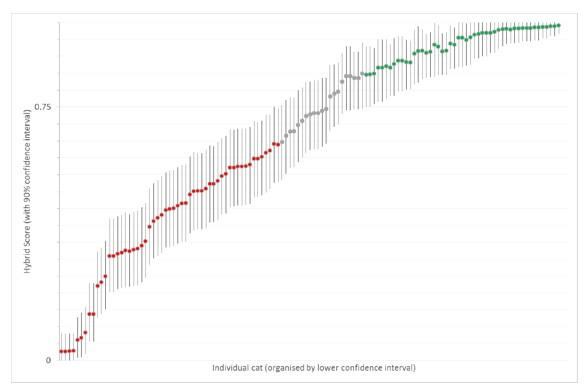
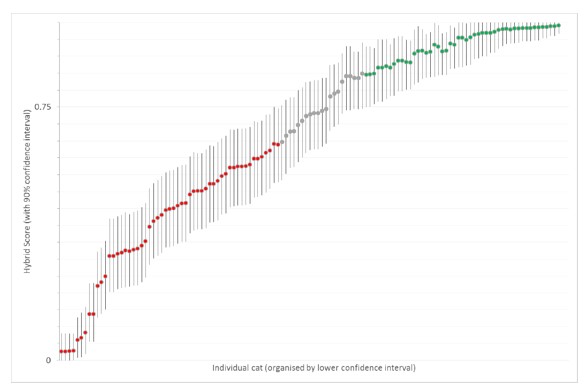
Fig. 2.7. Hybrid scores for individual cats from Scotland analysed at 35 loci in the test data set.
Click for a full description
View a larger version of this image.
- Cats are ordered along their scores on the x-axis.
- Points repre-sent the hybrid score of an individual cat.
- Lines repre-sent the 90% confidence interval.
- Cats in green are “Good wildcat”, cats in red are “Certain not good wild-cat”, cats in grey are “Cat of uncertain genetic status”.
Figure from Senn & Ogden 2015.
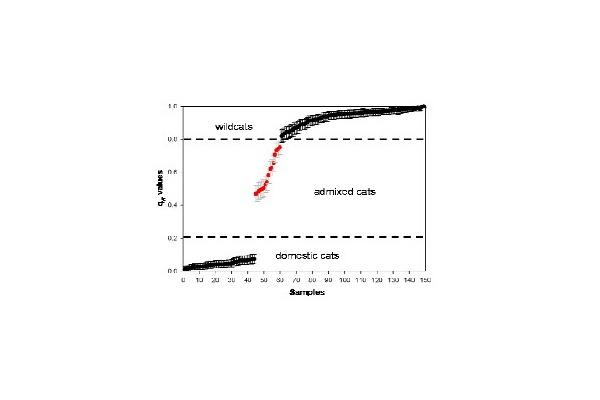
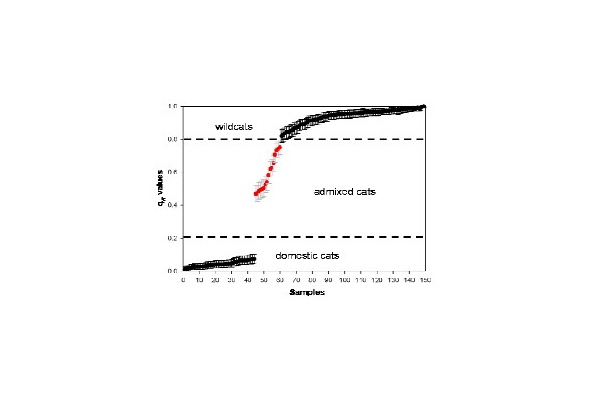
Fig. 2.8. Plot of individual qw values (to a wildcat cluster) and their 90% credibility intervals CI.
Click for a full description
View a larger version of this image.
The qi thresholds = 0.20-0.80 (interrupted lines) define the admixed geno-types. Pure wild and domestic cats from across Europe are in black, admixed individuals are in red. Figure from Mattucci (2014).
The extent of introgression in continental wildcat populations in Europe varies from “limited” in central and southern Europe to “widespread” in Scotland and Hungary (Mattucci 2014). Hybridisation is, for example, low in Germany, where only 3.5% are F1, F2, or backcrosses to either parental taxon (Steyer et al. 2018). Scotland is at the other extreme, where Senn & Ogden (2015) revealed that wild-living cats in Scotland nowadays show a hybrid swarm structure when analysed against reference data (Fig. 2.5.). In less introgressed populations, like for instance in Italy, the “wildcat” and “domestic cat” groups were clearly distinct (Fig. 2.6.; Mattucci 2014). The historic wildcat population in Scotland (museum specimens), although already hybridised, and the captive population of wildcats cluster at one end of the continuum are similar, whereas recent wild-living cats show a complete continuum, indicating an acceleration of hybridisation (Senn et al. 2018). The captive population was mainly founded with animals removed from the wild in the 1960s and 1970s.
Because of the hybrid swarm structure, a decision on a cutoff between wildcats and domestic cat types had to be taken for conservation action purposes (Senn & Ogden 2015). They proposed to choose cats with a 95%confidence of being better than a first generation backcross to wildcat, based on their genetic scores. A first generation backcross to wildcat is a cat where three of its four grandparents are wildcats and the fourth one is a domestic cat. They further investigated the relationship between pelage score and the hybrid score from genetics, to inform the selection of appropriate animals for a captive breeding programme. For each animal, where a good quality photo was available, a pelage score was estimated using the method of Kitchener et al. (2005). However, there was only a weak correspondence between the two types of markers. Beaumont et al. (2001) had drawn already a similar conclusion. According to Senn & Ogden (2015) the phenotypic traits in the wildcat are probably under the control of a small number of different genes, and in the situation of complex ancient hybridisation, small chunks of domestic cat genome enter the wildcat population carrying single genes that have a large effect on the phenotype. Because of this weak relationship Senn & Ogden (2015) developed a test where genetic and pelage traits are taken as independent lines of evidence and proposed a decision matrix. See also Senn et al. (2018).
For the identification of wildcats, hybrids and domestic cats the pelage scores are used: wildcats have a score of ≥17, hybrids 11-16.5 and domestic cats £ 10.5, respectively. Winter surveys were conducted in 2015/16, 2016/17 and 2017/18 in all five priority areas but not at the same time. Results revealed that only 20% of the specimens observed were wildcats, whereas 80% were hybrids or domestic cats at about the same proportion.
Legal status and listing
The wildcat is protected by national and international legislation. However, the legislation does not provide a list of criteria to differentiate wildcats from feral cats and hybrids (Macdonald et al. 2004). Since 1977, Felis silvestris has been included in Appendix II of CITES (UNEP-WCMC & CITES Secretariat 2018). The wildcat is listed on Annex IV of the EU Habitats Directive 92/43/EEC and listed in Appendix II of the Bern Convention as a “strictly protected fauna species” (Council of Europe 1979, EU 1992). The NCC wildcat survey from 1983-1987 led to the protection of the Scottish wildcat in Great Britain. It is listed as a protected species under UK law through the Conservation (Natural Habitat, & c.) Regulations of 1994 (amended in Scotland in 2004, 2007 and 2008; Kitchener 2012, Apostolico et al. 2016, Hetherington et al. 2016, legislation.gov.uk 2018). The wildcat is listed in Schedule 2 of these regulations as a “European protected species of animal” (Kitchener 2012). On 18 March 1988, the wildcat was added to Schedule 5 of the Wildlife and Countryside Act 1981 receiving full protection (Easterbee et al. 1991, Daniels 1997, Davis & Gray 2010, Kilshaw 2011, Silva et al. 2013a). “However, the Conservation (Natural Habitats, & c.) Amendment (Scotland) Regulations 2007 removed the wildcat from Schedule 5 of the Wildlife and Countryside Act 1981” (Kitchener 2012). Thus, it is only fully legally protected by the 1994 Act and following amendments (Kitchener 2012). The wildcat was also added to the revised UK Biodiversity Action Plan list of Priority Species, and Habitats in 2007, to the Scottish Biodiversity List (under the Nature Conservation (Scotland) Act 2004) as a species of principal importance for biodiversity conservation (Kilshaw 2011, Kitchener 2012, Sliva et al. 2013a). In 2007, SNH included the wildcat on the list of species for priority conservation action under the Species Action Framework because of its decline in distribution and abundance (Hetherington et al. 2016). The wildcat also became a key priority species of the Cairngorms Local Biodiversity Action Plan (Hetherington & Campell 2012).
Characteristics of the Scottish Wildcat
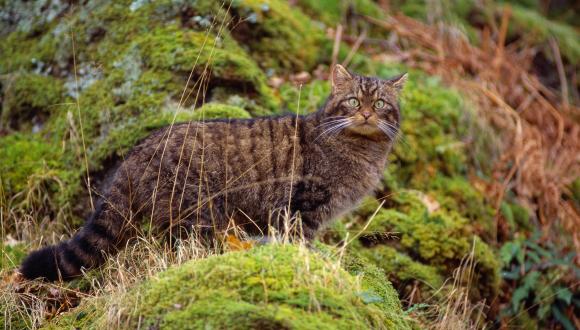
The wildcat has a yellowish-brown or greyish-brown to dark grey coloured fur with 7-11 dark brownish black body stripes (Fleming 1828, Taylor 1946, Kilshaw 2011). From nose to tail tip, the female wildcat in Scotland measures 73-89.5 cm and males 82.3-98.1 cm, respectively (Kilshaw 2011, Balharry & Daniels 1998). The tail is thickly furred, club-shaped, with 3-5 black rings, has a blunt black tip and a mean length of ~27cm (Fleming 1828, Anonymous 1987, Kilshaw 2011). Males weigh 3.3-7.26 kg, females 2.4-4.7 kg, respectively (Taylor 1946, Kilshaw 2011, Campbell 2015). Scottish wildcats can be distinguished from domestic cats based on their colouration and pelage markings, and dead specimens are distinguished by the relative length of the intestines and skull and mandible characters and biometrics (Table 2.2; Kitchener 1992, Kitchener et al. 2005, Kitchener & Daniels 2008).
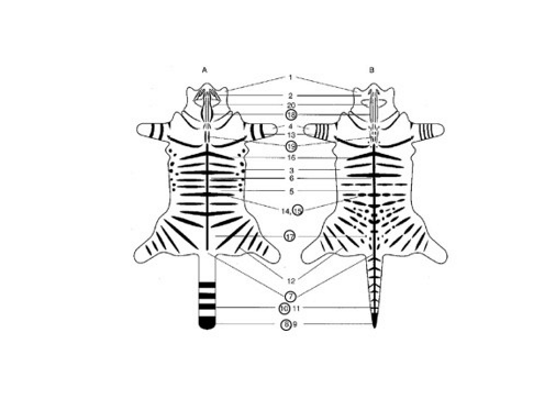
Kitchener et al. (2005) analysed the morphological differences between wild-living cats in Scotland based on 20 pelage characters combined with 40 skull parameters and the intestinal length. Wild-living cats were classified into three groups, with Group 1 cats furthest away from domestic cats, supposed to have little or no recent domestic cat ancestry. Seven of the 20 pelage characteristics were identified to significantly differentiate domestic cats and wildcats (Fig. 2.9., Table 2.3.). Kitchener et al. (2005) suggested using Group 1 to identify Scottish wildcats phenotypically, based on the identified seven key pelage characteristics. A strict scoring system for dead or immobilised cats (cats scoring 19 or more and with no score of 1 for any pelage characteristics), and a relaxed scoring system for field identification (cats with scores of 14 or more and with no score of 1 for any of the seven pelage characters) was suggested (Table 2.3), with the aim of identifying cats with a high proportion of wildcat characters, which may foster the restoration of the wildcat population (Daniels et al. 1998, Macdonald et al. 2004, Kitchener et al. 2005, Kilshaw et al. 2010, Macdonald et al. 2010). For (suspicious) hybrids fulfilling most of the pelage characteristics of a wildcat, genetic confirmation was advocated (Kilshaw et al. 2010).
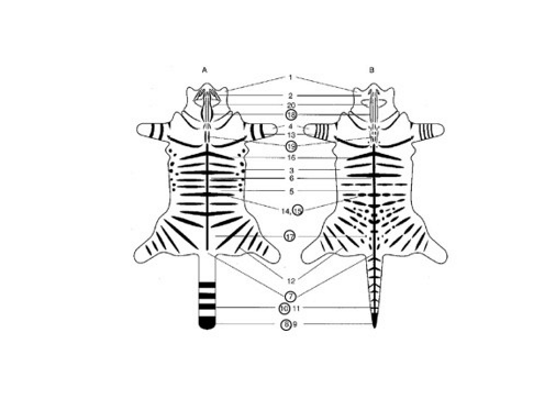
Fig. 2.9. Pelage characteristics to distinguish be-tween Scottish wildcats (A) and feral domestic tabby cats and wildcat x feral cat hybrids (B) (Kitchener et al. 2005).
Click for a full description
View a larger version of this image.
For each character a score of 3 is found in wildcats and 1 in domestic cats except for character 14 (Kitchener et al. 2005; Table 2.3). The seven key characteristics identified to differentiate wildcat and domestic cats are indicated with a black circle.
| Character | Score 1 | Score 2 | Score 3 |
|---|---|---|---|
| (1) White on chin | White extensive on muzzle | White on chin | Buff or off-white an chin |
| (2) Stripes on cheek | No dark stripes | Indistinct stripes | 3 clear stripes (2 fused) |
| (3) Dark spots underside | Absent | Indistinct | Distinct |
| (4) White on paw | White extensive on paw | White tuft on paw | No white on paw |
| (5) White on flank | Present | - | Absent |
| (6) White on back | Present | - | Absent |
| (7) Extent of dorsal line | Absent/covers entire tail | Continues onto tail | Stops at base of tail |
| (8) Shape of tail tip | Tapered to a point | intermediate | Blunt |
| (9) Colour of tail tip | Neither black nor dark | Dark | Black |
| (10) Distinctness of tail bands | Absent/joined by dorsal line | Indistinct or fused | Distinct |
| (11) Alignment of tail bands | Absent/not aligned | Disjointed | Aligned |
| (12)*Stripes on hind leg | < 4 or >7 stripes | - | 4-7 stripes |
| (13)*Bands encircling foreleg | <2 or >3 bands | - | 2 or 3 bands |
| (14) Tabby coat Patterns | Absent/not predominant | - | Predominant pattern |
| (15) Broken stripes on flanks & hindquarters | > 50% broken/no marking | 25-50% broken | <25% broken |
| (16)* Stripes on body | < 7 or > 11 unbroken stripes | - | 7-11 unbroken stripes |
| (17) Spots on flanks & hindquarters | Many/no marking | Some | None |
| (18) Stripes on nape | Thin/no stripes | Intermediate | 4 thick stripes |
| (19) Stripes on shoulder | Indistinct/no stripes | Intermediate | 2 thick stripes |
| (20) Colour of the back of ear | Same colour as head | Weak ochre/reddish | Ochre/reddish |
Prey selection
The preferred prey of the Scottish wildcat is the European rabbit, Oryctolagus cuniculus, notably an introduced species. Where rabbit population desitites are high, as in eastern Scotland, they can form up to 70% of the diet (Corbett 1979, Delahay et al. 1998, Kilshaw 2011). In western Scotland, where rabbit population densities are low, staple food is voles and mice (Delahay et al. 1998, Scott et al. 1993, Kilshaw 2011). Alternative prey species are birds, reptiles, invertebrates, fish and carrion (Hewson 1983, Corbett 1979, Kilshaw 2011). In Glen Tanar Estate, Aberdeenshire, wildcats mainly preyed on rabbits, especially young ones and those with myxomatosis. Rodents, shrews and birds were of less importance and gamebirds were only occasionally preyed on (Corbett 1979, Easterbee et al. 1991). However, in Drimnin estate, west Argyll, wildcats mainly preyed on rodents and birds (Hewson 1983). Balharry & Daniels (1998) found that small mammals (field voles, bank voles, wood mice and common shrews) were the most frequent prey species in Scotland, but considering biomass, lagomorphs were more important, followed by birds. There is little evidence for wildcat predation on lambs and roe deer fawns and it is considered to be uncommon (Fleming 1828, Easterbee et al. 1991, Balharry & Daniels 1998).
Habitat use and requirements
The main habitat requirements of the wildcat are shelter and prey availability (Easterbee et al. 1991, Kilshaw 2011). In Scotland, they inhabit conferous and broadleaved woodlands, grassland and scrub patches (Easterbee et al. 1991, Silva et al. 2013a). The wildcat is not primarily a forest animal, but forest is an important habitat for the wildcat (Campbell 2015). Woodland and dense gorse or juniper thickets are used for shelter and denning (Easterbee et al. 1991, Kilshaw 2011, SNH no date). Open areas are used for hunting, but woodland, scrub or stream edges are important for moving (Corbett 1979, Easterbee et al. 1991, Daniels 1997, Macdonald et al. 2004, SNH no date). In the east of Scotland, wildcats prefer margins of moorlands, pasturelands and woodlands, but in the west they are mainly found in uplands with rough grazing, moorlands with limited pastures and gorse bushland (Easterbee et al. 1991, Daniels 1997, Macdonald et al. 2004). Presence of European rabbit, high rodent diversity and the prevalence of large grassland areas are positively associated with wildcat occurrence (Silva et al. 2013a). Heterogeneous areas have higher prey diversity and abundance, and the presence of both rabbits and rodents may mitigate the effect of prey fluctuations (Silva et al. 2013a, b; Chapter 2.3.).
In contrast, areas with few grassland patches, secondary watercourses, heather moorland and higher elevations were associated with wildcat absence (Silva et al. 2013a, b). Easterbee et al. (1991) showed that wild-cats selected mosaics consisting of open fields and reforested patches, and Daniels (1997) found that in northeast Scotland, “wild-living” cats preferentially used woodland and stream edges and avoided open pasture and heather moorland. Corbett's (1979) study, also in the northeast of Scotland, found that Scottish wildcats preferentially used forested habitat, but avoided mature pine forests, and the study of Scott et al. (1993) in the west of Scotland reported that wildcats showed a preference for woodland and scrub habitat in relation to its availability within their home ranges. Wildcats are generally absent from areas of intensive cultivation (Easterbee et al. 1991), urbanised regions and human habitations (Kilshaw 2011, SWT 2011), although use of farm structures such as hay barns has been observed in various radiotracking studies, especially during winter months (Corbett 1979, Daniels 1997, Kilshaw unpub. data).
Scottish wildcats occur generally at low altitudes, usually not above 650 m, but may be found up to 800 m (Easterbee et al. 1991, Daniels 1997, Macdonald et al. 2004). Favourable environmental conditions for the wildcat are found at altitudes of 100-650 m with a rather cool climate (mean minimum annual temperature of -5-10 C°) and with low human population densities (<1 inhabitant/km2; Easterbee et al. 1991, Daniels 1997, Kilshaw et al. 2016). Industrial and urban infrastructures are considered barriers limiting the movement of the Scottish wildcat (Easterbee et al. 1991, JNCC 2007; Chapter 2.1, 2.3). However, wildcats may tolerate human disturbance through habituation. They can be found close to human settlements, possibly due to the proximity to lowland areas harbouring higher prey abundances or providing additional food sources (Sliva et al. 2013b). When the population density of wildcats is low, they may be attracted to feral cats and domestic cats living in the vicinity of human settlements during the mating season (Silva et al. 2013b). Less elevated areas with a connected mosaic of habitats (mix of woodland and grassland), abundant prey (rabbits and rodents(, shelter and dens should be priorities for conservation efforts (Silva et al. 2013a, Kilshaw et al. 2016, SWT no date).
Spatial ecology
Wildcats are solitary hunters and territorial using olfactory marks (scats, urine, and cheek rubbing) for marking and communication (Corbett 1979, Kilshaw 2011). Male home ranges overlap with the home range of one or more females, but female home ranges are exclusive (Corbett 1979, Macdonald et al. 2004). Home range size varies with habitat quality and prey availability (Easterbee et al. 1991, Corbett 1979, Daniels 1997, Scott et al. 1993). Where rabbit abundance is low and wildcats rely on small rodents, as on the west coast of Scotland, home ranges were found to be 8-18 km2 based on VHF radio tracking (Scott et al. 1993, Kilshaw 2011). Corbett (1979) found in northeast Scotland, where rabbit population density was high, home range sizes were c. 1.8 km2. Based on more recent GPS radio tracking studies, home ranges of wildcats were estimated at 15–25 km² (Campbell 2015, K. Kilshaw, unpub. data). Subadult male wildcats disperse further and faster than females, sometimes moving up to 55 km before settling down. They are able to travel more than 10 km per night (Hubbard et al. 1992, Scott et al. 1993).
Reproduction and demography
Rock cairns, large logging piles, clearfell, tree roots, fox dens, badger setts, fallen debris, hay barns or empty rabbit warrens are used as dens (Corbett 1979, Campbell 2015, Kilshaw 2011, Kilshaw unpub. data, SNH no date). Wildcats are sexually mature when they are approximately one year old (Kilshaw 2011). Wildcats usually mate and conceive in January to March and the litter is born in April to May (Matthews 1941, Kitchener 1995, SNH no date). If the first litter is lost early, females may have a second oestrus at the end of May or beginning of June (Matthews 1941, Daniels et al. 2002, SNH no date). Wildcats give birth to 1-8 kittens (average litter size: 3-4; Matthews 1941, Daniels et al., 2002, Macdonald et al. 2004, SNH no date). Young wildcats disperse at 5-6 months old (usually in September/October; Kitchener 1995, SNH no date). In Scotland, only 7% of wildcats live longer than 6 years in the wild. Maximum age for females was observed to be 10 years, and for males, 8 years (Balharry & Daniels 1998).
Phylogenetic and taxonomic characteristics
Taxonomy
The wildcat diverged from other felid branches around 6 million years ago (Macdonald et al. 2010). In the 18th century, the European wildcat Felis silvestris, the domestic cat Felis catus and the African wildcat Felis lybica were all considered separate species (Balharry & Daniels 1998). Ragni & Randi (1985) concluded, based on craniometric traits, that European wildcat, domestic cat and African wildcat belong to one polytypical species Felis silvestris. According to Driscoll (2011), the wildcat includes six subspecies: F. s. silvestris, F. s. lubica, A. s. cafra, F, s, ornata, F. s. bieti and F. s. catus. Kitchener et al. (2017) recognise in their revised taxonomy of the Felidae seven species in the genus Felis: F. bieti, F. catus, F. chaus, F. lybica, F. margariata, F. nigripes and F. silvestris. The wildcat occurring in Europe and Anatolia (F. silvestris) and the wildcat occurring in Africa and Asia (F. lybica) are classified as different species.
The wildcat in Scotland was originally described as a different species Felis grampia (Miller 1907), based on a cat specimen from Invermoriston (Balharry & Daniels 1998). Although the etymology of the name is nowhere explicitly stated, it is likely derived from the Scottish mountain range, the Grampian Mountains. Later on, the Scottish wildcat was classified as Felis silvestris grampia a subspecies of the European wildcat because of its darker colour and different stripes making them apparently distinct from the wildcat of central Europe, Felis silvestris silvestris (Miller 1912, Easterbee et al. 1991). However, pelage characteristics vary across European populations with a cline of distinctly striped animals in the west to faintly striped animals in the east (Kitchener et al. 2017). There is also individual variation among animals in Scotland. Therefore the justification for a separate subspecies is rather weak (Easterbee et al. 1991). Kitchener et al. (2017) suggested two subspecies of F. silvestris: F. s. silvestris distributed across Europe including Scotland, Sicily and Crete, and F. s. caucasica occurring in the Caucasus and Turkey. Thus, the Scottish wildcat is no longer recognised as a separate subspecies (Kitchener et al. 2017). Also according to Kilshaw et al. (2015), the wildcat in Scotland is a subpopulation of the European wildcat Felis silvestris silvestris.
Genetics of the wildcat in Scotland in comparison to the continental populations
Mitochondrial DNA
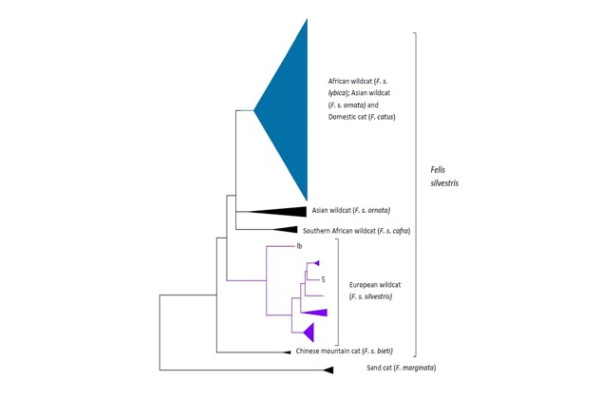
Neaves & Hollingsworth (2013) have re-analysed data collected by Driscoll et al. (2007) and generated a simplified neighbour-joining tree based on mtDNA (Fig. 2.10.). This tree shows the position of the wildcats in Scotland relatively close to other continental European wildcat populations. Driscoll et al. (2007) identified 5 haplotypes in the 43 samples from Scotland that were collected earlier by Balharry & Daniels (1998). They all belonged to Clade IV including Near Eastern and Central Asian wildcats as well as domestic cats (Driscoll et al. 2007), which indicates that these samples were probably largely from hybrids if not domestic cats. The findings of Balharry & Daviels (1998) were questioned earlier as there was the suspicion that they had collected only hybrids (Toms et al. 1999).
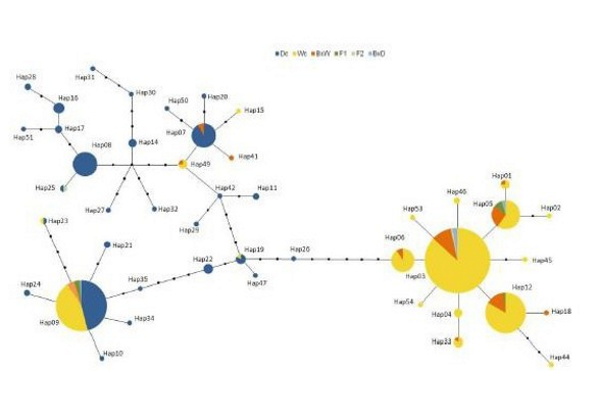
The relatively low number of haplotypes found in wildcats from Scotland probably reflects the isolation of the British wildcat population from continental Europe by rising sea levels approximately 7,000-9,000 years ago (Yalden 1999), but could also be the result of recent population decline and drift (A. Kitchener, pers. comm.). For comparison, Nussberger (2013) found in 400 samples from Switzerland, France and Germany 45 distinct haplotypes forming two clusters (Fig. 2.11.), based on two primer pairs of the control region yielding sequences of 350 bp and 200 bp, respectively. The two clusters can be attributed to domestic cats and wildcats, with 31 and 14 distinct haplotypes, respectively. Steyer et al. (2018) obtained a 110-bp sequence of the control region also using two primers and 1071 individual cats from Germany and Luxembourg. They found 19 haplotypes in domestic cats and 13 in wildcats.
Haplotype networks have been published for continental European populations (Nussberger 2013, Steyer et al. 2018), and are presently being investigated also for the wild living cats in Scotland allowing then a comparison with published European reference data.
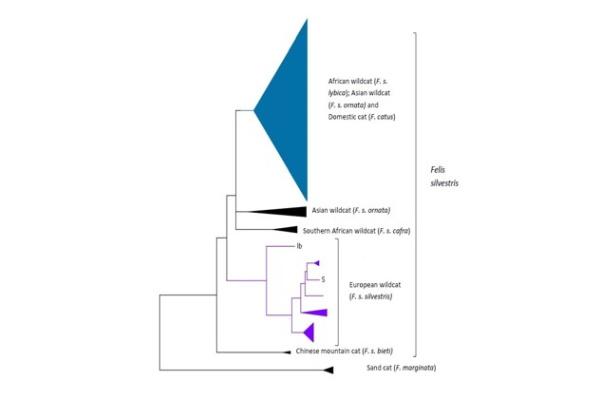
Fig. 2.10. Relationship between groups of wildcats and domestic cats based on mtDNA (from Driscoll et al. 2007).
Click for a full description
View a larger version of this image.
The genetic lineage containing the domestic cat is shown in blue, and the Scottish/European wild-cats are in purple.
S = Scottish wildcat, Ib = Iberian wildcats.
Not labelled European wildcats (purple) came from France, Germany, Luxembourg, and Hun-gary (Driscoll 2011).
Figure from Neaves & Hol-lingsworth (2013).
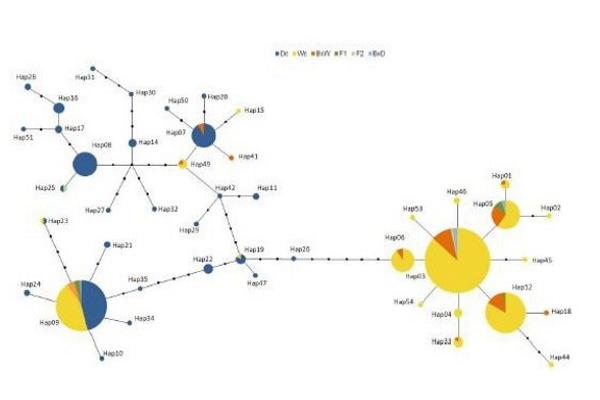
Fig. 2.11. Mitochondrial DNA haplotype network of wildcats (yellow), domestic cats (blue), and hybrids (other colours) from Switzerland, France and Germany.
Click for a full description
View a larger version of this image.
- Colours correspond to the six genealogical categories defined through auto-somal nuclear markers.
- Size of circles is proportional to the number of individuals observed.
- Each dot corresponds to one mutation.
Figure from Nussberger (2013).
Genetic variability
Beaumont et al. (2001) analysed 250 samples from wild-living cats in Scotland (including 13 museum skins) and 74 domestic cats from England and Scotland looking at 9 microsatellites. There was no difference between wild-living cats and domestic cats for expected heterozygosity (Hexp = 0.739 vs Hexp = 0.735) and number of alleles per locus (A = 10.9 vs A = 10.6).
Neaves & Hollingsworth (2013) distinguished between domestic cats, hybrids and wildcats, and calculated genetic diversity based on 9 microsatellites for the three groups and the strict and relaxed pelage classification according to Kitchener et al. (2005). They used samples collected by Balharry & Daniels (1998) across Scotland between 1960 and 1994. For the strict classification criteria, wildcats had lower expected heterozygosity and number of alleles than hybrids and domestic cats (Heterozygosity: Hexp wildcat = 0.61 versus Hexp hybrids = 0.72 and Hexp domestic = 0.75; number of alleles: A wildcat = 2.67 vs A hybrids = 9.22 and A domestic = 10.44).
However, the sample size for wildcats was only n = 8, whereas for hybrids and domestic cats the sample size was much larger (n = 93 and n = 91, respectively). For the relaxed classification, the expected heterozy-gosity rose to Hexp = 0.67, the number of alleles to A = 5.33 and the sample size to n = 26 (Neaves & Hollingsworth 2013). For the other two groups the values were similar for both scenarios.
Oliveira et al. (2008) analysed 72 wildcats and 109 domestic cats from various parts of Portugal and Spain with 12 microsatellites. Expected heterozygosity was 0.759 ± 0.025 for wildcats in Portugal, 0.707 ± 0.035 for wildcats in Spain and 0.771 ± 0.028 for domestic cats, respectively, with a mean of 5.25 alleles per locus. Mattucci et al. (2015) used 31 microsatellites to analyse 1218 samples of wildcats from 15 European countries and 293 domestic cats. Expected heterozygosity was 0.73 ± 0 .19 (14.2 alleles/locus) for the wildcats and 0.79 ± 0.09 (15.3 alleles/locus) for domestic cats, respectively. This comparison suggests that both heterozygosity and number of alleles are lower in wildcats from Scotland than from the continent, although it is difficult to compare the studies due to differences in the methods (Neaves & Hollingworth 2013). It would be very valuable to compare wildcats from Scotland with those from Continental European populations under a standardised approach.
Wildcats in Scotland had already lower genetic variability based on samples collected 25 to almost 60 years ago compared to wildcats from continental Europe assessed recently. With an estimated population size of as low as 115–130 (Kilshaw 2015) or 200 (95% CI = 30–430; Mathews et al. 2018), continuing hybridisation (Senn & Ogden 2015, Senn et al. 2018) and long-term isolation, it should be expected that the genetic variability may even be lower today.
Recent conservation initiatives and projects
Conservation planning and initial projects
The dawn of contemporary efforts to conserve the wildcat in Scotland was the extensive survey by the NCC from 1983–1987 (Chapter 2.1), published by Easterbee et al. (1991). But it took another 13 years until the first comprehensive analysis and action plan was published (Macdonald et al. 2004).
The Scottish Wildcat: Analyses for Conservation and Action Plan 2004
The report 'The Scottish Wildcat: Analyses for Conservation and an Action Plan' (Macdonald et al. 2004) provided an overview of the status, natural history and threats to the wildcat in Scotland, and presented recommendations for conservation actions. Hybridisation and persecution were identified as the main threats to the wildcat in Scotland. The authors concluded that the protection of individuals with classical wildcat pelage may not be sufficient to conserve and restore wildcat populations in Scotland. A major conclusion of their work was that it would be “helpful to separate the question of how individual specimens are defined and diagnosed as wildcats under the law from the question of how wildcats may most effectively be conserved and their populations restored.” They proposed a “two-tier system whereby individual cats are defined (and thus legally protected) on the basis of classical pelage, but whereby the viability of their populations is secured through a series of management actions” (Macdonald et al. 2004). The recommended measures included:
- Definitions for conservation and legal protection
- Strengths of pelage as a defining characteristic: Cats with a classical wildtype pelage should be defined as wildcats for the purpose of legal protection.
- Weaknesses of pelage as a defining characteristic: Some cats failing the classical pelage test may be equally genetically similar to pre-Iron Age wildcats than the ones which pass the test. The conservation of the wildcat should not only include its protection on the basis of pelage alone, but also include zoned protection and selective removal of domestic cat genes.
- Regional zonation: Research should be focused on zones, so called Special Areas for Wildcat Conservation (SAWC), which contain the highest number of non-domestic genes and phenotypes.
- Selective removal and derogations from protection: Some phenotypes should be selectively removed to accelerate and enhance directional selection towards classical pelage.
- Staunching the flow: The flow of domestic cat genes into the wild-living cat population should be stopped.
- An integrated approach
- Control of “feral” cats and responsible ownership of domestic cats: Measures could range from banning the keeping of domestic cats to encouraging or prescribing neutering as well as vaccinating against common domestic cat diseases. A control programme for feral cats in and around SAWCs.
- Education and the “will to protect”: Promotion of the educational message that the wildcat is a part of the British Heritage.
- Habitat “protection” and the wider context: In a habitat protection plan for the wildcat forestry, habitat corridors and ways to crossing busy roads should be included. A mixed-age, mixed-species forest is needed.
- Captive breeding and reintroduction: A reintroduction programme is recommended when all other options have been explored. A studbook should be established and the breeding of wildcats be managed.
- Monitoring: The use of roadkill data and questionnaire surveys are recommended to systematically monitor the wildcat. An exploratory study using camera traps and molecular scatology should be conducted.
- Some research priorities:
- How can wild-living cats, and especially wildcats, be surveyed and monitored?
- Can further molecular marker(s) be identified that would assist in distinguishing wildcats from other wild-living cats?
- Can variation in hair characteristics further inform the diagnosis of hybrids and shed light on whether wildcats are at a selective advantage over domestic cats and hybrids?
- How effectively can wildcat pelage be distinguished in the field?
- How serious is the impact of wildcats and wild-living cats on game-management?
- What are the risk factors for domestic cat genes entering the wild-living cat population?
- What management procedures most effectively foster the restoration of Scottish wildcat populations?
- Recommended actions and legislative changes
- To conduct a public information campaign and inform stakeholders about the status and value of the wildcat and the steps needed to conserve the species;
- To provide a clear definition for a wildcat to ensure its effective protection, as the legislation did not yet provide a list of criteria to differentiate wildcats from feral cats and hybrids;
- To add the wildcat to the list of Priority Biodiversity Action Plan species;
- To establish “a system of regional zonation, based on the designation of areas with variable probabilities of containing cats of a certain type, which should be used as a framework within which specific conservation actions could be targeted”;
- To agree on a Code of Practice for Wildcat Conservation;
- To identify SAWCs, based on the frequencies of occurrence of furthest from domestic cats to conserve the genes most likely representative of pre-Iron Age wildcats from Scotland;
- To reduce hybridisation and contact between domestic and wild-living cats;
- To apply non-lethal cat control (except removal of cats not meeting criteria) in SAWCs;
- To work with veterinarians in SAWCs including proactive and free neutering of domestic cats for cat owners, and an information leaflet for responsible cat ownership to prevent hybridisation and disease transmission;
- To work with game-managers within SAWCs and develop non-lethal control methods;
- To develop and implement a regular monitoring programme to assess effectiveness of conservation actions;
- To not conduct reintroduction at present, but to conduct a feasibility study;
- To encourage the stud book for the Scottish wildcat and carefully manage captive individuals.
The “Scottish Wildcat: Analyses for Conservation and Action Plan” by Macdonald et al. (2004), was never directly implemented, but strongly informed the subsequent research, planning and practical activities to conserve the wildcat in Scotland, and most of the reccommendations were taken up in the subsequent projects and initiatives.
Species Action Framework 2007- 2012
The Species Action Framework (SAF) was created in response to the 2004 Scottish Biodiversity Strategy, launched in 2007 by the Government and coordinated by SNH (Gaywood et al. 2016). The SAF “set out a Wildcat in Scotland – Review of Conservation Status and Activities 26 strategic approach to species management in Scotland, together with a list of 32 species (including the Scottish wildcat) for which new, focused effort and resources over five years (2007-2012) could make the most difference for biodiversity” (Gaywood et al. 2016). For the wildcat, five actions were identified at the beginning of the SAF:
- Provide a robust dataset to clarify the distribution of the Scottish wildcat;
- Identify potential wildcat strongholds for conservation action;
- Improve guidance on methods to improve habitat management in potential wildcat areas to encourage a sustainable population;
- Initiate a programme of wildcat conservation measures to reduce the threat from hybridisation;
- Raise awareness of the status of the wildcat and establish appropriate partnerships to support coordinated management action for its conservation.
The work funded by SAF comprised three objectives:
- Identification of the Scottish wildcat and the development of a practical guide for identifying wildcats: SNH commissioned the Wildlife Conservation Research Unit of the University of Oxford (WildCRU) to examine the association between morphological and genetic characteristics of the wildcat in Scotland. Kilshaw et al. (2010) concluded that at least 70% of the specimens collected from free-living populations and held in museum collections were wildcat-domestic cat hybrids or were domestic cats. Based on pelage patterns, three groups of cats were identified (wildcats, domestic cats and hybrids), which could also be distinguished by genetics. Kilshaw et al. (2010) concluded that the pelage characteristics defined by Kitchener et al. (2005) were sufficient to identify wildcat individuals that were genetically different from domestic cats.
- Development of survey field methods using camera traps and a detailed survey protocol: Camera trapping was tested in the Cairngorms National Park (CNP) in parts of the Seafield Estate and Strathspey, North East Scotland, where predator control was still applied (Kilshaw & Macdonald 2011). Wildcats captured on camera-trap photographs were identified based on the key pelage characters identified by Kitchener et al. (2005). All cats with a score of 14 and with no score of 1 were considered to be wildcats. Out of 13 individually identified wild-living cats, 4 were classified as wildcats, 9 as hybrids and none as feral cats (Kilshaw & Macdonald 2011). Camera trapping was found to be an effective method for monitoring wildcats (Kilshaw & Macdonald 2011).
- Development of a project to secure the future of the wildcat in the Cairngorms area: Based on the wildcat survey of 20062008, the Cairngorms National Park was considered a good place to test the protocols and practical conservation actions for the wildcat ( Chapter 2.2; Hetherington et al. 2016; see below for more details).
Cairngorms Wildcat Project
The Cairngorms Wildcat Project (CWP) was conducted in the CNP from 2009–2012 and largely funded by SNH under SAF, with additional resources from RZSS and others. The project was informed by a stakeholder conference in 2008 and a partnership of the CNP Authority, SNH, Royal Zoological Society of Scotland (RZSS), Scottish Gamekeepers Association (SGA) and Forestry Commission Scotland (FCS; Hetherington & Campbell 2012, Hetherington et al. 2016). It was a practical trial of targeted conservation actions for the wildcat aimed at securing its future within the CNP. The main objectives, activities and achievements were:
1. Raising awareness of wildcats and their conservation
To raise awareness of the wildcat at the local and wider public level, and public engagement were considered to be crucial for the success of any wildcat conservation project (Hetherington & Campbell 2012, Hetherington et al. 2016). The CWP established a website for up-to-date information about the project and for collecting sighting records. A Facebook page and a YouTube channel were installed and the brand “Highland Tiger” created to raise awareness. The CWP team produced promotional materials, offered educational talks in schools and gave presentations to key audiences (veterinaries, farmers, local cat welfare groups and gamekeepers; Hetherington & Campbell 2012). The awareness of the wildcat increased and the engagement of the public was successful. The “Highland Tiger Fund” received donations of £48,000 (Hetherington & Campbell 2012, SNH 2013, Hetherington et al. 2016).
2. Neutering domestic cats
Special attention was given to domestic cat owners and gamekeepers. The CWP cooperated with the cat welfare charity “Cats Protection” and with the local veterinary community to coordinate the promotion and delivery of neutering and vaccination of pet and feral domestic cats in CNP, in order to lower the risk of hybridisation with and disease transmission to wildcats (Hetherington & Campbell 2012, Hetherington et al. 2016). Feral cats were trapped, neutered and released to the wild (so called TNR approach). A leaflet was produced promoting responsible cat ownership. The CWP cooperated with gamekeepers to establish a practical wildcat-friendly predator control protocol to minimise the risk of harming wildcats, and distributed identification cards for distinguishing wildcats from feral cats (Hetherington & Campbell 2012, Fredriksen 2015). CWP encouraged gamekeepers to use live cage traps for feral cat control rather than snaring or night shooting based on eye-shine (Hetherington & Campbell 2012). Feral cat management was supported by trained Cats Protection volunteers applying TNR within the CNP, and neutering and vaccinating pet and feral domestic cats was promoted through the engagement with local veterinaries and Cats Protection (Hetherington & Campbell 2012, Hetherington et al. 2016). From 20052011 some 7,560 feral and domestic cats were neutered at seven Cairngorms veterinary practices covering parts of the CNP. The neutering of 3,180 cats at these veterinary practices was funded by Cats Protection (Hetherington & Campbell 2012). However, as the number of unneutered cats, as well as the extent of interactions between feral and wildcats in the CNP are unknown, the benefits of TNR cannot be assessed. Nevertheless, there is potential for TNR to continue to be more targeted and to contribute more to wildcat conservation with an increased understanding of wildcat populations (Hetherington & Campbell 2012). TNR depends on the volunteers, which have to be coordinated, trained, motivated and resourced.
3. Working with estates
The collaboration with estates was successful and an effective partnership between conservation and land management interests and with the SGA was built (Hetherington & Campbell 2012, SNH 2013). Improved understanding of wildcat identification among gamekeepers led to the application of more wildcat-friendly control practices of feral cats. The protocol for wildcat-friendly management was promoted by the SGA and adopted locally by gamekeepers. Moreover, a wildcat-friendly predator control option in Wildcat Priority Areas (PA) was created for the Scottish Rural Development Programme (Hetherington & Campbell 2012, Hetherington et al. 2016). However, indiscriminate spotlight shooting (lamping) for controlling feral cats was still applied (Hetherington & Campbell 2012).
4. Researching and monitoring wildcats
Intensive and opportunistic camera trapping was conducted for monitoring wildcats in the CNP, direct sighting reports compiled, and (wild)cat carcasses collected (Hetherington & Campbell 2012). The intensive camera trap study was conducted repeatedly in the five target estates, following the protocol of Kilshaw & Wildcat in Scotland – Review of Conservation Status and Activities 28 Macdonald (2011). Information on feral cat control activities and cat records was collected from the same estates (Hetherington & Campbell 2012). Knowledge about distribution, occurrence and hybridisation of wildcats in the CNP was enhanced and the value of camera trapping to monitor wildcats and hybridisation was demonstrated (Hetherington & Campbell 2012, Hetherington et al. 2016). The extent of hybridisation was found to be high. Camera trapping revealed that wildcats occurred at low numbers in the west (likely reflecting lower prey abundance; A. Kitchener, pers. comm.), but were absent in the east of the CNP. This difference in wildcat occurrence was possibly due to different land and wildlife management practices in the past. The eastern estates were more managed for red grouse hunting and there was hence more intensive predator control.
Hetherington & Campbell (2012) considered the conservation success of the CWP difficult to assess due to the short duration of the camera-trap study. Collaboration between estates, farmers and Cats Protection TNR branches was recommended to be continued, as well as public awareness-raising on wildcat conservation, including targeted information on domestic cat management in the agricultural sector by Cats Protection and vets (Hetherington & Campbell 2012). A closer connection with the agricultural sector could help in identifying incentives for farmers to ensure responsible cat ownership. The effectiveness of the TNR method should be (quantitatively) evaluated, the TNR programme expanded and wildcat-friendly predator control be more widely encouraged (Hetherington et al. 2016). Intensive camera-trap monitoring, possibly in connection with genetic sampling, could be expanded to other areas, guidance on best practice for camera trapping wildcats should be made more widely available and reported wildcat records should be verified (Hetherington & Campbell 2012).
The CWP enhanced the awareness of the wildcat in Scotland locally and nationally, and provided useful feedback on resources required for wildcat management. According to Hetherington et al. (2016) the CWP “… directly contributed to the development and resourcing of ongoing action under Scottish Wildcat Action…”.
Scottish Wildcat Action
Scottish Wildcat Action (SWA) is led by Scottish Natural Heritage. The project is funded by a range of sources including the Scottish Government, the Heritage Lottery Fund Scotland, SNH, RZSS and other partners. The SWA is the major project implementing the Scottish Wildcat Conservation Action Plan (Hetherington et al. 2016).
Scottish Wildcat Conservation Action Plan
Following from the SAF, an updated strategy, the Scottish Wildcat Conservation Action Plan (SWCAP; SNH 2013), coordinated by SNH and directed by the Scottish Wildcat Conservation Action Plan Steering Group (SWCAPSG) was developed and launched by SNH and its partners in 2013 (Hetherington & Campbell 2012, Hetherington et al. 2016). The SWCAP was agreed by the main organisations and individuals included in wildcat work. The plan will be updated periodically (SNH 2013).
The long-term vision of the SWCAP is “to restore viable populations of Scottish wildcats north of the highland boundary fault line". The Plan aims to halt the decline of the Scottish wildcat within six years through the implecation of conservation action (SNH 2013). Assumptions underlying the SWCAP are that wildcat populations are present and can morphologically be identified. It seeks “to protect a distinct group of cats that look like wildcats, but may not all be genetically pure wildcats” (SNH 2013). Main objectives are (1) to identify at least five wildcat conservation Priority Areas. (2) to further develop conservation work in these areas, and (3) to continue working on the creation of a wider conservation programme (Table 3.1; SNH 2013). By 2019 the SWCAP wants to:
- Secure at least five stable populations of Scottish wildcat in the wild;
- Improve the understanding of wildcat status, distribution, numbers, genetics and extent of hybridisation;
- Increase local awareness of threats posed by hybrids, feral and domestic cats to wildcats;
- Encourage widely implemented responsible domestic cat ownership in PAs promoted throughout the Highlands;
- Reduce the risk of accidental persecution;
- Have a better understanding of factors affecting wildcats and how land management can benefit population viability (SNH 2013).
The SWCAP was presented in the form of a Logical Framework, summarised in Table 3.1. First actions planned by the SWCAPSG were to conduct further surveys for the definition of PAs for wildcat conservation, to investigate the extent of hybridisation and the threats from feral cats and hybrids with regard to a better understanding of the genetic composition of the remnant populations, to create management protocols for feral cat and hybrid control in the PAs, to evaluate the status of Scottish wildcats in captivity and the requirements for a captive breeding programme, and to establish guidelines to avoid negative impacts on wildcats by forestry operations and development projects (SNH 2013).
The SWCAP is implemented by the Scottish Wildcat Action (SWA), a partnership of 26 key partners and funders (Scottish Wildcat Action, 20.7.2018; Appendix I). The SWA consists of a Steering Group, a Steering Group Chair, a Priorities Area Project Manager, a Communication Co-ordinator and three Project Officers responsible for the management and implementation of conservation actions in delineated PAs (Fig. 3.2). There is also a Cat Conservation Officer based at, and managed by, the RZSS (equivalent to a project officer). Much of the SWA work builds on the experience from CWP (Hetherington et al. 2016).
To implement the SWCAP, SWA focusses on five PAs (Fig. 3.1), where it works with local people and in particular with land managers, veterinarians and volunteers to reduce the risks of hybridisation, disease and accidental persecution. The SWA started with six PAs but Strathavon was given up as no wildcats were detected in this PA. SWA aims to make these PAs a safe place for wildcats by reducing threats by applying a Trap-Neuter-(Vaccinate)-Release (TNVR) programme to feral cats and by encouraging cat owners to neuter and vaccinate pet cats, thus appealing for responsible cat ownership (SWA 2016). To identify wildcats in the field situation, the SWA uses the classical pelage scoring method of Kitchener et al. (2005) with a cut off score of 17. The SWA also engages with land managers to improve land management practices to support wildcat conservation, and conducts intensive camera-trap surveys (SPICe no date). The situation of wildcats in all PAs was assessed through camera-trap surveys before implementing TNVR (SWA 2016). Camera trapping is continuing to identify any changes in cat activity and to estimate wildcat, feral cat and hybrid numbers (SWA 2016). The SWA furthermore compiles chance sightings of wildcats, feral cats or hybrids through the project’s website. Activities and achievements of SWA with regard to the implementation of the SWCAP are summarised in detail in Table 3.1.
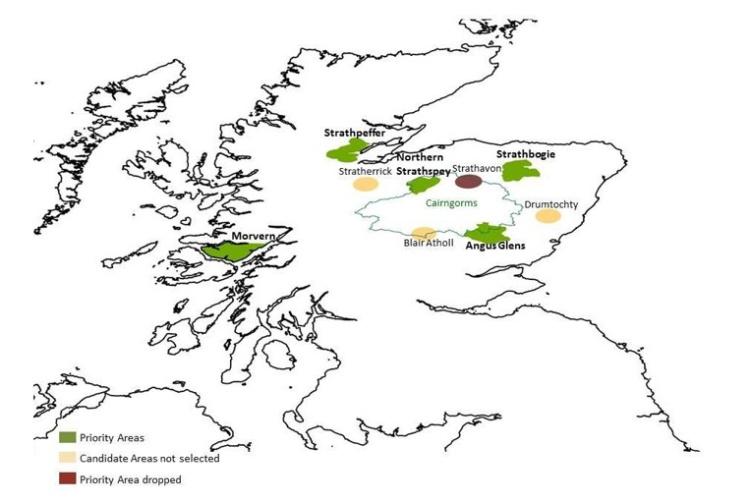
Fig. 3.1. Scottish Wildcat Priority Areas where most of the work of the SWA takes place: Morvern, Strathpeffer, Northern Strathspey, Strathbogie and Angus Glens.
Click for a full description
View a larger version of this image.
Work at Strathavon was stopped as no wildcats were detected (Scottish Wildcat Action 07.08.2018).
Table 3.1. Objectives, Projects, Actions (as presented in the SWCAP; SNH 2013), achievements and milestones of the SWA as evaluated by the SWCAP Steering Group. The main source for the table was an Excel spreadsheet based on the SWCAP LogFrame showing the work and achievements until May 2017, provided by the SWCAP Steering Group. More recent updates on activities conducted and achievements reached provided by the SWCAP Steering Group members until December 2018 were included and the progress of each Action re-evaluated by ourselves applying the categories of the SWCAP Steering Group.
- Completed,
- Work ongoing - significant progress made but not complete yet,
- Work ongoing - progress made, but significant amount of work still to be done,
- Dark orange = limited work so far – the majority of work still to be done.
The leading and partner institutions for each Action are listed in the Logical Framework of the SWCAP (SNH 2013).
Abbreviations:
- BRC = Biological Records Centre,
- CRRU = Campaign for Responsible Rodenticide Use,
- ddRAD = double digest RAD sequencing,
- HFW = Highland Foundation for Wildlife,
- HLF = Heritage Lottery Fund,
- HWP = Highland Wildlife Park,
- NBN = National Biodiversity Network,
- NFUS = National Farmers Union Scotland,
- PTES = People’s Trust for Endangered Species,
- SGA = Scottish Gamekeepers Association,
- SGP = Sharing Good Practice,
- SRDP = Scottish Rural Development Programme.
| Objectives/Projects/Actions | Conducted work and achievements |
|---|---|
1.1.1 Carry out surveys to establish the status of contemporary populations of wildcats, feral cats and hybrids using appropriate techniques. (COMPLETED) | Completed in August 2014. Littlewood et al. (2014) conducted camera trapping, genetic analysis of scats and tissue samples and a questionnaire survey of the attitudes of key stakeholders with regard to wildcat conservation in nine candidate areas (Angus Glens, Dulnain, Morvern, Strathavon, Sthrathbogie, Strathpeffer, Stratherrick, Blair Atholl, Drumpchty). |
1.1.2 Identify PAs for wildcat conservation based on survey results. PAs should take account of all cat populations, population viability and defendability. (COMPLETED) | Completed in August 2014. Based on the study of Littlewood et al. (2014), including wildcat records and habitat quality, the SWA identified 6 (Angus Glens, Dulnain (Northern Strathspey), Morvern, Strathavon, Strathbogie and Strathpeffer) PAs. In 2017, Strathavon was removed as a PA as no wildcat evidence was recorded (Steering Group 2017a). |
| Objectives/Projects/Actions | Conducted work and achievements |
|---|---|
2.1.1 Agree a wildcat-friendly protocol including an identification key and the use of cage traps. (COMPLETED) | Completed. |
2.1.2 Ensure the wildcat-friendly protocol is incorporated in relevant training/liaison with keepers/rangers in PAs. (Work ongoing - progress made, but significant amount of work still to be done.) | SNH and SWA are involved in the design of game management courses. Protocols were promoted by articles in magazines highlighting the need for restraint in lethal control in PAs and by requests to monitor trapping and snaring. In some PAs control methods were replaced by live trapping. In all SGA training, members are made aware of wildcats. SGA members are encouraged to pass on records of potential wildcats and feral cats in PAs. Land owners applying Scottish wildcat-friendly predator control can get financial support (Scottish Government 2015). Quarterly statistics on the number of estates committed to wildcat friendly preditor control are produced. |
2.1.3 Work with estates and provide resources to promote the protocol in PAs e.g. identification cards and cage traps. (Work ongoing - progress made, but significant amount of work still to be done.) | A new version of the wildcat ID cards, created by CWP, was released (Steering Group 2017a). 1,000 ID cards were printed and are still distributed. SGA promotes the protocol at shows and events, distributes ID cards and posted them on their Facebook and web sites. Funding for cage traps for estates is still needed and discussions with HLF over funding of cage traps for estates is continuing. SRDP is unlikely to be a good source of funding for traps for estates. Landowner engagement was high with most estates willing to work with the project on some level. However, landowners do not necessarily allow TNVR and game bird estates conduct lethal cat control in form of lamping and/or use of infrared scopes (with a higher risk of accidentally shooting wildcats). Until May 2017, 36 estates participated in some form with the project (Steering Group 2016a, 2017a, b, c, d). The number of SRDP estates interested in wildcat-friendly measures was 1-2 over the whole project period to date (Steering Group 2016a, 2017a, b, c, d). |
2.1.4 Work with estates to collate information on feral cats trapped; pelage and disease. (Work ongoing - progress made, but significant amount of work still to be done.) | Originally it was hoped to report these via SRDP, but there has been no take-up. May be sensitivity over direct provision of data by estates. SGA has used Facebook and website to ask estate/keepers/rangers for records of caught or dispatched feral cats. From 2016 to end of 2017 only 3 of all participating estates provided data on cats (Steering Group 2016a, 2017a, b, c, d). Most estates do not have good cat records and it is difficult to get any records (Steering Group 2017c). Quarterly statistics for the number of estates providing data are produced. |
| Objectives/Projects/Actions | Conducted work and achievements |
|---|---|
2.2.1 Avoid creating artificial food sources for feral cats. Including: proper storage of foodstuffs, advice on mice and rat control and avoiding secondary poisoning. (Work ongoing - progress made, but significant amount of work still to be done.) | This task was planned to be conducted by the new land management subgroup (Steering Group 2017c). A student placement study involving survey of land managers has been conducted and is nearly finished (Steering Group 2017a). Farmers require training on poison use, wildcat issues could be incorporated. Potential for SWA PA staff to develop relevant guidance material specifically targeted at farmers. NFUS can help distribute material through membership newsletter and organising NFUS Branch talks in PAs. The CRRU rodenticide code has been published, which increased awareness of rodenticide best practice in farming community. Three articles were published in farming press. |
2.2.2 Highlight the risks of toxoplasmosis to livestock from feral cats. (Work ongoing - progress made, but significant amount of work still to be done.) | Student study nearly finished. Potential for SWA PA staff to develop relevant guidance material specifically targeted at farmers. NFUS will help distribute guidance material through its membership newsletters, help organise NFUS Branch talks in PAs by SWA staff etc. three articles were published in the farming press. |
2.2.3. Produce guidance on land management that will benefit wildcats. (Work ongoing - progress made, but significant amount of work still to be done.) | Student study nearly finished. Some trials may be useful at some point, equivalent to those on forestry as described in 2.3.2. Potential for SWA PA staff and partners to develop relevant guidance material for farmers, gamekeepers and others, probably towards end of the project 2019–2020. NFUS recognises the value of some agricultural areas for wildcats, will help distribute material and organise NFUS Branch talks in PAs by SWA staff etc. |
| Objectives/Projects/Actions | Conducted work and achievements |
|---|---|
2.3.1 Revise and promote FCS guidance on forestry operations and wildcats (including habitat management for wildcats). (Work ongoing - progress made, but significant amount of work still to be done.) | The FCS guidance was reviewed. Relevant information on wildcats is already provided in FCS guidance. Discussions are underway to look at developing more refined guidance for specific wildcat 'hotspots' within PAs. SWA PA staff have run training sessions with relevant forest conservancies. The topic was also covered at the SGP wildcat event in February 2017. Currently, a “Forestry and wildcats project” is being developed, allowing reporting and assessing all work done with regard to wildcat-friendly forestry practice. |
2.3.2 Carry out trials of a limited range of habitat management measures on the National Forest Estate, e.g. assess the benefits of extended fallow periods on restock sites, creation of brash piles and artificail den sites. (Work ongoing - progress made, but significant amount of work still to be done.) | 24 artificial dens created by end of 2016 and 24 brash piles by end of 2017, but no evidence of use to date. Around 20 dens were created in Angus Glens. 10 den boxes (as Culbin design) have been set up in forests in Moray. Cameras were placed in winter 2018/19 at artificial den sites in Angus Glens to evaluate their use. Den use has not been fully assessed yet, but advice on camera trap setting for monitoring has been provided by SWA PA staff (Steering Group 2017a). Measures should be included in land management guidance. The benefits of ‘extended fallow periods’ has not been assessed, but it has been questioned whether this is needed. The FES has carried out vole surveys in forestry areas and is currently carrying out more detailed vole survey in Clashindarroch. |
| Objectives/Projects/Actions | Conducted work and achievements |
|---|---|
2.4.1 Produce a protocol for an effective TNR programme. Operating guidance and contacts. (COMPLETED) | Completed in May 2014. TNR protocol was agreed with Cats Protection (Steering Group 2015a). Captured cats with a pelage score of 17 or more can be again released under SNH license. In PAs currently no cats are euthanised by SWA except due to welfare reasons. |
2.4.2 Promote reporting of feral cats to Cats Protection or local vets by farmers and crofters. (Work ongoing - significant progress made but not complete yet) | Records of feral cats outside PAs reported to SWA are forwarded to Cats Protection. Records within PAs are picked up by SWA project officers. NFUS will help disseminate information. Quarterly statistics for TNR are produced. |
2.4.3 Support local volunteer groups to carry out TNR. (Work ongoing - significant progress made but not complete yet) | Main TNVR programme started in autumn 2016 and continued to end of March 2018 (Rawling 2017, 2018). Volunteer work is carefully coordinated and targeted. Contractors were selected for work in the more remote Angus Glens PA and Morvern PA. TNVR training was provided for project staff and leaflets on TNVR were produced and distributed (Steering Group 2016b, 2017a). The TNVR programme is explained and an identification key for cats provided on the SWA website (Scottish Wildcat Action, 27.06.2018). The TNR work in PAs was possibly not enough to stop the addition of feral cats to the wild-living cat populations. Quarterly statistics for TNR are produced. |
| Objectives/Projects/Actions | Conducted work and achievements |
|---|---|
2.5.1 Targeted public awareness within PAs (cat health and neutering). (Work ongoing - significant progress made but not complete yet) | Continuing task within PAs. Projects officers and staff use opportunities to increase public awareness via local media, social media, newsletters, talks/presentations, one-to-one discussions etc., and the Responsible Cat Ownership 'Supercat' campaign was launched (® Action 3.8.1). SWA provided so far 11 free neutering and vaccination vouchers for cat owners living in PAs, financial help for micro-chipping and a list of vets in PAs (Scottish Wildcat Action). The supporting campaign #Generation-Wildcat was launched on 22 June 2018, targeting outdoor enthusiasts, land managers, estate owners, gamekeepers, supporters of SWA, Scottish crofting and farming communities and Scottish Government and Ministers. Posters were distributed (SWA 2017). The Parliamentary Petition by Ellie Stirling increased public awareness in regard to responsible cat ownership, the SWCAPG was subsequently asked to submit evidence (Steering Group 2017e). The BBC produced broadcasts on the Scottish wildcats for use in schools 1st and 2nd level. A booklet including information on the Scottish wildcat’s ecology, biology and history was produced by the SNH and a fact file was produced by the National Museum of Scotland. A PhD student from Exeter University will investigate the attitudes of cat owners and farmers (Steering Group 2017e). |
| Objectives/Projects/Actions | Conducted work and achievements |
|---|---|
2.6.1 Develop and implement monitoring protocols to inform approaches in PAs. (Work ongoing - significant progress made but not complete yet) | An intensive monitoring protocol, and an ad hoc monitoring protocol have been set up which will continually be reviewed. Morvern PA survey work done over the winter of 2016/17, plus Strathavon (where wildcat numbers were very low) to check eastern area of PA. This survey confirmed Strathavon numbers are undetectably low, and helped to target TNVR at Morvern in March. SGA asks members to pass on records of potential wildcats and feral cat populations within PAs. Camera trap surveys in all PAs (except Morvern) were conducted and baited hair posts installed to collect genetic samples during winter 2015/16. 19 wildcats, 40 hybrids and 44 feral/domestic cats were pictured in the five PAs (Steering Group 2016b, 2017a, SWCAP Steering Group 2018). Density estimates of wildcats for five PAs: Morvern: 0.7/100 km², Northern Strathspey 1.6, Strathbogie 1.2, Strathpeffer 4.9 and Angus Glens 3.7 (Campbell unpubl.). Newey et al. (2015) conducted a simulation based study to assess the effectiveness of different survey designs to inform wildcat camera trap monitoring protocols. Guide to camera trapping Scottish wildcats, partly developed in order to fulfil some of the national level monitoring goals, and training videos on monitoring cats using trail cameras were developed (Scottish Wildcat Action, 27.06.2018). Results are annually reviewed (km² of quality habitat surveyed in PAs). |
| Objectives/Projects/Actions | Conducted work and achievements |
|---|---|
3.1.1 Assess the genetic status of the current captive population. (Completed) | By 2017 all adult living captive wildcats included in the breeding population were genetically sampled and assessed based on the hybrid scoring “matrix” in conjunction with available pelage scores (SNPs, and DNB). 89% of the captive wildcat population was assessed as suitable for conservation breeding (Steering Group 2017c). Genetic work conducted at RZSS shows that wild-living cats in Scotland show a hybrid swarm structure, but the historic wildcat population and the cats in captivity are all at the “wildcat end” of the continuum (Senn & Ogden 2014, Senn et al. 2018.). 100% of the cats in captivity have also been analysed via higher resolution genomic “ddRAD” methods. |
3.1.2 Acquire more wildcats of known genetic status to increase the diversity of the captive population. (Work ongoing - significant progress made but not complete yet) | All known captive wildcats were identified and included in studbook managed by RZSS (H. Senn, pers. comm.). Longterm goal is to acquire new founders to supplement the genetic diversity of the existing UK captive population. Senn & Odgen (2015) developed a genetic system to determine hybridisation of wildcats and to select individuals suitable for the conservation breeding programme. Cats that are assessed to be closer to “pure” wildcat than a first generation backcross to wildcat are to be taken into the breeding programme (Senn & Odgen 2015). Genetic and pelage assessment are combined for choosing individuals (Senn & Odgen 2015, Steering Group 2015d). By Q3 2018 11 wild-caught cats had been tested for inclusion in the breeding programme and only one cat passed the genetic/pelage criteria and has been added to the conservation breeding programme (H. Senn, pers. comm.). The trapping of the 11 cats occurred as the result of the following efforts: 18 meetings held with individual estates asking that cats (with wildcat markings) trapped during legal feral cat trapping exercises be handed in (Steering Group 2015c). Eight camera-trapping exercises then also undertaken across these estates yielding five additional images of possible wildcats at five separate locations, resulting in one live capture, two unsuccessful live captures and two candidate cats where capture might be attempted after the breeding season of 2018 (H. Senn, pers. comm.). Equipment support was given to three estates to assist with their own camera trapping surveys. However, this yielded no high scoring wildcat suitable for live capture. Four additional public sightings were reviewed for live capture potential, two were of cats inside the PA boundary and two others were not pursued due to low pelage scores (H. Senn, pers. comm.). Owing to the low success rate of finding non-hybrid cats outside the PAs, semen sampling from wild-living cats in the PAs was attempted in February 2017. Protocols for semen extraction from wildcats were designed (Steering Group 2017d) and used for the successful live capture and sampling of two high scoring wildcats (based on PA camera trap images) from Northern Strathspey. Both target cats failed the genetic/pelage matrix and samples were not stored (Steering Group 2017c). A future option might include sourcing wildcats from Europe, but would need very careful consideration (Steering Group 2017c). Now trapping and testing the 22 potential wildcats within the PAs identified by camera trapping is a priority (Steering Group 2017c), although it should be noted that there is currently no intention to remove these cats from the PAs to the captive breeding programme. |
3.1.3 Update the existing wildcat husbandry manual and disseminate to all holders. Standards will be a condition of participation in the captive breeding programme. (Completed) | Updated Scottish Wildcat Husbandry Guidelines were completed and disseminated to all current captive Scottish Wildcat holders in November 2016. These guidelines set out recommended standards for enclosure design, husbandry & management and veterinary management for all Scottish wildcats held in the captive breeding programme. Meetings of holders of wildcats held, 2016 & 2018, (zoos, private individuals, colleges etc.) and have been used by RZSS to update the studbook and to ensure collaboration and communication of breeding programme objectives. 71% of holders (22/31) have signed management agreements with RZSS to record their adherence to breeding programme management requirements (H. Senn, pers. comm.). Draft version of Conservation breeding guidelines (specific to pre-release management) completed in April 2017 (Barcley et al. in prep.). |
3.1.4 Captive breeding (Work ongoing - significant progress made but not complete yet) | The current aim is to create a captive population of 150 individuals as a source population for a future release programme. In the period 2015–2018 (since RZSS has taken over the studbook) the breeding population has increased by 28% (from 68 to 94) with the no. of holders increasing by 19% (from 26 to 31; H. Senn, pers. comm.). Three individual quarantine enclosures completed at HWP in 2015. Two individual off-show breeding enclosures completed 2016 at HWP. Annual breeding recommendations were sent out to all holders for breeding seasons 2015/2016, 2016/2017, 2017/2018. Using the ddRAD data, a molecular studbook is in the final stages of constructions (Steering Group 2017b) and will be used to minimise inbreeding in the population in the future. |
| Objectives/Projects/Actions | Conducted work and achievements |
|---|---|
3.2.1 Scope the potential for and requirements of reinforcement/reintroductions following IUCN guidelines and the Scottish Best Practice Code on Species Translocations and associated guidelines. (Work ongoing - progress made, but significant amount of work still to be done.) | Continuing discussions and development. Meeting with IUCN Cat Specialist Group members in March 2017 involving RZSS, SNH, NMS, and CNPA. Before the start of the SWA, Daniels (2013) conducted a feasibility study of the Argyll area and assessed it as not suitable for wildcat reintroduction because of too low prey populations. Suitability of the PAs and possibly other areas as host sites for viable wildcat populations needs to be assessed (Steering Group 2017c). Host 3 Scottish wildcat interns, preparatory work identified by Q4 2016. This action will be addressed by a sub-group during 2019. |
3.2.2 Examine what lessons can be learned from other wildcat/small carnivore re-introduction projects. (Work ongoing - progress made, but significant amount of work still to be done.) | Continuing discussions and development. RZSS met with specialists in Spain leading on Iberian lynx conservation breeding/reintroduction in mid-2016, this was followed by a visit by Antonio Rivas to Scotland in November 2016. Also meeting with IUCN Cat Specialist Group members in March 2017 involving RZSS, SNH, NMS, CNPA. |
3.2.3 Carry out a trial release of captive cats to assess their ability to adapt to a wild-living situation. (Limited work so far – the majority of work still to be done.) | Some initial discussions were held, but the expectation is that such a trial will be done later, when other aspects of captive conservation work have further progressed and it is clear that suitable release areas exist. |
| Objectives/Projects/Actions | Conducted work and achievements |
|---|---|
3.3.1 Assess the correlation between genetic markers and other diagnostic characteristics. (Work ongoing - progress made, but significant amount of work still to be done.) | Some progress, but need more coherent metadata ® ddRAD (see Senn et al. 2018). Campbell (2015) and Senn & Odgen (2015) found no good correlation between the pelage scores of Kitchener et al. (2005) and the genetic test and recommend using both separately. Only if both approaches are positive for wildcat, should the specimen be included in the breeding programme. According to Senn et al. (2018.) pelage scores do not fully match with genetic scores; when only applying the 7 key pelage scores possibly some high genetic-scoring individuals may be missed. PhD project (initiated October 2017) led by University of Bristol and RZSS, with University of Cardiff and NMS on whole genome sequencing of wildcats will also investigate this in more detail. |
3.3.2 Assess levels of hybridisation and disease in wild populations. (Work ongoing - significant progress made but not complete yet) | An assessment of hybrid scores for 202 animals from SWA TNVR and other trapping activities, taking into account pelage and genetic scoring, is being worked on. Additional 295 cats assessed from a variety of contemporary and historical sources to form baseline data (Senn et al. 2018). Additional background checks conducted on data quality via ddRAD genomic sequencing (see above). All studies of wild-living cats in Scotland show a hybrid swarm structure. The historic wildcat population and the captive wildcats group at the “wildcat end” of the continuum (Senn & Odgen 2015, Senn et al. 2018). All wild-living cats captured, dead cats collected and a subsample of farm cat colonies are screened for diseases. FIV has been detected in one male hybrid and FIV, FeLV and “cat flu” in the wild-living cat population in 4 PAs (Rawling 2018, Meredith et al. 2018). |
3.3.3 Assess the genetic diversity of wild populations. Compare between regions and with European populations (Work ongoing - progress made, but significant amount of work still to be done.) | An ongoing student thesis to screen mtDNA of approx. 300 wild Scottish samples and compare to published European reference data. RZSS looked for the possibility to get wildcat samples across Europe to get a wider perspective of hybridisation issues (Steering Group 2017e). PhD project (initiated October 2017) led by University of Bristol and RZSS, with University of Cardiff and NMS on whole genome sequencing of wildcats will also investigate this in more detail. |
| Objectives/Projects/Actions | Conducted work and achievements |
|---|---|
3.3.1 Assess the correlation between genetic markers and other diagnostic characteristics. (Work ongoing - progress made, but significant amount of work still to be done.) | Some progress, but need more coherent metadata ® ddRAD (see Senn et al. 2018). Campbell (2015) and Senn & Odgen (2015) found no good correlation between the pelage scores of Kitchener et al. (2005) and the genetic test and recommend using both separately. Only if both approaches are positive for wildcat, should the specimen be included in the breeding programme. According to Senn et al. (2018.) pelage scores do not fully match with genetic scores; when only applying the 7 key pelage scores possibly some high genetic-scoring individuals may be missed. PhD project (initiated October 2017) led by University of Bristol and RZSS, with University of Cardiff and NMS on whole genome sequencing of wildcats will also investigate this in more detail. |
3.3.2 Assess levels of hybridisation and disease in wild populations. (Work ongoing - significant progress made but not complete yet) | An assessment of hybrid scores for 202 animals from SWA TNVR and other trapping activities, taking into account pelage and genetic scoring, is being worked on. Additional 295 cats assessed from a variety of contemporary and historical sources to form baseline data (Senn et al. 2018). Additional background checks conducted on data quality via ddRAD genomic sequencing (see above). All studies of wild-living cats in Scotland show a hybrid swarm structure. The historic wildcat population and the captive wildcats group at the “wildcat end” of the continuum (Senn & Odgen 2015, Senn et al. 2018). All wild-living cats captured, dead cats collected and a subsample of farm cat colonies are screened for diseases. FIV has been detected in one male hybrid and FIV, FeLV and “cat flu” in the wild-living cat population in 4 PAs (Rawling 2018, Meredith et al. 2018). |
3.3.3 Assess the genetic diversity of wild populations. Compare between regions and with European populations (Work ongoing - progress made, but significant amount of work still to be done.) | An ongoing student thesis to screen mtDNA of approx. 300 wild Scottish samples and compare to published European reference data. RZSS looked for the possibility to get wildcat samples across Europe to get a wider perspective of hybridisation issues (Steering Group 2017e). PhD project (initiated October 2017) led by University of Bristol and RZSS, with University of Cardiff and NMS on whole genome sequencing of wildcats will also investigate this in more detail. |
| Objectives/Projects/Actions | Conducted work and achievements |
|---|---|
3.4.1 Improving our understanding of where and why hybridisation occurs. (Work ongoing - progress made, but significant amount of work still to be done.) | Provisional work undertaken by Roo Campbell prior to SWA. WildCRU is developing a proposal to do further GPS-based work on wildcats in PAs. A PhD student from Exeter University will investigate behaviour of domestic and hybrid cats and their interactions with wildcats (Steering Group 2017e). Trapping of wildcats for genetic research and GPS collar study in collaboration with K. Kilshaw from WildCRU are ongoing (Rawling 2018, Steering Group 2017a). Campbell (2015) aimed to study spatial ecology of the Scottish wildcat but only captured hybrids in northern Scotland in 2013– 2014. This indicated that the main risk of further introgression arose from wild-living hybrids and not from new hybridisations with feral cats. |
3.4.2 Assess the factors affecting wildcat population viability: recruitment and mortality. (Limited work so far – the majority of work still to be done.) | Results will come from the long term monitoring work; final analysis is not anticipated until 2019-2020. |
3.4.3 Assess species interactions and competition for den sites. (Work ongoing - progress made, but significant amount of work still to be done.) | 6 artificial den boxes set up at Culbin Forest in fall 2012, baited, and monitored by cameras. No wildcats or feral cats reported. The number of cats in the area also appears to be very low, so effectiveness could not be assessed. HFW remain convinced that artificial dens in trees or rocky dens could enhance breeding success in right locations. Further work now underway on FCS land. Den sites will be monitored in winter 2018/2019 (Action 2.3.2). |
| Objectives/Projects/Actions | Conducted work and achievements |
|---|---|
3.5.1 Agree standards for wildcat records / criteria for NBN records. (Completed)
| Completed (iRecord system established).Wildcat records are periodically added to NBN database (Steering Committee 2016c). Mammal tracker sighting app was modified to use it also to record wildcats, pet and feral domestic cats. Records submitted by Mammal tracker are saved into the BRC records database (Steering Group 2015b, 2016a). The SWA worked together with the Mammal Society to improve the wildcat part of their new Mammal Mapper App, which allows distance sampling based density estimates. The SWA website provides identification assistance. From April 2015 to December 2017, 125 wildcats, 179 hybrids and 45 domestic cats were reported via iRecord (Steering group 2017e). Quarterly statistics of public sightings are produced. |
| Objectives/Projects/Actions | Conducted work and achievements |
|---|---|
3.6.1 Agreed a protocol for the collection and archiving of wildcat specimens/samples/postmortem and disease screening. (Completed) | Protocols including a photography protocol for recording pelage pattern of live and dead cats were completed (A. Kitchener, pers. comm.). A meeting in Edinburgh in January 2017 proposed on how to develop this further. Implementing the Action will however need allocation of staff resources. Dead cats are processed and sampled following an agreed protocol by NMS and RDSVS; skins, skeletons and tissue samples are archieved permanently at NMS. |
| Objectives/Projects/Actions | Conducted work and achievements |
|---|---|
3.7.1 Develop and implement a programme of monitoring for wildcats. (Work ongoing - progress made, but significant amount of work still to be done.) | A baseline exists for the PAs, and the new sightings app will contribute to this action. A significant amount of data from the PAs has been collected so far and there are increasing amounts of data being generated via MammalWeb and other applications. However, action point has yet to be fully developed and progressed. |
| Objectives/Projects/Actions | Conducted work and achievements |
|---|---|
3.8.1 Develop a campaign to promote responsible cat ownership and promote how the public can con-tribute to wildcat conservation. (Work ongoing - progress made, but significant amount of work still to be done.) | The Responsible Cat Ownership campaign was launched in January 2017 ("Supercat" campaign) and will continue. This was a major action achieved. The potential of compulsory cat ownership responsibilities should be examined and discussed with Scottish Government and others. The “Supercat” campaign encourages cat owners to microchip, neuter and vaccinates their cats. Neutering, vaccination and microchipping are explained in detail on the SWA website. Special effort was taken around the PAs (Steering Group 2017d, Scottish Wildcat Action Campaign #GenerationWildcat was launched in June 2018 (® Action 2.5.1). Quarterly statistics on veterinary neutering figures are produced. No data on the effects of the #Supercat campaign, started in January 2017, is available so far and thus its effectiveness cannot be assessed. The SWA recognises that campaigns have limitations. It is very difficult to evaluate to which extent the campaigns have resulted in an increased number of neutered, vaccinated and chipped domestic cats within the PAs (SWCAP Steering Group 2018). |
3.8.2 Ensure wildcat awareness is part of training courses for relevant professions; game keepers and vets. (Work ongoing - progress made, but significant amount of work still to be done.) | Plans currently being made to set up training/awareness days for veterinary practices in or close to PAs. In all SGA training, members are informed about wildcat conservation, the protocols established for the SWCAP, and SGA involvement (® Action 2.1.2). The need for SGA members to pass on records of potential wildcats and feral cat populations within PAs are highlighted. |
3.8.3 Ensure MSPsare briefed on wildcat conservation. (Work ongoing - progress made, but significant amount of work still to be done.) | Rhoda Grant, Member of the Scottish Parliament, is the 'species champion' for the wildcat. Site visit made with SWCAP partners in September 2018. |
| Objectives/Projects/Actions | Conducted work and achievements |
|---|---|
3.9.1 Produce guidance on when and what survey methods are recommended. (Work ongoing - progress made, but significant amount of work still to be done.) | SGP event targeted at this audience held in February 2017. Existing guidance on SNH website was highlighted and publicised. Feedback from the event to be used for developing new, targeted guidance as part of the SWA legacy expectation is that this would be done at end of project, 2019–2020. |
| Objectives/Projects/Actions | Conducted work and achievements |
|---|---|
3.10.1 Develop wildcat training and guidance for ecological surveyors. (Work ongoing - significant progress made but not complete yet.) | A Sharing Good Practice event targeted at developers, planners, consultants etc. was hosted by SNH in February 2017 with some 60 attendees. Existing guidance on SNH website was highlighted and publicised. Feedback from the event to be used for developing new, targeted guidance as part of the SWA legacy – expected to be done at end of project, 2019–2020. Quarterly statistics on the number of training courses are produced. A document on protected species advice for developers has been produced, highlighting the legal protection for wildcats, when a development might affect wildcats and what should be done to mitigate impact. Information on licences needed to permit development or land management practices that might affect wildcats, to possess wildcats and licences needed for surveys and research are provided on the SNH website. |
| Objectives/Projects/Actions | Conducted work and achievements |
|---|---|
3.11.1 Explore potential of SRDP, funds, charities and private sponsors to support plan delivery; together with contributions from partner organisations. (Work ongoing - progress made, but significant amount of work still to be done.) | Continuing promotion of requests for donations via SWA websites etc. with support from RZSS. SRDP in place by 2015. Baxter funding award of £1K made in April 2017 for education work. SNH staff member contributes 1 day/week time to funding issues during 2017/2018 in first instance – this to include developing potential LEADER bid. |
3.11.2 Develop bids, launch appeals. (Work ongoing - progress made, but significant amount of work still to be done.) | Continuing promotion of requests for donations via SWA websites etc. with support from RZSS. A bid has been submitted to PTES for funding purposes, in collaboration with MammalWeb to support wildcat recording and verification protocols (Steering Group 2017e). This bid was not successful. Nevertheless, the collaboration with MammalWeb was developing well. |
According to the assessment of the SWCAP Steering Group in May 2017 (SWA 2017), 6 (15%) of the Actions were then completed, 6 (15%) had made significant progress, 23 (59%) progressed but still needed a significant amount of work, and 4 (19%) had made only limited progress with the majority of work still to be done. Since this intermediate assessment, further Actions have been advanced or completed, which is captured in the colour shades in Table 3.1 above. According to Table 3.1., 8 (20.5%) of the Actions were completed, 8 (20.5%) made significant progress, 21 (54%) progressed but still need significant amount of work and 2 (5%) had made only limited progress.
Camera trapping surveys
Based on camera-trap surveys in the PAs, the minimum number of wildcats alive and the minimum number of un-neutered hybrids in each PA have been estimated (Table 3.2). Wildcats were identified according to the 17 point pelage-score threshold (R. Campbell, pers. comm.). The genetic analysis show that all sampled wild-living cats are hybrids to a greater or lesser extent and very few reach the 17 point pelage-score threshold (R. Campbell, pers. comm.). Many cats that look like wildcats were not sampled because, up to spring 2018, most of the trapping work has been targeted at cats suitable for TNVR. The sampled cats did not render better genetic results than cats with lower pelage scores (R. Campbell, pers. comm.). Some cats score more than 17 points possibly because “they are the last of a dwindling number of high pelage scoring cats” or because “there is sufficient gene flow from other high pelage scoring cats areas outside of the priority areas” or “simply because breeding among the remaining hybrid cats occasionally throws out high pelage scoring offspring” (R. Campbell, pers. comm.). As an alternative explanation, A. Kitchener (pers. comm.) suggested that this may indicate a breakdown in correlation between genetic and morphological characters owing to high levels of introgression in the hybrid swarm.
| - | Angus Glens | Morvern | Strathbogie | Strathpeffer | Strathspey |
|---|---|---|---|---|---|
| Number of wildcats | 5 | 3 | 6 | 0 | 1 |
| Number of un-neutered hybrids | 15 | 1 | 22 | 10 | 23 |
Overview on TNVR efforts and achievements
Any cat with a 7PS less than 17 was considered to be a hybrid or feral cat and thus a target for TNVR. The first full season of active TNVR was conducted during winter 2016/17 (Rawling 2017). TNVR was applied in all six PAs to some extent from October 2016 to March 2017 (Rawling 2017). In total, 90 cats were treated/underwent TNVR process during this time span (Table 3.3 & 3.4; Rawling 2017). Over the winter 2017/2018 TNVR was conducted in five PAs simultaneously with wildcat trapping (Rawling 2018). In total 106 animals were treated/underwent TNVR process (Table 3.3 & 3.4). During 2017/2018, “every TNVR site had landowner access permission. Not all estates who gave access for general wildcat survey work also gave permission for TNVR as some preferred to continue their own lethal control methods” (Rawling 2018). As of September 2018, four cats were caught and fitted with GPS collars (K. Kilshaw, pers. comm.), two of which are classed as wildcats on the basis of pelage and two as hybrids (none would pass the genetic threshold for wildcat used for conservation breeding). In late 2018 an additional animal was added, classed as a wildcat based on pelage (genetic test pending; Rawling 2018).
| - | Oct 2016-Mar 2017 | Late 2017-Mar 2018 |
|---|---|---|
| Wildcats (>= 17 PS) caughtand released (Plus one black hybrid (Q score 0.8) released in 2016/17.) | 1 (+ 1 black hybridreleased) | 5 |
| Cats euthanised by vets on welfare grounds | 12 | 6 |
| Kittens (pet/feral) rehomed | 6 | 10 |
Pet cats caughtand released untreated or feral cats foundto be already neutered | 7 | 13 |
| Feral cats treated and released | 63 | 72 |
| Total | 90 | 106 |
| Item or type of cat | Priority Area (PA) and season | |||||||||||
|---|---|---|---|---|---|---|---|---|---|---|---|---|
| - | Angus Glens 16/17 | Angus Glens 17/18 | Morvern 16/17 | Morvern 17/18 | Strathbogie 16/17 | Strathbogie 17/18 | Strathpeffer 16/17 | Strathpeffer 17/18 | Strathspey 16/17 | Strathspey 17/18 | Strathavon 16/17 | Strathavon 17/18 |
| No. trap nights | 495 | 385 | 37 | 44 | 364 | 328 | 214 | 315 | 52 | 42 | 67 | - |
| No. trap sites | 39 | 35 | 6 | 7 | 12 | 26 | 9 | 19 | 7 | 6 | 5 | - |
| No. pet cats caught, released untreated | 0 | 0 | 0 | 1 | 1 | 1 | 3 | 2 | 2 | 0 | 1 | - |
| No. wildcats caught and released untreated | 1 | 3 | 0 | 0 | 1 | 2 | 0 | 1 | 0 | 0 | 0 | - |
| No. cats euthanised | 1 (Felv) | 0 | 1 | 0 | 9 (one died) | 3 | 1 | 1 (FIV) | 0 | 1d | 1 | - |
No. cats caught and rehomed | 3 | 0 | 0 | 0 | 5 | 7 | 0 | 3 | 1 | 0 | 0 | - |
| No. feral cats neutered and released | 8 | 17 | 3 | 0 | 43 | 42 | 4 | 9 | 0 | 4 | 0 | - |
# previously treated ferals re-caught and released | - |
1 | - |
1 | - |
5 | - |
2 | - |
0 | - | - |
# pet neutering/ vaccination vouchers used | 0 | 2 | 0 | 0 | 5 | 36 | 0 | 1 | n/a | n/a | n/a | - |
# of volunteers involved in TNVR | 1 | 3 | 1 | 3 | 7 | 8 | 9 | 11 | 12 | 1 | 4 | - |
Other initiatives and projects
Wildcat Haven
Wildcat Haven was initiated in 2008/2009 (accessed 07.08.2018). The work has been taking place in Morvern (where also one of the SWA PAs is located) and on Ardnamurchan (Fig. 3.3). More recently Wildcat Haven has been active in parts of Strathbogie, another SWA PA. The project sites were chosen based on wildcat sightings and the characteristics of the landscape, “low human population, low pet cat population, limited development, few roads and a high level of awareness and concern for nature and conservation amongst the local community” (Wildcat Haven 07.08.2018). Wildcat Haven is run by a team led by Director Emily O’Donoghue and Chief Scientific Advisor Dr. Paul O’Donoghue, and including several field vets and field biologists.
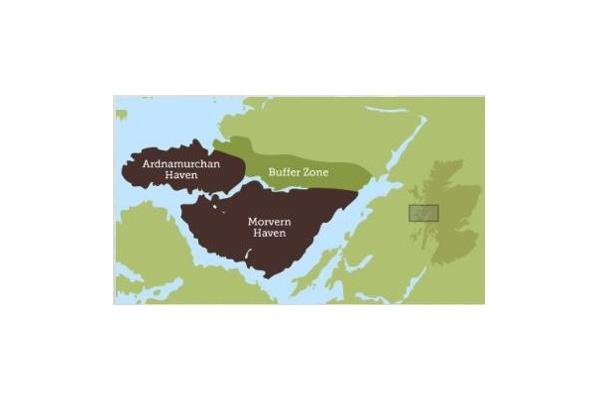
Fig. 3.3. Project area of Wildcat Haven
Click for a full description
View a larger version of this image.
(source: Wildcat Haven, 07.08.2018).
The main threat to the wildcat is recognised to be hybridisation. The project “seeks to protect a naturally sustainable population of up to 1,000 pure Scottish wildcats across the West Highlands region of Scotland”. The Action plan as described at Wildcat Haven’s website (07.08.2018) includes:
- Saving the genetically pure Scottish wildcat;
- Removing all feral cats from the region;
- Using humane, neutering based feral cat controls;
- Establishing buffer zones to prevent feral cats returning to the area;
- Removing feline diseases from the entire haven;
- Developing a genetic test for wildcat purity;
- Establishing project owned wildcat reserves across the region;
- Documenting every individual cat in the area;
- Conducting unique research into cat behaviour, genetics and diseases;
- Building wildcat education and awareness worldwide;
- Encouraging reforesting to enhance natural habitat;
- Working alongside local communities and landowners;
- Advising locally owned, low impact, prowildcat tourism;
- Creating new jobs in the local community;
However, the plan per se was not publicised. The project aims to build a safe haven of more than 18,000 km² for wildcats “bolstered by a spine of wildcat reserves acting as strongholds for the species”. Wildcat Haven advertises a wildcat conservation area in the western Highlands: “Ardnamurchan, Sunart, Morvern and Moidart: the ‘inland islands’ now a feral-free Scottish Wildcat Haven”. A buffer zone free of feral cats
should protect the future wildcat population on these peninsulas. Once this area is free of hybrids and feral cats, wildcats will be able to survive and expand naturally (Keane 2017). The project offers free pet cat neutering (Wildcat Haven, 07.08.2018). Feral cats and “lowgrade hybrids” in the project area are reported to be subject to a Trap-Neutering-Release programme. However, Wildcat Haven has not possessed a SNH licence permitting the legal release of feral cats since October 2015 (SNH Licensing, pers. comm.). Blood samples are taken from all captured cats, which are also checked for their health and microchipped. Feral cats and hybrids are neutered. Feral cats or hybrids positive for FIV or FeLV are euthanised. Wildcats are distinguished from hybrids using pelage scores developed by Kitchener et al. (2005) and genetic testing. Wildcat Haven claims to have developed the “First and only comprehensive genetic test for wildcat purity, and the first and only use of that test in the field”.
The project area is monitored by means of camera traps, and some hybrids also by means of radio telemetry (Wildcat Haven, 07.08.2018). No results from the monitoring and field work are made available on the website. A licence return to SNH to cover a licence held for the period 1 October 2012 to 1 October 2015 refers to 58 cats (two hybrids as defined by Wildcat Haven and 56 pet/feral cats) trapped as part of TNVR work in Ardnamurchan. A licence was also held by Wildcat Haven staff from October 2013 to October 2015 to trap, collar and track wildcats but there is no record of any wildcats being tracked. Further information on the work of Wildcat Haven has been sought by email on the 24.09.2018, but no response has been received.
Petition managing the cat population in Scotland 2017
The petition by Ellie Stirling “calls on the Parliament to urge the Scottish Government to review the Code of Practice under the Wildlife and Natural Environment (Scotland) Act 2011 and to identify measures which could be introduced to control the soaring domestic cat population and protect the existence of the Scottish wildcat” (03.07.2018) and was started on 18 October 2017. The petition states that all domestic cats are non-native species under the Wildlife and Natural Environment (Scotland) Act 2011 and thus have to be under human control. (03.07.2018). Currently, owned free-roaming cats are considered to be under human control if they are “expected to return” to their owners, but there is no requirement for owned cats to be microchipped, registered or neutered. It was recommended that owners should voluntarily neuter their cats and routinely vaccinate and microchip these animals (Stirling 2017). The biggest cat welfare charity in the UK neuters around 20,000 feral cats per year (Stirling 2017). However, for TNR to be effective in reducing free-ranging domestic cat populations, at least 71-94% of the domestic cat population would have to be neutered. Natoli et al. (2006 cited in Stirling 2017) concluded that in the absence of a public education campaign to stop people from abandoning cats, TNR efforts of feral cats are useless. Therefore, voluntary neutering was considered not sufficient and the petition demands to:
- Define a neutered cat as “under human control”;
- Neuter, microchip and register all owned cats with the responsibility and costs to be borne by the owner;
- Install a licensed exemption scheme to allow responsible breeding of domestic cats by appropriate persons;
- Identify feral cats by an eartip cutting at the time of neutering;
- Conduct these actions as soon as possible due to the high reproductive rate of domestic cats (Stirling 2017).
The SWCAP Steering Group and Professor Anna Meredith were invited by the Parliamentary Petitions Committee to submit evidence specifically relating implications for wildcat conservation, and two papers were provided (Meredith 2016, SWCAP Steering Group 2018). Both papers propose that effective conservation of the wildcat in Scotland requires urgent introduction of additional statutory control measures on domestic cat ownership by the Scottish Government (Stirling 2017). However, animal welfare organisations, such as the Scottish Society for the Prevention of Cruelty to Animals (SSPCA) and Cat Population Control Group (CPCG) as well as the British Veterinary Association (BVA), have concerns with regard to the effectiveness of the proposed measures for conserving the wildcat and do not support the petition. All three organisations argue that compulsory cat neutering throughout Scotland to protect the wildcat is not an appropriate solution, as cats in urban areas do not have an impact on the wildcat (Scottish SPCA 2018, CPCG 2018). Moreover, they state that if compulsory neutering would have to be paid by the cat owners, it may lead to an increase of abandoned cats. They also question the feasibility of law enforcement (Scottish
SPCA 2018, CPCG 2018). The Scottish Government’s Code of Practice for the Welfare of Cats informs cat owners of the benefits of neutering their cats (Cabinet Secretary for Environment, Climate Change and Land Reform 2018). The Government works closely with partner organisations that are helping to implement the Scottish Wildcat Conservation Action Plan and free ranging domestic cat numbers are monitored in wildcat PAs by SWA (SPICe no date). Based on received statements to the petition from animal welfare and veterinary bodies, the Scottish Government stated that it did not consider compulsory microchipping or neutering to be currently required for cats. However, the Government will update regulations with regard to licensing of cat breeding (Scottish Government 2018).
Current plans for future wildcat conservation work
Scottish Wildcat Action
SWA is considering necessary measures after the end of SWA in March 2020. The SWCAP Steering Group anticipates that conservation actions continue to focus on discrete geographical areas, but in the longer term it anticipates restoring the Scottish wildcat more widely across Scotland (SWCAP Steering Group 2018).
Responsible cat ownership and management of feral cats
According to the SWCAP Steering Group, the aim of the programme until 2025 is “to remove the threat of pet domestic cats present within discrete PAs (and any buffer areas) hybridizing with, or spreading disease to, wildcats, and acting as a source of more feral domestic cats in the wild)” and “to ensure feral domestic/hybrid cats present within PAs (and any buffer areas) are captured and processed during the TNVR programmes” (SWCAP Steering Group 2018). In the longer term these measures should be expanded across all of Scotland. The Steering Group proposes different options for responsible pet ownership, including more rigorous legal measures. As the number of un-neutered domestic cats is still high and voluntary schemes
seem not to be sufficient “to reduce and ultimately prevent the recruitment of free-ranging and unowned fertile cats that are able to hybridise with Scottish wildcats …” (SWCAP Steering Group 2018), the Steering Group recommends creating “a clear and unambiguous definition of what constitutes ownership and control of a domestic cat, and the responsibilities of such ownership” and introducing compulsory legal
measures across Scotland “that would prevent ownership of pet domestic cats unless they were neutered/vaccinated/chipped (with some exceptions)”. These measures should start at least within PAs and surrounding buffer zones until 2025, extending subsequently to the whole of Scotland after 2025 (SWCAP Steering Group 2018). A coordinated programme of education and well-targeted communication should support any change of legislation. For technical issues with regard to such changes, the SWCAP Steering Group proposes cooperating with animal welfare and veterinary organisations (SWCAP Steering Group 2018).
Wildcat ecology and behaviour (currently part of SWA)
In January 2018, WildCRU started a new two year project to look at the spatial ecology of the Scottish wildcat and the potential role of GPS collars in adaptive conservation management of the species in collaboration with Forestry Commission Scotland and the SWA field team, putting GPS radio tracking collars on some wildcats and wildcat x hybrids in the PAs (Scottish Wildcat Action, see also information under Scottish Wildcat Project). This project aims to increase the existing knowledge about the wildcat’s behavioural ecology using GPS radio tracking and to examine more in detail how such information can be used for conservation management of the wildcat population, specifically in relation to activity under the SWCAP.
Campbell’s (2015) study using GPS tracking improved the information on Scottish wild-living cat habitat and den use, previously collated based on less accurate VHF radio tracking data (Corbett 1979, Scott et al. 1993, Daniels 1997, Daniels et al. 2001). However, the study suffered from early failures of the systems, and low collar recovery; only 50% of the collars were recovered). Improved GPS systems with remote data download technique are now used (K. Kilshaw, pers. comm.).
GPS technology allows the collection of detailed information on the movement patterns and land tenure system of the cats, finescale habitat use and spatial ecology of individuals, and reproductive success by identifying den sites (e.g. in relation to prey availability). Such detailed information on seasonal movement patterns and ecological behaviour will allow better understanding hybridisation – and consequently lead to more targeted TNVR efforts – and potential threats such as regular crossing of busy roads or use of habitats outside PAs within potentially hostile territories, and will therefore promote adequate mitigation measures (K. Kilshaw, pers. comm.).
Currently the size of the PAs is based on providing sufficient habitat to support 20 adults female wildcats (Littlewood et al. 2014), which was primarily derived from VHF radio tracking and camera trapping studies, both of which are less accurate and generate considerably less information than GPS collars. More reliable data on home range size and ranging movement will allow for adjusting PAs, if required. Improved information on the wild living cats’ land use will furthermore facilitate the identification of potential wildcat habitats. One of the aims of the SWCAP is to expand the existing geographical range of the wildcat, which requires identification of possible re-introduction sites.
Conservation breeding programme (currently part of SWA)
The captive breeding programme led by RZSS is a key part of the SWCAP with regard to the possible need for pure wildcats for reinforcement of the population or creating new populations through reintroduction. Some experts see the captive breeding programme as the only solution to save the Scottish wildcat. They suggest taking as many “pure” Scottish wildcats from the wild (Fredriksen 2015). “Release into the wild, however, as the director of one of SNH’s identified ‘key sites’ for captive breeding noted, is unlikely to happen for some time as the conditions threatening the survival of a ‘pure’ wildcat type in the wild – namely the co-presence of feral and hybrid cats – are likely to persist into the foreseeable future” (Fredriksen 2015). The director explained: “The value of the captive programme in realistic terms, as I see it, is that if we establish a purebred or as near as we see as a purebred cat population in a captive environment under the stewardship of a coordinated breeding programme, that is the only 100%, sure-fire, absolutely guaranteed way of saving the Scottish wildcat … I’m really confident that the captive programme will do exactly what it says on the tin. I am not so confident we’ll be as successful, certainly not in the short term, with conserving the animal in the wild or creating enough habitat that is safe for wildcats to go back into” (Fredriksen 2015).
Easterbee et al. (1991) already suggested strengthening existing, isolated wildcat populations through reinforcement (release of additional wildcats). Hubbard et al. (1992) suggested that suitable habitat patches depleted of wildcats could be actively restocked. However, before any reinforcement or reintroduction of wildcats can be considered, the problems of hybridisation with pet and feral domestic cats need to be solved and potential local resistance by farmers and landowners addressed (Kitchener 1992). The SWT mentioned the translocation of wildcats as an option in ecologically connected and restored landscapes providing suitable wildcat habitat (SWT 2011). Releasing wildcats in Scotland for conservation purposes was also considered and discussed in Macdonald et al. (2004, 2010).
In April 2017, the breeding population of Scottish wildcats in captivity numbered 79 (30 males and 49 females) allocated to 23 holders within the UK (Barclay et al. unpubl.). Currently, the captive breeding population numbers 94 (Table 3.1). “Given that the first records for this population Scottish wildcats being held in captivity originate from the early 1970s and that historically cats have been held and transferred through several private collections, it has created the unfortunate situation where accurate details on a number of
individuals and their offspring / siblings are missing” (Barclay et al. unpubl.). Based on samples from all individuals a molecular studbook is being created to inform breeding and transfer recommendations for the captive breeding population (Barclay et al. unpubl.).
A minimum of 30 individuals was estimated to be needed as founders. The captive population is managed according to EAZA breeding programme guidelines (Steering Group 2014). The RZSS in collaboration with a number of SWA partners is preparing an EU LIFE programme project for wildcat restoration in Scotland, including captive breeding and releases. The concept note for the project was accepted in autumn 2018 (D. Barclay, pers. comm.). The project would build on the work of SWA, which will end in March 2020 (RZSS 2018). The project includes the construction of a multi-purpose conservation centre for wildcats in Cairngorms NP that will be suitable for captive breeding, pre-release training, and quarantine (RZSS 2018). Release sites will be defined in line with the IUCN Guidelines for Reintroductions and Other Conservation Translocations (IUCN SSC 2013) and the Scottish Code for Conservation Translocations (NSRF 2015).
Evaluation of the conservation efforts for the wildcat in Scotland
For the evaluation of the efforts to conserve the wildcat in Scotland, we distinguish two questions: (1) Was the planning process of the SWCAP coherent, the setting of priorities logical, and its implementation effective and efficient? (2) Is it likely that the current strategy and the conservation efforts will allow reaching the specific goals or in general, the recovery of a viable population of wildcats in Scotland, considering the present day state of knowledge?
The first question refers to planning and implementation of the SWCAP, hence to its efficiency. As a reference, we use the IUCN recommendations for strategic planning in species conservation (e.g. IUCN – SSC Species Conservation Planning Sub-Committee 2017, Breitenmoser et al. 2015). The second question refers to the present and future effectiveness of the SWCAP and is more difficult to address, as the answer must be given based on incomplete information. Long-term species conservation programmes inevitably suffer from uncertainty as a consequence of lack of data and understanding at the beginning, and unpredictable developments during the process. Such projects must hence be organised as an adaptive process, and both objectives and activities must be reviewed at regular intervals and adjusted where needed.
We focus here on SWA and the SWCAP. We have tried to also consider the contribution of Wildcat Haven to the conservation of the wildcat in Scotland. But the information presented at the website (Wildcat Haven) is not comprehensive or conclusive, and our request for further information has not been answered.
Organisation and structure of the SWCAP
The SWCAP is owned and implemented by the Scottish Wildcat Conservation Action Plan Steering Group (SWCAPSG) which forms a wide partnership (Appendix I). The SWCAP Steering Group oversees the implementation of the activities. SWA has political and financial support from the Scottish Government for the implementation of activities. Some financial information is provided in the minutes of the SWCAP Steering Group (e.g. Steering Group 2017b). The minutes reveal that the total budget of the SWA is £1,619,504, of which £599,706 were spent until 31 July 2017. Furthermore, the Steering Group provided a budget by “Work Package”, of which TNR and Monitoring are more than £500,000 each, followed by Land Manage-ment, Communications, and Project Management, with budgets in the range of £200,000-260,000. These figures seem reasonable, if not modest for a programme of this magnitude. However, we do not have sufficient insight to assess the financial situation of the SWA. Consequently, our evaluation does not consider whether the financial means for implementing a certain activity were adequately available, although we are of course aware that the implementation of a conservation strategy is often impeded by limited funding.
The SWCAP is organised in the form of a Logical Framework or LogFrame (Pages 5–7 in SNH 2013), which is widely used for planning and controlling conservation programmes, including the IUCN–SSC Species Conservation Planning Sub-Committee (2017). The terms used in the SWCAP differ partly from the IUCN terminology. We use here the terms of the SWCAP, but mention the differences where needed.
The SWCAP presents 10 topics (assumed to be equivalent to Objectives in IUCN terminology) under three headings (SNH 2013), 18 Projects (IUCN: Results) and a total of 39 Actions. For each Action, a lead institution and additional partners were identified and the priority (high, medium, and low) and implementation phase (development or delivery phase) were defined. The presentation is short and understandable, but consequently lacks methodological details, a time frame or a budget frame.
Achievements of the SWCAP per Project
We evaluated the achievements at the level of the Projects (Results or Targets in IUCN terminology) in the SWCAP and rated it according to a traffic-light system (green = good, yellow = satisfactory, red = not satisfactory) indicating its accomplishment to date. We refer to Table 3.1 or to the SWCAP (SNH 2013) with regard to the Actions mentioned.
Survey and local liaison
1.1 Identify at least five geographic areas for conserving wildcats (Green - good)
This Result has been completed in 2014 in the time frame defined in the SWCAP and before the start of the work of the SWA in 2015 (Actions 1.1.1 & 1.1.2). Six Priority Areas were considered, and five retained for the concrete conservation activities (Fig. 3.2). The PAs were identified based on the then available information, but before 3.7 (see below) was tackled.
Land management actions for wildcats (Results 2.1–2.3)
2.1 Promote wildcat-friendly predator control (Red - not satisfactory)
A wildcat-friendly protocol, including identification key and information on the use of cage traps, was created and promoted (Action 2.1.1; Table 3.1). The Project had a high priority to avoid the accidental killing of wildcats during predator control activities. However, the progress with regard to its implementation was so far not significant. During the first two years of SWA, only few estates signed up for wildcat-friendly predator control measures. Very few estates provided data on cats (Actions 2.1.2–2.1.4; Table 3.1). The implementation period is 2015–2020, so there are two more years to go and further efforts to implement the protocol have to be taken (Action 2.1.2). In October 2018, a Land Management Sub-Group was established to advance these actions (M. Gaywood, pers. comm.). It would be important to enhance the provision of data on captured cats by estates (Action 2.1.4), which could provide important information on the feral cats in the PAs. The collaboration with the estates must be improved and intensified (Action 2.1.3), also with regard to the option of future reintroductions or reinforcement. A protocol with adequate indicators should be developed to assess the effectiveness of the Project.
2.2 Promote wildcat-friendly management of estates (Yellow - satisfactory)
For the Actions (2.2.1-2.2.3) preparatory work has been conducted and partnerships have been built. A student placement study based at the University of Aberdeen (involving a survey of farming attitudes to wildcats and relevant land management practices) was carried out and will inform this result, and SWA will work together with NFUS (Table 3.1). None of the Actions under this Project have been completed, but the implementation of the Actions will continue until 2020. The Project was assigned a medium priority. Indeed, the significance of these measures for the conservation of wildcats is not understood, simply because there is nowhere in Scotland with a wildcat nucleus left that could serve as reference population to test the response to these measures compared to other threats or other mitigation measures, respectively. However, in Spain agreements with landowners on the management of their estates were a key to the successful conservation of the Iberian lynx (Simón et al. 2012). These agreements were successful because they were of mutual benefit. Based on the outcomes of the student placement study, appropriate Actions to address farmers’ concerns with regard to wildcat-friendly management should be taken. The promotion of wildcat conservation is hoped to also have a positive effect on the attitudes of land managers, especially farmers, with regard to neutering and microchipping their cats.
2.3 Promote wildcat-friendly forestry practice (Red - not satisfactory)
Both Actions (2.3.1 and 2.3.2) have not yet been completed. Possibilities to better promote the FCS guidance, including habitat management for wildcats, should be looked at. As forest habitats are considered crucial for wildcats, a wildcat-friendly forestry practice is important to enhance their conservation, but there is no consensus on best practice forest management to support wildcats. For example the SWCAP promotes the creation of artificial dens, but the significance of such measures is not understood. More wildcats should be observed by means of radiotelemetry to understand their sensitivity (or tolerance) to different forests and forest management practices. The SWCAP is now developing a “Forestry and Wildcats Project” which will be used to report and assess the work under this Project, e.g. den building and use.
Moreover, the project on the ecology of wildcats by means of GPS radio tracking is expected to provide more accurate insights. More wildcats are planned to be collared in winter 2018/2019. Project 2.3 (similar to Project 2.2) suffers from the fact that the effect of the proposed conservation measures on the wildcat population cannot be tested in Scotland because the remnant wildcat nuclei are so weak and suffer from many other threats, too.
Recommendations for forest and land management to support wildcat conservation were developed in Germany (e.g. Trinzen & Behrmann 2015; BUND 2016), but generally, the habitat requirements and use of habitats by wildcats would require further research and an international exchange of knowledge. Recent observations of recovering and spreading wildcat populations in Germany and Switzerland indicate that wildcats are using a wider spectrum of habitats than assumed, including agricultural lands. But as distribution and dynamics of wildcats depend on a variety of factors, no single case study can provide a comprehensive answer to such questions.
Responsible cat ownership and management of feral domestic cats (Results 2.4–2.5)
The Projects under this Objective were given high priority and their implementation obtained considerable financial support.
2.4 Promote a co-ordinated approach to trap-neuter (vaccinate) and release (TNR) of feral cats in priority areas (Yellow - satisfactory)
Action 2.4.1 has been completed and Actions 2.4.2 and 2.4.3 are making progress. The tools to report feral cats have been created (How you can help report; Table 3.1, Action 2.4.2), but so far only few feral cats were reported by the public (Rawling 2017). Volunteer groups carrying out TNVR are coordinated and trained (Action 2.4.3; Table 3.1). However, the efforts seem not to have been able to reduce the feral cat population. The TNVR approach has to be reviewed, assessed with regard to its efficiency and be adapted. TNVR is very demanding of time and resources, but it is crucial for limiting the hybridisation risk, both for the remnant wildcats and for future reintroduction projects. Prior to the TNVR work, intensive winter survey work was conducted in most areas to provide a baseline on the number of wildcats, hybrids, feral domestic cats, and pet domestic cats present in the PAs. However, reliable monitoring of the free-ranging cats started only recently (see below), and a positive effect of TNVR on the wildcat population cannot (yet) be demonstrated. Natoli et al. (2006) estimated that for TNVR to be effective, it would have to reach 71-94% of the pet and feral domestic cats. From October 2016 to March 2018, 135 feral cats received TNVR treatment across all PAs (Table 3.3), but it is unknown what percentage of the feral population these cats represent. The SWCAP Steering Group considered TNVR as not sufficient
to stop the addition of feral cats to PAs. The minimum goal of neutering or removing at least 71% of all hybrids, feral and free-ranging domestic cats up to 2020 seems unrealistic, considering that recent camera trapping in the PAs has confirmed the high presence of un-neutered hybrids compared to the few wildcats (Table 3.2). The crucial question here seems to be the population dynamics of the feral cat “population” (e.g. if this is a self-sustaining source or rather a sink population requiring continuous immigration of free-ranging domestic cats). Such information would be important to balance the efforts for responsible cat ownership and TN(V)R.
It is important to further analyse the compiled information on feral cats, e.g. estimation of feral cat population size and distribution to better understand their population dynamics and role, e.g. with regard to hybridisation or competition. While a neutered feral cat is no further threat with regard to hybridisation, it is still a potential competitor and a source of diseases. Removal of feral cats might be the better solution (also with regard to reinforcement/reintroduction of wildcats), but it is assumed that (lethal) removal today has a low acceptance in society, and it would hence be important to understand if such a measure would be effective (or if the cats removed would simply be replaced).
2.5 Promote the responsibilities that go with domestic cat ownership to communities in priority areas, including considering not keeping cats in these aeas (Green - good)
The Action to reach this high priority Project has progressed significantly, but is not yet completed. To increase public awareness, different means were applied (e.g. the campaigns “Supercat” and #Generation-wildcat, Scottish Wildcat Action; Table 3.1). The new campaign #Generationwildcat was launched in June 2018. Up to March 2018, only eleven free neutering vouchers had been handed out (Steering Group 2018), which may indicate that cat owners are not willing to join in, were not reached by
the current efforts, or that most farm cats had already been neutered. Bacon (2017) found in a survey that responsible cat ownership compliance was high; 98% neutered their cats, 85% vaccinated and 75% micro-chipped. Farmers and crofters were more compliant than other cat owners. Neutering vouchers are aimed at domestic cats and farmers able to bring their cats to veterinary clinics (i.e. socialised cats). Thus, full farm cat colony neutering is more commonly done and paid for directly by the project (R. Campbell, pers. comm.). Further work on the attitudes of cat owners and farmers is underway (Table 3.1); the effectiveness of these campaigns has still to be evaluated. Preliminary findings indicate a high awareness and responsibility of cat owners (although some of the results might be biased; see Bacon 2017), and seem to be in contrast to the recent findings that unneutered hybrids outnumber pure wildcats by far (Table 3.2). As a matter of fact, the significance of free-ranging owned cats for hybridisation is not understood (see also comments to Project 2.4). If feral (hence not owned) cats or hybrids are the main risk to wildcats with regard to further hybridisation, the importance of the activities to further responsible cat ownership may be overestimated. However, the importance of TNVR however goes beyond the immediate risk that a free-ranging owned cat mates directly with a pure wildcat. Free-ranging owned cats may be the source population for feral cats and hence foster hybridisation indirectly, or they could also act as competitors to or sources of diseases for wildcats.
Monitoring of wildcat poulations (Result 2.6)
2.6 Monitoring of population trends in priority areas
Good progress has been made on this Result with regard to establishing the methodology. Camera trap monitoring has been conducted in all PAs (Action 2.6.1; Table 3.1). To evaluate trends and developments in wildcat populations in the PAs, the time series are so far too short, and consistent monitoring must be continued. All evidence (e.g. photographs) of feral/domestic cats and hybrids should also be analysed to estimate their numbers and trends. The ratio wildcats/hybrids/feral cats is an important parameter, because the different groups may change as a consequence of ecological trends (e.g. prey fluctuation or habitat alteration). Monitoring must have high priority! Understanding the population dynamics of wildcats and their potential competitors is of crucial importance, not only for assessing the success of the implemented measures, but for the general understanding of wildcat biology/ecology and for designing appropriate conservation measures. Indeed, a much broader monitoring concept that goes beyond the PAs should be developed and implemented (Chapter 5, see also Result 3.7).
Ex situ (Results 3.1 & 3.2)
3.1 Develop a captive breeding programme for wildcats with a view to reinforcing poulations in the wild in the future. N.B. this will require that the risks to wildcats have first been addressed in potential release locations. (Yellow - satisfactory)
The whole captive population of wildcats in Scotland has been assessed genetically (Action 3.1.1) and husbandry guidelines and the studbook (Action 3.1.3) have been updated. This Action was planned to be done in 2014-2015, but the time line for 3.1.1 was too short. A concept note for a larger reintroduction and conservation breeding programme including a breeding centre has been submitted by the RZSS to the EU LIFE Plus Programme 2018 (Action 3.1.4; Table 3.1). Thresholds and methods for choosing cats were discussed (Action 3.1.2) and decided with regard to the circumstances for including individual cats into the captive breeding programme and from where they could be taken. Only one of the cats captured so far was considered a wildcat suitable for the captive breeding programme. The captive breeding programme in the context of conserving the wildcat in Scotland is meaningful as a preparation for reintroduction or reinforcement, hence engaging in captive breeding implies a certain shift of focus (which we welcome; see recommendations in Chapter 5) and must be continued after SWA has ended.
3.2 Scope population reinforcement or reintroductions (to take place if required after current plan timescales) (Yellow - satisfactory)
Actions 3.2.1–3.2.3 had been assigned a medium to low priority. However, as the captive breeding programme is progressing and becoming more concrete, these Actions may become more urgent. Some progress has been made and discussions with regard to reintroductions and reinforcement took place (Table 3.1).
Technical/scientific oversight (Results 3.3 & 3.4)
3.3 Improve our knowledge of wildcat genetics and taxonomy (Yellow - satisfactory)
This Project was given high priority, but progress was delayed because of the lack of funding. Information on the genetic structure of the cats living wild in Scotland has now been published (e.g. Senn et al. 2018; Table 3.1). The hybridisation levels of the wildcat population and the correlation of genetic and diagnostic characteristics were recently made available (Actions 3.3.1 & 3.3.2) but the extent of diseases in wildcats and their genetic diversity have not yet been fully assessed (3.3.2 & 3.3.3). Understanding hybridisation, genetic diversity and the possible role of diseases is important also with regard to the planned reinforcements and reintroductions. An additional and important issue is the genetic relationship of the Scottish population with continental populations and understanding the genetic/phylogenetic history of the Scottish wildcat. Cooperation between the relevant research groups have been initiated (H. Senn, pers. comm.).
3.4 Improve our understanding of wildcat ecology and behaviour as affects their conservation (Red - not satisfactory)
Actions under this Project were assigned high (3.4.1 & 3.4.2) and low (3.4.3) priority. The progress so far was not satisfactory. Action 3.4.1 was planned to be completed by 2015. But only one study including collaring of wild-living cats has been conducted so far; another study using GPS collars started at the beginning
of 2018 (Table 3.1). Results for the Action 3.4.2 are not to be expected before 2019-2020. It is crucial to understand wildcat ecology and behaviour, and its interaction with feral and domestic cats to define appropriate conservation actions. Indeed, we think that understanding wildcat ecology and the wildcat’s (behavioural) relationship to other wild-living cats is of utmost importance for the design of meaningful conservation measures. The implementation of further field research based on new techniques (see Wildcat ecology and behaviour in Chapter 3.3) is encouraging, but may be hampered through the low abundance of wildcats. Understanding hybridisation from an ethological, ecological and genetic point of view is of utmost importance for the conservation of Felis silvestris in Scotland and elsewhere, and international cooperation is needed to address these questions.
Screening, monitoring and archive of specimens (Results 3.5-3.7)
3.5 Standardise wildcat records (Green - good)
The Action (3.5.1) was assigned low priority. It has been completed in the given timespan (Table 3.1). Such standardisation is important for a continuous monitoring of the population of wild-living cats in Scotland, which we think should receive more attention in the future and beyond the PAs (Chapter 5).
3.6 Develop a protocol for wildcat samples (green - good)
Action 3.6.1 has been completed. The timespan for its achievement was 2014-2015 (Table 3.1). The agreement on a protocol to collect (wild)cat samples e.g. for disease screening is important. Since the inception of the project, cat carcasses have been collected, samples have been taken and analysed, but each element of the sampling process (SWA staff, Royal (Dick) School of Veterinary Studies and NMS) had their own protocols for handling samples. A photographic protocol for recording pelage colouration and markings of live and dead cats was developed too. See also general recommendations on monitoring. A database that combines data from NMS, RDSVS, RZSS and SNH is nearing completion.
3.7 Monitor national wildcat distributions and population trends (Yellow - satisfactory)
Progress with Action 3.7.1, which has been given medium priority, has been made recently. A step towards the development of a national monitoring protocol is SWA’s collaborating with MammalWeb. Moreover, two international students with wildcat experience conducted rapid assessment surveys of areas outside of PAs in summer and autumn 2018, and will be reporting shortly (R. Campbell, pers. comm.). This Project is of high importance with regard to the control and adjustment of the entire programme. Monitoring at all levels is not only crucial for the design of measures to conserve the remnant wildcat population and to monitor the population trends and developments of all wild-living cats, but it will also be important for expanding activities beyond the PAs and for any reintroduction project. To our understanding, there is con-tinuing dispute on the distribution and abundance of wildcats in Scotland, which is considerably hampering a consensus on the best conservation strategy. The only way to overcome this situation is an agreed, scientifically robust protocol for monitoring wildcats across its potential range. A comprehensive programme of monitoring wild-living cats should have been implemented with high priority at the beginning of the programme, and also because establishing and testing such a system always takes several years. See also Project 2.6 and recommendations in Chapter 5.
Communications, public awareness/education (Result 3.8)
3.8 Develop and implement a national communications plan to support conservation actions (Yellow - satisfactory)
This Project received high attention from within SWA, and progress was made for all Actions (3.8.1–3.8.3). Campaigns were launched and awareness raising conducted (Table 3.1). The options of how the public can contribute to wildcat conservation could be further enhanced (Action 3.8.1), as well as awareness raising in training courses (Action 3.8.2). It is important that game keepers are aware of the challenges of misidentification when conducting predator control measures. To secure political support for wildcat conservation, Action 3.8.3 was designed, with a timespan of two years from the start of the SWA in 2015, but only limited progress has been made. Considering the importance and the substantial means going into awareness raising and education, it might be worthwhile setting up a project evaluating the impact and efficiency of these efforts (e.g. based on realistic indicators).
Ensure adequate protection for wildcats from development pressures (Results 3.9-3.10)
3.9 Increase wildcat awareness amongst developers and planning authorities to ensure adequate survey and mitigation for wildcats prior to approvals. (Yellow - satisfactory)
The timeline for high priority Action 3.9.1 was 2014–2015, but the Project has not yet been completed and only moderate progress was made (Table 3.1). Surveying the presence of wildcats during development projects could add to the understanding of the overall status of the species across Scotland and should be considered under a national monitoring scheme (Project 3.7). A “Sharing Good Practice” event for developers, planners, consultants etc. was organised by SNH in February 2017 and brought together some 60 attendees (M. Gaywood, pers. comm.). For wildcats, SNH can issue licences for development, land management, (and for possession, survey and research) under some circumstances, and has published advice for developers. Progress on this project was obviously hampered through the low priority that monitoring and survey concepts received generally. A trail camera leaflet is now being developed. Other methods for the monitoring such as den site detection, scat detection etc., will be formalised too and be made accessible to consultants and the public.
3.10 Promote competency of ecological surveys for wildcat. (Yellow - satisfactory)
Action 3.10.1 was assigned medium priority, to take place 2014 and 2015. Progress has been made (see also Result 3.9 above) but further work to complete this Project is needed in connection with advancing monitoring in general (see Project 3.7 and recommendations in Chapter 5) and Project 3.9.
Investigate funding and support for actions
3.11 Investigate the potential for external funding to deliver the SWCAP. (Red - not satisfactory)
Actions 3.11.1 and 3.11.2 were assigned high priority, to be conducted from 2014–2015. None of the Actions has been completed and only limited progress was made (Table 3.1). Assured additional funding will be crucial for implementing further Actions during and after SWA. One example for this is the submission of an EU LIFE project proposal (see Project 3.1). As mentioned above, it was beyond our possibilities to assess the financial structure of the projects planned under the SWCAP; but it is obvious that at least the implementation of some of the projects were hampered or delayed because of the lack of funding.
The “mid-term evaluation” of the SWCAP Steering Group revealed that substantial work would be needed during the coming years, as 69% of the Actions were classified to still need significant amount of work or for which the majority of work still needs to be conducted.
We evaluated four Projects out of a total of 18 as being “good” regarding the progress made. Ten Results were assessed as being “satisfactory” and four Results as being “not satisfactory”. It has to be noted that the priority and implementation schedule differed among the Projects, but there were also Activities with a high priority, which were implemented with a delay. For several Projects (e.g. 3.6, 3.9, 3.10, 3.11) the timespan set was obviously too tight. It is a very general and almost inevitable phenomenon when develop-ing a LogFrame that the schedule is too optimistic. Furthermore, priority setting at the beginning of such a vast programme is difficult, as important pieces of information will only become available through the implementation of certain Projects and Activities. The only way to handle these challenges is an adaptive management approach with a constant and consistent monitoring of the progress and the effectiveness of the Projects. This is not only important for a continuous adjustment and fine tuning of the conservation activities, but also with regard to economise funds wherever possible.
Evaluation of the SWA with regard to the implementation of the SWCAP and its outreach
Outreach and reporting
The SWCAP Steering Group meets three to four times a year to review progress and problems, discuss future tasks and assign responsibilities. The minutes of these meetings are made available on the SWA website, but no biannual or annual reports on the work of SWA are provided. Annually a “SWA Forum” is hold where updates on the work of the SWA are given and to which all partners, volunteers, wildcat enthusiasts and all other interested people are invited to (M. Gaywood, pers. comm.).
There are a lot of outreach activities, which are also featured on the SWA website and documented in the Steering Group Meeting minutes. Talks and presentations on SWA and the conservation of the wildcat were frequently given. Active public awareness raising – especially for critical interest groups – was/is conducted and information is disseminated through Twitter and Facebook and the SWA website, which is widely used (Steering Group 2017e). There was also regular coverage of SWA in local, regional and national media (Steering Group 2016b, 2017 a, b, c, d, e). The work of SWA with regard to captive breeding was also featured by BBC Winterwatch (Steering Group 2016b). To fulfil Action 3.8.1 Develop a campaign to promote responsible cat ownership and promote how the public can contribute to wildcat conservation two campaigns were launched: the Supercat campaign promoting responsible cat ownership across Scotland, and the #GenerationWildcat campaign asking the general public, outdoor enthusiasts, farmers, land managers, and gamekeepers to support wildcat conservation by reporting any sightings of what they believe are Scottish wildcats from the priority areas. Last but not least, the SWA website contains resources for schools and educational purposes for young students, partly also made available on BBC School Radio. The website provides materials for children on the Supercat and #GenerationWildcat campaigns. All in all, the outreach of the SWA addressing the general public and specific groups is impressive. Nevertheless, we found that consistent and regular information (e.g. yearly reports) depicting the progress of the SWA to the interested audience (including the evaluators) was missing. Publishing the minutes of the Steering Group meetings certainly increases transparency; we nevertheless recommend making a better distinction between internal reporting used for monitoring and control, and external reporting to inform stakeholders and the general public (Chapter 5).
Setting of priorities
Settings of priorities in the SWCAP were mentioned in Chapter 4.2. From our present-day perspective, the priority setting for Action(s) under Results 3.3, 3.4, 3.6 and 3.7 was not appropriate; activities addressing monitoring and understanding of wildcat ecology should all have been given a higher (chronological) priori-ty, not only because distribution, abundance and trend of wildcat population(s) is a the crucial criterion for success or failure of the programme, but also because it is the ultimate parameter to adapt Projects and Activities during the implementation phase.
Cooperation within the SWA and with other institutions
In February 2017, it was agreed that the communication between key research partners has to be improved to support quicker decision making and to establish a shared data/photo repository accessible by the key research partners (Steering Group 2017d). After the discussion of the 1st draft of this report, the Steering Group organised a workshop in October 2018 with the aim to review and improve the reporting, to evaluate the priority conservation actions as well as to revisit the SWCAP itself, and to compare it with the IUCN strategic planning approach. The results of this workshop will be available in 2019.
Several SWA partners are involved in international scientific projects (e.g. genetic research) and conservation breeding is well integrated into the international (research) scene, but we think that a more specific exchange of information with wildcat research and conservation groups from continental European countries could help to advance the understanding of some critical factors of wildcat conservation, such as hybridisation or habitat use.
Assessment of the situation of the wildcat and the effectiveness of SWA/SWCAP
The prospect of the conservation programme depends (1) on the status of the wildcat (abundance, distribution and trend) and (2) on the perspective to mitigate the crucial threats in time to halt the decline and accomplish the turn around.
Status of the wildcat in Scotland
The former and present status of the wildcat in Scotland was reviewed in Chapter 2. The area occupied has considerably declined between 1983-87 (Easterbee et al. 1991; Fig. 2.2) and 2006-08 (Davis & Gray 2010; Fig. 2.4), although Davis & Gray (2010) stated that the (overall) distribution has changed little since the 1980s. Based on existing records and a shortlist of potential conservation sites, the SWA PAs (Fig. 3.2) were selected based on Littlewood et al. (2014), representing the areas where in situ conservation efforts were considered worthwhile. Population estimates have drastically dropped from 2,800-10,700 (Harris et al.
1995) or 4,200 (Macdonald et al. 2010) in the 1990s to 115-314 in recent years (Kilshaw 2015). An alternative recent estimation of 35-400 pure wildcats was released by Wildcat Haven (® Chapter 2). This figure cannot be judged as the method of estimation was not explained, but the higher margin is in the range of the estimation of Kilshaw (2015), and the lower margin in the range of the newest SWA figures (see below). The challenge of producing reliable estimates was (and is) the elusiveness of the species and the problem of distinguishing “pure wildcats” from tabby domestic cats and hybrids.
Although previous estimates of abundance, possibly also of distribution were too optimistic, the population trend of the wildcat was clearly negative over the past decades. After the historic bottleneck at the turn of the 19th/20th century, the wildcat seems to have recovered and recolonised habitats north of the central belt (Easterbee et al. 1991). It is not clear when the “re-decline” started, but obviously, the legal protection of the species and various listings in conservation regulations in the 1980s and 1990s have not been able to halt the decline. The newest numbers of the surveys in the five PAs reveal a pessimistic picture (but confirm the low estimation of Kilshaw 2015): The number of phenotypical wildcats detected in the PAs varied from 0-6, with a minimum total of 15 (SWA, unpubl. data; Table 3.2). However the number of un-neutered hybrids detected in the same areas was 88 (1-27). Only in Morvern PA were more wildcats than hybrids detected (3 wildcats versus 1 un-neutered hybrid). In an earlier study across Scotland, Kilshaw (2015) had camera-trapped 87 wildcats compared to 145 hybrids and 193 feral cats, but the threshold for defining a wildcat was more relaxed than that used by SWA.
The situation of the wildcat in Scotland is desperate. Just as concerning as the alarmingly small number of wildcats is its patchy distribution and the overwhelming presence of hybrids detected in the same areas. There are populations of other cat species that have recovered from very low abundance, but nowhere under similar circumstances (presence of feral cats and hybrids) as those the wildcat faces in Scotland.
Mitigation of threats
It is impossible to say if the indiscriminate killing of wild-living cats, hybridisation with pet/feral domestic cats or other threats, such as habitat loss or fragmentation, were foremost responsible for the decline of the wildcat. But there is a broad view, which we share, that today, hybridisation and the presence of feral cats and hybrids in the wildcat habitats are the most important threat to the survival of the wildcat in Scotland.
It was discussed if hybridisation was increasing over time, or whether it was a limited event linked to the range expansion after the First World War (e.g. Kitchener et al. 1992; Chapter 2). The severe bottleneck with the geographical restriction of the wildcat population to north-western Scotland one hundred years ago and subsequent hybridisation during the recovery was likely to be the beginning of the problems of the Scottish wildcat (and a remarkable difference to comparable situations in continental Europe; see below). However, new genetic research suggests that hybridisation has accelerated in recent times (Senn et al. 2018; Chapter 2), in contrast to the study of Beaumont et al. (2001), who then concluded that wildcat-like “cats do not have very recent domestic ancestry”.
Hybridisation was recognised by SWA as the main threat and accordingly, emphasis was given to mitigate this threat, e.g. by means of TN(V)R. Reducing the risks posed by pet and feral domestic cats to wildcats was the most important activity of the SWCAP, which directly or indirectly is covered by several Projects and Actions (e.g. Projects 2.1, 2.4, 2.5, and 3.8; SNH (2013)). Nevertheless, these efforts were recognised as not sufficient to stop the addition of feral cats to the wild-living population (Table 3.1 in Chapter 3). But even if the further import of domestic cats into the wild-living population can be stopped, the efforts to neuter or remove feral cats and hybrids would have to be considerably boosted to remove this threat. In the five PAs surveyed in 2017/18, the ratio of wildcats to un-neutered hybrids was almost 1:6 (Table 3.2).
Hybrids have become so common that they mate with each other and produce complex hybrids (Senn et al. 2018), so today a continuum from Felis silvestris to Felis catus is observed, a so-called hybrid swarm. This is a situation that we do not know for any Felis silvestris population in continental Europe, where the over-all abundance of domestic cats is also high. There is some (preliminary) indication that in a “healthy” wildcat population, hybridisation is not an irreversible process. But it is also a reasonable hypothesis that if hybridisation has reached a level as observed in Scotland, factors acting against hybridisation are no longer effec-tive.
It goes without saying that other threats (“disturbance”, habitat destruction/fragmentation and continued killing) must be addressed, too, at least as co-variables, and that some of them likely have an important impact on very small populations. However, recent experiences with recovering and re-expanding wildcat populations in north-western continental Europe demonstrate that (healthy) wildcat populations can cope with challenges, such as fragmentation, traffic accidents, forest management, accidental or intentional killing, and can regain lost ground even in cultivated areas. We also emphasise here the problem of hybridisation, because this is the most striking difference to the conservation of wildcats in countries such as France, Germany, or Switzerland, where Felis silvestris presently shows a remarkable and mostly spontaneous recovery (see below and Chapter 5).
Prospect of the SWA to conserve the wildcat under the SWCAP
Littlewood et al. (2014) estimated in a population viability analysis that a group of 40 wildcats (with a sex ratio of 1:1) would stand a 95% chance of surviving for 50 years. Accordingly, the PAs were selected to be able to each host 20 females. The newest surveys in the PAs (Table 3.2 and above) have revealed that such wildcat populations are nowhere to be found any more. There were some additional spots considered as candidates for PAs (Fig. 3.2), but it seems highly unlikely that anywhere in Scotland, a pure wildcat population consisting of 20 females can be discovered. Hence we conclude that there is no viable population of wildcats left anywhere in Scotland. Indeed, the total number of pure wildcats discovered in Scotland is so low that the criteria for “viability” is likely not even met by the total population – even without the continued threat from hybrids and pet/feral domestic cats.
In this respect, the SWCAP (SNH 2013) is not only going to miss its general Goal for the first six years – to halt the decline – we also believe that it is unrealistic that even increased efforts in the future will allow the recovery of the wildcat population in Scotland. We consider the free-living population of Felis silvestris in Scotland to be no longer viable and, respectively, the continuous threats to be too strong to allow a recovery under the present conservation paradigm.
This pessimistic assessment does not mean that current conservation efforts are meaningless and the recovery of the wildcat in Scotland is not possible or should not be envisaged. But we think that (1) the recovery will only be possible with the support of reintroduction/reinforcement projects, that (2) this will only be possible when the remaining “pure Scottish wildcats” (based on a rigorous genetic protocol) are reinforced through wildcats e.g. from the north-western continental populations (Chapter 5), and (3) if rigorous precaution is taken to avoid hybridisation of the newly released wildcats. Indeed, such an alternative or additional approach was already considered in the SWCAP (SNH 2013) under the Objective “Ex situ”
(Projects 3.1, 3.2 and related issues), and respective activities have already been launched (Chapter 3.4), for example by building up the number and quality of the wildcats in captive breeding programme, including the preparation of a number of new conservation breeding enclosures (Action 3.1.4 of the SWCAP) and by preparing an EU LIFE project that includes conservation breeding and reinforcement. Nevertheless, such an approach would still require a rigorous suppression of feral cats and hybrids in areas of reinforcements, and the removal of feral cat in areas of potential reintroduction.
Conclusions and recommendations
“We have given ourselves just six years to halt the decline” stated P. Wheelhouse, Minister for Environment and Climate Change, in the foreword to the SWCAP (SNH 2013). This time span will be over by the end of 2019, and there is no indication that the turnaround for the Scottish wildcat will be achieved by then. On the contrary, information available to date indicates that the present situation of the wildcat in Scotland is worse than it was assumed to be at the start of SWA. However, this is not an indication of a failure of the programme, but simply the consequence of more reliable data and a more realistic understanding; we think that earlier assessments of the situation of the wildcat in Scotland were too optimistic. So an important achievement of SWA has been to present a more realistic picture of the situation of wild-living cats in Scotland.
We hereafter present some conclusions from our review of the situation of the wildcat in Scotland and the conservation efforts to date, and give general recommendations for the recovery of the species in Scotland and more specific recommendation for the continuation of SWA work under the SWCAP.
Conclusions
The phylogenetic particularity of the “Scottish wildcat” is not clear. The British wildcats were certainly part of the continental population in the late Pleistocene, have then been isolated through the flooding of the English Channel and were finally restricted to north-western Scotland in the early 20th century. The Scottish wildcat has been described as a subspecies Felis silvestris grampia by Miller (1907, 1912), but Kitchener et al. (2017) regard it as “doubtfully distinct”. Indeed, wildcats from Scotland are close to specimens from north-western continental Europe (Fig. 2.9; Neaves & Hollingsworth 2013).
However, this discussion is somehow obsolete. We consider the wildcat population in Scotland to be no longer viable. It is too small, too fragmented and too hybridised. A proper population viability analysis was never done, but all robust information available indicates that the wildcat in Scotland is on the verge of disappearance. There is still the claim of Wildcat Haven of a firm wildcat presence in western Scotland, but there is no confirmed evidence for this statement. This dispute should nevertheless be settled by means of a survey based on a robust protocol. Based on all information available for this review, it seems highly un-likely that anywhere in Scotland, a nucleus of pure wildcats will be discovered that could change the pessimistic perspective of the wildcat in Scotland.
Our conclusion is that it is too late to conserve the wildcat in Scotland as a stand-alone phylogenetic unit. But we still recommend to save as much of the gene pool of the Scottish wildcat population as possible in order to retain possible adaptive traits. As a general approach, we recommend to boost considerably the Scottish population with individuals from the continent. The source population(s) will have to be defined, but at the present state of knowledge, the geographically closest populations seem also to be genetically the closest relatives. Furthermore, the north-western continental population lives under similar ecological and climatic conditions as the potential wildcat habitats on the British Island would offer.
The approach for the recovery of the wildcat in Scotland including the translocation of wildcats from continental population(s) will have to be discussed and outlined in detail, but we agree that conservation breeding (as already initiated) would be the obvious way to conserve as much as possible the genetic features of the original population. Continental wildcats could be introduced either into the breeding programme (using zoo-born individuals) and/or into the wild (using wild-born cats or adequately bred and prepared specimens from breeding programmes). Both, reintroduction projects or reinforcement of remnant nuclei should be considered, whereas the latter approach implies that hybrids are removed. The presence of feral cats would have to be addressed before releasing wildcats in any situation.
General recommendation for the recovery of the wildcat in Scotland
Monitoring (wild living cats across Scotland)
Campbell (2015) conducted camera survey to inform live-trapping of wild-living cats in northern Scotland in 2013 and 2014, Kilshaw & Macdoncald (2011) evaluated the use of camera trapping in a survey in parts of the Seafield and Strathspey Estates, north-eastern Scotland. Camera trapping is nowadays the main monitoring method applied in the PAs. Monitoring wildcats in Scotland is a particular challenge because of the high degree of hybridisation, which complicates phenotypic identification from pictures, and because Scottish wildcats seem not to respond to lure sticks (Kilshaw et al. 2015, K. Kilshaw, pers. comm.), a method widely used for genetic monitoring of wildcats in the north-western continental population. Appropriate morphological and genetic identification schemes have been developed in the framework of the SWCAP and should become the standard for robust monitoring of wildcats across Scotland.
Agreeing on a new strategy for the conservation of the wildcat in Scotland requires a consensus on the status of the species. Although it seems highly unlikely that undiscovered nuclei of wildcats in Scotland persist (see above), we recommend clarifying this by means of a robust survey in all areas under dispute based on a standardised protocol. It is important to provide clarification on this in order to avoid wasting funds and time to search for assumed wildcat occurrences. In case any wildcat occurrence is discovered outside the identified PAs, a continued robust monitoring has to be established there, too.
The monitoring of wildcats, hybrids and feral domestic cats in the PAs needs to be continued. This is presently the only robust data set allowing tracking the development of the situation. We consider the ratio wildcats: hybrids (Table 3.2) to be the most important indicator for the constant assessment of the status of the wildcat. Furthermore, this monitoring allows evaluating the effectiveness of many other interventions such as TN(V)R.
Generally, we recommend investing more into the monitoring of the effectiveness of the implemented activities. Many of the Projects and Actions under the SWCAP require a considerable investment, but their effectiveness remains unclear. We are aware that the very low abundance of wildcats hampers the moni-toring of success, but many of the activities implemented (from responsible cat ownership to land and forest management recommendations) will be important also under a scenario of reinforcement and reintroduction and need therefore be evaluated more in detail.
Research and research cooperation
Many of the Projects and Actions proposed in the SWCAP were based on assumptions and expert opinion. This is understandable as conservation measures are considered to be urgent, but genuine research (and monitoring as mentioned above) should prepare and accompany the implementation of conservation measures. Concepts for more (ecological) research have been summarised in Chapter 3.4. Research on such an elusive and rare species is difficult and expensive. But advances in camera trapping, GPS telemetry, molecular-genetic analyses and the respective statistical analytical tools increasingly facilitate such work.
Again, the low abundance of wildcat is a hindrance; studies at population level are practically impossible now. But a better understanding of wildcat ecology and behaviour and their relation to hybrids and feral domestic cats would also be welcome with regard to reinforcement and reintroduction. Furthermore, we encourage Scottish scientists to liaise with wildcat researchers and conservationists on the continent to establish comparative studies to better understand the particular situation in Scotland.
Spatial concept
We recommend a new spatial concept is developed for the restoration of the wildcat in Scotland including the wildcats in the PAs (and their possible reinforcement), but also considering reintroduction. Littlewood et al. (2015), who reported on the selection of the PAs, and Kilshaw (2015), who looked at the potential distribution of wildcats, feral cats and hybrids, performed analyses to be built upon.
The approach presented by Wildcat Haven (Wildcat Haven) for western Scotland seems a reasonable spatial concept. The idea of preparing the peninsulas of Morvern and Ardnamurchan as wildcat recovery sites, separated from the mainland with a high feral cat population density through a buffer zone could be one possible approach for a reinforcement or reintroduction. The prospects of such an approach would have to include an estimation of viability of a future wildcat population, as the ecological carrying capacity of the west-coast habitats are probably lower than in the eastern parts. Another potential area for a large-scale reintroduction/reinforcement project is Cairngorms National Park, including the adjacent PAs (Northern Strathspey, Strathbogie, and Angus Glens, but possibly also the excluded PA Strathavon and the other candidate areas, Blair Atholl and Drumtochty). Much preparatory work has been done in Cairngorms NP (Hetherington & Campbell 2012), the habitat is suitable, and the local people are supportive of wildcat conservation. The challenge here will be the suppression of hybrids and feral cats. Furthermore, a new spatial concept should consider all potential wildcat habitats and should go beyond areas recolonised in the 20th century. On the one hand, the wildcat in Scotland has probably not survived in the “best” habitat (Easter-bee et al. 1991; Chapter 2.1), on the other hand, landscapes and (forest) habitats in Scotland have changed considerably in the past 100 years.
Conservation breeding, reintroduction and reinforcement
Breeding of wildcats in European zoos is well established, and experience for the specific breeding of wild-cats for reintroduction or reinforcement is available (Hartmann-Furter 2006, 2009). Captive-born wildcats have been used for reintroduction projects in Germany (Hartmann-Furter 2009), and although the post-release monitoring of the reintroduced populations was poor, there is practical experience available to build on. A summary of these experiences is provided by Gow & Cooper (2018). Any specimen to be used for breeding and/or release would have to be genetically tested, as, many of the wildcats in captivity in Europe have been found to be hybrids (Witzenberger & Hochkirch 2014).
Reintroductions/reinforcements will have to be carefully prepared and to follow the IUCN guidelines (IUCN/SSC 2013) and the Scottish Code for Conservation Translocations, which addresses specific Scottish requirements (NSRF 2014, www.snh.gov.uk/translocation-code). We recommend that possible projects in Scotland should be considered in the context of other similar plans for England and Wales (Cooper 2018, Gow & Cooper 2018). Although it may seem visionary at the moment, the recreation of a “British wildcat metapopulation” may require the definition of certain common standards in a very early stage.
Responsible cat ownership, TN(V)R and control of feral cats and hybrids / predator control
Considering the efforts and the achievements so far, this seems to be the major challenge in wildcat recovery across the UK. The domestic cat population in the UK is estimated at 10 million individuals with around 90% of domestic cats neutered, leaving 1 million domestic unneutered cats (Meredith et al. 2018). The feral cat population in the UK is estimated at around 1 million, with at least 100,000 cats in Scotland. Experiences with wildcat populations on the Continent demonstrate that wildcats can maintain their genetic integrity also in landscapes with high population densities of domestic cats. However, we assume that small populations (such as the wildcat population in Scotland 100 years ago) are more vulnerable to hybridisation – which will also be relevant at an early stage of a reintroduction project. To prevent hybridisation in a reinforced or reintroduced wildcat population during its initial phase requires efficient suppression of hybrids and/or feral cats. Furthermore, the owned domestic cat population remains a potential source for a feral cat population and requires continued investment into responsible cat ownership.
Cover photo: Wildcat (Felis silvestris) male meets domestic cat female, © L. Geslin.
References and Appendix 1
References
Anonymous 1987. Survey of the status and distribution of the wildcat Felis silvestris in Scotland 1983–1987.
A summary report. Nature Conservancy Council, August 1987. 10 pp.
Anonymous 1990. Research and survey. Mammals. Nature Conservancy Council. 6th Report. 2 pp. Apostolico F., Vercillo F., La Prta G. & Ragni B. 2016. Long-term changes in diet and trophic niche of the
European wildcat (Felis silvestris silvestris) in Italy. Mammal Research 61(2), 109–119.
Arnold H. R. (Ed.) 1984. Distribution maps of the mammals of the British Isles. Biological Records Centre.
Institute of Terrestrial Ecology, Monks Wood Experimental Station, Abbots Ripton, Huntingdon. 68 pp. Balharry D. & Daniels M. 1993. Wildcat recovery programme in Scotland. Wildcat Survey 1983–1987. Scottish National Heritage. 102–110.
Balharry D. & Daniels M. J. 1998. Wild living cats in Scotland. Scottish Natural Heritage Research, Survey and Monitoring Report. 83 pp.
Barclay D., Hartmann M., Girling S. & Richardson D. in prep. RZSS Scottish wildcat (Felis silvestris) Conserva-tion Breeding for Reintroduction Management Protocol. RZSS. 73 pp.
Bacon A. 2017. Responsible cat ownership attitudes and behaviours in the context of Scottish wildcat (Felis silvestris) conservation. PhD Thesis. Veterinary Science in Conservation Medicine at the University of Edinburgh. 83 pp.
Beaumont M., Barratt E. M., Gottelli D., Kitchener A. C., Daniels M. J., Pritchard J. K. & Bruford M. W. 2001.
Genetic diversity and introgression in the Scottish wildcat. Molecular Ecology 10, 319–336.
Breitenmoser U., Lanz T., Vogt K. & Breitenmoser-Würsten Ch. 2015. How to save the cat – Cat Conserva-tion Compendium, a practical guideline for strategic and project planning in cat conservation. Cat News Special Issue 9, 36 pp.
BUND (Bund für Umwelt und Naturschutz Deutschland) 2016. Wildtierkorridore & Waldaufwertung. Ergeb-nisse und Erfahrungen des Projekts „Wildkatzensprung“. Bund für Umwelt und Naturschutz Deutsch-land e.V., Friends of the Earth Germany, Berlin. 52 pp.
Cabinet Secretary for Environment, Climate Change and Land Reform 2018. PE1674/D. Cabinet Secretary for Environment, Climate Change and Land Reform submission of 25 January 2018. 2 pp.
Campbell R. D. 2015. Spatial ecology of the Scottish wildcat. Final report. Wildlife Conservation Research Unit, Oxford University, UK. 105 pp.
Campbell R. D. unpubl. Population analysis on formal survey data. SWA. 1–3 pp.
Cooper P. 2018. Should we bring back the wildcats of old England? BBC Wildlife, Agust 2018, 30-34.
Corbett L. K. 1979. Feeding ecology and social organization of wildcats (Felis silvestris) and domestic cats (Felis catus) in Scotland. PhD thesis, University of Aberdeen, Scotland.
CPCG (Cat Population Control Group) 2018. PE1674/F. Cat Population Control Group submission of 09 Feb-ruary 2018. 2 pp.
Daniels R. 2013. Reintroduction of the Scottish wildcat (Felis silvestris grampia): a feasibility study of the Argyll area. BSc thesis, Geography and Environmental Management. 53 pp.
Daniels M. J., Wright T. C. M., Bland K. P. & Kitchener A. C. 2002. Seasonality and reproduction in wild-living cats in Scotland. Acta Theriologica 47(1), 73–84.
Daniels M. J., Beaumont M. A., Johnson P. J., Balharry D., Macdonald D. W. & Barratt E. 2001. Ecology and genetics of wild-living cats in the north-east of Scotland and the implications for the conservation of the wildcat. Journal of Applied Ecology 38, 146-161.
Daniels M. J. 1997. The biology and conservation of the wildcat in Scotland. PhD, University of Oxford. Daniels M. J., Golder M. C., Jarrett O. & MacDonald D. W. 1999. Feline viruses in wildcats from Scottland.
Journal of Wildlife Disease 35(1), 121–124.
Davis A. R. & Gray D. 2010. The distribution of Scottish wildcats (Felis silvestris) in Scotland (2006–2008).
Scottish Natural Heritage Commissioned Report No. 360, 52 pp.
Driscoll C. A. 2011. Phylogenetics and Conservation of the wildcat, Felis silvestris, and Caspian Tiger, Panthe-ra tigris virgate. PhD thesis, University of Oxford. 297 pp.
Driscoll C. A., Menotti Raymond M., Roca A. L., Hupe K., Johnson W. E., Geffen E., Harley E., Delibes M., Pontier D., Kitchener A. C., Yamaguchi N., O’Brien S. J. & MacDonald D. 2007. The Near Eastern Origin of Cat Domestication. Science express, 1–7.
Driscoll C., Yamaguchi N., O’Brien S. J. & Macdonald D. W. 2011. A suite of genetic markers useful in as-sessing wildcat (Felis silvestris ssp.) – domestic cat (Felis silvestris catus) Admixture. Journal of Heredity 102(SI), 87–90.
Easterbee N., Hepburn L. V. & Jefferies D. J. 1991. Survey of the status and distribution of the wildcat in Scotland, 1983-1987. Nature Conservancy Council for Scotland.
Fleming J. 1828. History of British animals. Edinburgh: printed for Bell & Bradfute, Edinburgh, and James Duncan, London. 567 pp.
Fredriksen A. 2015. Of wildcats and wild cats: troubling species-based conservation in the Anthropocene.
Environment and Planning D: Society and Space. 17 pp.
Gaywood M. J., Boon P. J., Thompson D. B. A. & Strachan I. M. (Eds) 2016. The Species Action framework Handbook. Scottish Natural Heritage, Battleby, Perth. 387 pp.
Gow D. & Cooper P. 2018 unpubl. A strategy for the reintroduction of the wildcat (Felis silvestris) to Eng-land. Report. 123 pp.
Hartmann-Furter M. 2006. Reintroduction of captive-bred wildcats in Germany. Iberian lynx ex-situ seminar series book of proceedings, 135-137.
Hartmann-Furter M. 2009. Breeding European wildcats (Felis silvestris silvestris, Schreber 1777) in species-specific enclosures for reintroduction in Germany. In Iberian Lynx Ex Situ Conservation: An Interdisci-plinary Approach (Conservación Ex Situ del Lince Ibérico: Un Enfoque Multidisciplinar). Vargas A., Breitenmoser-Würsten C. & Breitenmoser U. (Eds). Fundación Biodiversidad in collaboration with: IUCN Cat Specialist Group. Madrid. pp. 453-461.
Harris S., Morris P., Wray S. & Yalden D. 1995. A review of British mammals: population estimates and con-servation status of British mammals other than cetaceans. Woodland Road, Bristol, Egham Surrey, Ox-ford Road, Manchester. School of Biological Sciences, University of Bristol, Department of Biology, Royal Holloway, University of London, Department of Environmental Biology, University of Manches-ter. Report. 183 pp.
Hetherington D. & Campbell R. 2012. The Craingroms Wildcat Project Final Report. Report to Cairngorms National Park Authority, Scottish Natural Heritage, Royal Zoological Society of Scotland, Scottish Gamekeepers Association and Forestry Commission Scotland. 111 pp.
Hetherington D., Bryce J. & Cole M. Scottish Wildcat. 2016. In The Species Action framework Handbook.
Gaywood M. J., Boon P. J., Thompson D. B. A. & Strachan I. M. (Eds). Scottish Natural Heritage, Battle-by, Perth. 94–105.
Herrmann M., Kitchener A. , Meinig H., Stubbe M., Fernandes M., Conroy J., Giannatos G., Herrero J., Kranz
A. & Olszanska A. 2007. Felis silvestris. The IUCN Red List of Threatened Species 2007: e.T60354712A112955994. Downloaded on 08 August 2018.
Hewson R. 1983. The food of wild cats (Felis silvestris) and Red foxes (Vulpes vulpes) in west and north-east Scotland. Journal of Zoology 200(2), 283–289.
Hobson K. J. 2012. An investigation into prey selection in the Scottish wildcat (Felis silvestris silvestris). MSc thesis, Imperial College London, London. 65 pp.
Hubbard A. L., McOrist S., Jones T. W., Boid R., Scott R. & Easterbee N. 1992. Is survival of European wildcats Felis silvestris in Britain threatened by interbreeding with domestic cats? Biological Conservation 61, 203–208.
IUCN SSC 2013. Guidelines for Reintroductions and Other Conservation Translocations. Version 1.0. Gland, Switzerland. IUCN Species Survival Commission, viiii + 57 pp.
IUCN SSC Species Conservation Planning Sub-Committee. 2017. Guidelines for Species Conservation Plan-ning. Version 1.0. Gland, Switzerland. IUCN. xiv + 114 pp.
JNCC (Joint Nature Conservation Committee) 2007. Second report by the United Kingdom under Article 17 on the implementation of the Directive from January 2001 to December 2006. Conservation status as-sessment for species: S1363 – Felis silvestris – wildcat. Peterborough. 7 pp.
Keane K. 2017. Wildcat or not? Catty rivalry between conservation groups. BBC News 17. August 2017. (accessed 13.07.2018).
Kilshaw K. 2011. Scottish wildcats. Scottish Natural Heritage. Report 48 pp.
Kilshaw K. 2015. Introgression and the current status of the Scottish Wildcat (Felis silvestris silvestris). D. Phil Thesis, University of Oxford, Department of Zoology. Wildlife Conservation Research Unit. 232 pp.
Kilshaw K. & Macdonald D. W. 2011. The use of camera trapping as a method to survey for the Scottish wildcat. Scottish Natural Heritage Commissioned Report 479, 32 pp.
Kilshaw K., Drake A., Macondald D. W. & Kitchener A. C. 2010. The Scottish wildcat: a comparison of genetic and pelage characteristics. Scottish Natural Heritage Commissioned Report No. 356. 60 pp.
Kilshaw K., Johnson P. J., Kitchener A. C. & MacDonald D. W. 2015. Detecting the elusive Scottish wildcat
Felis silvestris silvestris using camera trapping. Oryx 49(2), 207–215.
Kilshaw K., Montgomery R. A., Campbell R. D., Hetherington D. A., Johnson P. J., Kitchener A. C., Macdonald
D. W. & Millspaugh J. J. 2016. Mapping the spatial configuration of hybridization risk for an endan-gered population of the European wildcat in Scotland. Mammal Research 61 (1), 1–11.
Kitchener A. C., Yamaguchi N., Ward J. M. & MacDonald D. W. 2005. A diagnosis for the Scottish wildcat (Felis silvestris): a tool for conservation action for a critically-endangered felid. Animal Conservation 8, 223–237.
Kitchener A. C., Breitenmoser-Würsten Ch., Eizirik E., Gentry A., Werdelin L., Wilting A., Yamaguchi N., Abramov A. V., Christiansen P., Driscoll C., Duckworth J. W., Johnson W., Luo S.-J., Meijaard E., O’Donoghue P., Sanderson J., Seymour K., Bruford M., Groves C., Hoffmann M., Nowell K., Timmons Z. & Tobe S. 2017. A revised taxonomy of the Felidae. The final report of the Cat Classification Task Force of the IUCN/SSC Cat Specialist Group. Cat News Special Issue 11, 80 pp.
Kitchener A. C. & Daniels M. J. 2008. Wildcat Felis silvestris. In Mammals of the British Isles: Handbook, 4th edition. Harris S. & Yalden D. W. (Eds). The Mammal Society, Southampton. pp. 397–406.
Kitchener A. C. 2012. Wildcat. In UK BAP mammals. Interim guidance for survey methodologies, impact assessment and mitigation. Cresswell W. J., Birks J. D. S., Dean M., Pacheco M., Trewhella W. J., Wells
D. & Wray S. (Eds). The Mammal Society, Southampton. pp. 56-66.
Kitchener A. 1992. The Scottish wildcat Felis silvestris: decline and recovery. In Cats. Proceedings of the conference/workshop held by the association of British wild animal keepers. The Ridgeway trust for Endangered cat. pp. 21–41.
Langley P. J. W. & Yalden D. W. 1977. The decline of the rarer carnivores in Great Britain during the nine-teenth century. Mammal Review 7(3–4), 95–116.
Lionikaite S. 2017. Insights into population health and diet of Scottish Wildcats (Felis silvestris) from post-mortem analysis of 31 specimens. Student Research Component Thesis. The Royal (Dick) School of Veterinary Studies. University of Edinburgh.
Littlewood N. A., Campbell R. D., Dinnie L., Gilbert L., Hooper R., Iason G., Irvine J., Kilshaw K., Kitchener A., Lackova P., Newey S., Ogde R. & Ross A. 2014. Survey and scoping of wildcat priority areas. Sottish Natural Heritage Commissioned Report No. 768. 146 pp.
Macdonald D. W., Daniels M. J., Driscoll C., Kitchener A. & Yamaguchi N. 2004. The Scottish wildcat: anal-yses for conservation and an action plan. Executive summary. 1–6 pp.
Macdonald D. W., Yamaguchi N., Kitchener A. C., Daniels M., Kilshaw K. & Driscoll C. 2010. Reversing cryptic extinction: the history, present, and future of the Scottish wildcat. In The Biology and Conservation of Wild Felids. Macdonald D. & Loveridge A. J. (Eds). Chapter 22. Oxford University Press, Oxford. 471–491.
Matthews L. H. 1941. Reproduction in the Scottish wild cat, Felis silvestris grampia, Miller. 59–76.
Mathews F., Kubasiewicz L. M., Gurnell J., Harrower C. A., McDonald R. A. & Shore R. F. 2018. A review of the population and conservation status of British mammals: Technical Summary. A report by the Mammal Society under contract to Natural England, Natural Resources Wales and Scottish Natural Heritage. Natural England, Peterborough. 80 pp.
Mattucci F. 2014. Conservation genetics of European wildcat (Felis silvestris silvestris): a wide and integrat-ing analysis protocol for admixture inferences and population structure. MSc Thesis. University of Bo-logna. 212 pp.
Mattucci F., Oliveira R., Lyons L. A., Alves P. C. & Randi E. 2015. European wildcat populations are subdivid-ed into five main biogeographic groups: consequences of Pleistocene climate changes of recent an-thropogenic fragmentation? Ecology and Evolution 6 (1), 3–22.
McOrist S., Boid R., Jones T. W., Easterbee N., Hubbard A. L. & Jarrett O. 1991. Some viral and protozool diseases in the European wildcat (Felis silvestris). BioOne 27(4), 693–696.
McOrist S. & Kitchener A. C. 1994. Current threats to the European wildcat, Felis silvestris, in Scotland. Am-bio 23, 243–245.
Meredith A., Bacon A., Allan B., Kitchener A., Senn H., Brooks S., Kortland K., Hetherington D. & Davies S.
2018. Domestic cat neutering to preserve the Scottish wildcat. Veterinary Record 183(1), 27–28.
Miller G. S. 1907. Some new European Insectivora and Carnivora. Annals and Magazine of Natural History (7 series) 20, 389-398.
Miller G. S. 1912. Catalogue of the mammals of western Europe (Europe exclusive of Russia), in the collec-tion of the British Museum. London, British Museum (Natural History).
Natoli E., Maragliano L., Cariola G., Faini A., Bonanni R., Cafazzo S. & Fantini C. 2006. Management of feral domestic cats in the urban environment of Rome (Italy). Prventive Veterinary Medicine 77, 180–185.
Neaves L. E. & Hollingsworth 2013. The Scottish wildcat (Felis silvestris). A review of genetic information and its implications for management. Conservation Genetic Knowledge Exchange project. 31 pp.
Newey S., Potts J. & Irvine R. J. 2015. Simulation study to inform the design of wildcat camera trap monitor-ing protocols. Scottish Natural Heritage Commissioned Report No. 899, 23 pp.
NSRF (National Species Reintroduction Forum) 2014. The Scottish Code for Conservation Translocations.
Scottish Natural Heritage, Inverness, UK. 82 pp.
Nussberger B. 2013. Assessing introgression between Eurpean wildcats (Felis silvestris silvestris) and domes-tic cats (Felis silvestris catus). PhD thesis, University of Zurich. 123 pp.
Oliveira R., Godinho R., Randi E. & Alves P. C. 2008. Hybridization versus conservation: are domestic cats threatening the genetic integrity of wildcats (Felis silvestris silvestris) in Iberian Peninsula? Philosophi-cal Transactions Royal Society B. 363, 2953–2961.
Pierpaoli M., Biro Z. S., Herrmann M., Hupe K., Fernandes M., Ragni B., Szemethy L. & Randi E. 2003. Genet-ic distinction of wildcat (Felis silvestris) populations in Europe, and hybridization with domestic cats in Hungary. Molecular Ecology 12, 2585–2598.
Ragni B. & Randi E. 1985. Multivariate analysis of craniometrics characters in European wild cat, Domestic cat, and African wild cat (genus Felis). Zeitschrift für Säugetierkunde 51, 243–251.
Rawling E. 2017. End of Season Report 2017 all WPAs. May 2017, 15 pp. Rawling E. 2018. End of Season TNVR Report 2018 all WPAs. May 2018. 13 pp.
RZSS 2018 unpublished. Draft Concept note for EU LIFE Wildcat restoration project Scotland. RZSS. 7 pp.
Scott R., Easterbee N. & Jefferies D. 1993. A radio-trakcing study of wildcats in western Scotland. In Seminar on the biology and conservation of the wildcat (Felis silvestris). Council of Europe, Strasbourg, Nancy, France. pp. 94–97.
Scottish Government 2015. Supporting guidance for Wildcat Friendly Predator Control. 20 March 2015. (accessed 05.07.2018).
Scottish Government 2018. PE1674/K Scottish Government submission of 19 July 2018. Accessed 16.08.2018).
Scottish SPCA 2018. PE1674/B. Scottish SPCA submission of 3 January 2018. 4 pp. (Accessed 16.08.2018).
Senn H. V., Ghazalli M., Kaden J., Barclay D., Harrower B., Campbell R. D., Macdonald D. W. & Kitchener A. C. 2018. Distinguishing the victim from the threat: SNP-based methods reveal the extent of introgressive hybridization between wildcats and domestic cats in Scotland and inform future in-situ and ex-situ management options for species restoration. Evolutionary Applications, 1–16.
Senn H. V. & Ogden R. 2015. Wildcat hybrid scoring for conservation breeding under the Scottish Wildcat Conservation Action Plan 2015. Royal Zoological Society of Scotland, 74 pp.
Silva A. P., Kilshaw K., Johnson P. J., MacDonald D. W. & Rosalino L. M. 2013a. Wildcat occurrence in Scot-land: food really matters. Diversity and Distribution 19, 232–243.
Silva A. P., Rosalino L. M., Johnson P. J., MacDonald D. W., Anderson N. & Kilshaw K. 2013b. Local-level de-terminants of wildcat occupancy in Northeast Scotland. European Journal of Wildlife Research 59(3), 449–453.
Simón M. A., Gil-Sánchez J. M., Ruiz G., Garrrote G., McCain E. B., Fernández L., López-Parra M., Rojas E., Arenas-Rojas R., Del Rey T., García-Tardio M. & López G. 2012. Reverse of the decline of the endan-gered Iberian lynx. Conservation Biology 26, 731–736.
SNH (Scottish Natural Heritage) 2013. Scottish Wildcat Conservation Action Plan. 12 pp. (accessed 16.08.2018).
SNH (Scottish Natural Heritage) 2018. History of Scotland’s woodlands. (accessed 02.08.2018).
SNH (Scottish Natural Heritage) no date. Forest operations and wildcats in Scotland. FCS Guidance Note 35d. 10 pp. (accessed 16.08.2018).
SPICe no date. Briefing for the Public Petitions Committee. Managing the Cat Population in Scotland. 5 pp. (accessed 06.08.2018).
Steering Group 2015b. Scottish Wildcat Conservation Action Plan Partnership – Steering Group. 10th December 2015. 7 pp. (accessed 13.08.2018).
Steering Group 2015c. Scottish Wildcat Conservation Action Plan Partnership – Steering Group. 17th August 2015, SNH Battleby. 6 pp.(accessed 13.08.2018).
Steering Group 2015d. Scottish Wildcat Conservation Action Plan Partnership – Steering Group. 18th March 2015. 8 pp. (accessed 13.08.2018).
Steering Group 2016a. Minutes of the 13th meeting of the Scottish Wildcat Action Steering group. 13th June 2016. 11 pp. (accessed 14.08.2018).
Steering Group 2016b. Scottish Wildcat Conservation Acton Plan Partnership – Steering Group. 10th December 2015, SNH Battleby. 7 pp. (accessed 14.08.2018).
Steering Group 2016c. Scottish Wildcat Conservation Action Plan Partnership – Steering Group. 10th March 2016, SNH Battleby. 8 pp. (accessed 13.08.2018).
Steering Group 2017a. Minutes of the 14th meeting of the Scottish Wildcat Action Steering Group. 21st September 2016. 15 pp. (accessed 13.08.2018).
Steering Group 2017b. Key notes and Action points. Scottish Wildcat Conservation Action Plan Partnership Steering Group meeting 24th August 2017. 16 pp. (accessed 13.08.2018).
Steering Group 2017c. Key notes and action points. Scottish Wildcat Conservation Action Plan Partnership Steering Group meeting 11th May 2017. 13 pp. (accessed 13.08.2018).
Steering Group 2017d. Minutes of the 15th meeting of the Scottish Wildcat Action Steering Group. 2nd February 2017. 16 pp. (accessed 14.08.2018).
Steering Group 2017e. Minutes of the 18th Meeting of the Scottish Wildcat Action Steering Group. 6th De-cember 2017. Perth. 18 pp. (accessed 13.08.2018).
Steering Group 2018. Responsible domestic cat ownership and reducing the threat to Scottish wildcats: Paper to Scottish Government. 22 pp.
Steyer K., Tiesmeyer A., Muñoz-Fuentes V. & Nowak Carsten 2018. Low rates of hybridization between Eu-ropean wildcats and domestic cats in a human-dominated landscape. Ecology and Evolution 8 (4), 1–15.
Stirling E. 2017. PE1674/A. Petitioner submission of 22 November 2017. 17 pp. SWA (Scottish Wildcat Action) 2018. Logframe evaluation excel sheet.
SWA (Scottish Wildcat Action) 2017. SWA Steering Group Meeting 11 May 2017. Review of the Scottish Wildcat Conservation Action Plan (SWCAP). 6 pp.
SWA (Scottish Wildcat Action) 2016. Scottish Wildcat Action – Statement on TNVR and wildcat – 19th August 2016. 1 pp.
SWT (Scottish Wildlife Trust) 2011. The Scottish wildcat (Felis silvestris). Policy. 11 pp.
The Scottish Parliament website 2018. PE01674: Managing the Cat Population in Scotland. (accessed 03.07.2018)
SWCAP (Scottish Wildcat Conservation Action Plan) Steering Group 2018. Responsible domestic cat owner-ship and reducing the threat to Scottish wildcats: Paper to Scottish Government. Final version 27.03.2018. 22 pp.
Taylor W. L. 1946. The wild cat (Felis silvestris) in Great Britain. Journal of Animal Ecology 15(2), 130–133. The University of Edinburgh 2015. Scottish wildcats threatened by feline form of HIV, research finds. News
Release Friday 18 September 2015.
Trinzen M. & Behrmann J. 2015. Aufwertung von Wildkatzenlebensräumen in der Nordeifel unter besonde-rer Berücksichtigung von Waldgebieten im Rahmen des BUND Projektes “Wildkatzensprung”.
Toms M. P., Siriwardena G. M. & Greenwood J. J. D. 1999. Developing a mammal monitoring programme for the UK. BTO Research Report No. 223. BTO, Thetford. 104 pp.
UNEP-WCMC & CITES Secretariat 2018. Felis silvestris Schreber, 1777.
Witzenberger K. A. & Hochkirch A., 2014. The genetic integrity of the ex situ population of the European wildcat (Felis silvestris silvestris) is seriously threatened by introgression from domestic cats (Felis sil-vestris catus). PloS one 9, p.e106083.
Yalden D. W. 1982. When did the mammal fauna of the British Isles arrive? Mammal Review 12(1), 1–57. Yalden D. W. 1999. The History of British Mammals. Poyser Natural History, London. 305 pp.
Yamaguchi N., Kitchener A., Driscoll C. & Nussberger B. 2015. Felis silvestris. The IUCN Red List of Threat-ened Species 2015: e.T60354712A50652361. Downloaded on 14 May 2018.
Appendix 1
| Partner | Abbreviation | Reference |
|---|---|---|
| Aigas Field Centre | AFC | www.aigas.co.uk, 05.07.2018 |
| Ailsa Black | https://www.ailsablack.com/ | |
| Alladale Wilderness Reserve | https://alladale.com, 05.07.2018 | |
| Cairngorms National Park Authority* | CNPA | http://cairngormsnature.co.uk, 05.07.2018 |
| Chester Zoo | https://secure.thebiggive.org.uk/projects/view/20300/s aving-the-scottish-wildcat, 05.07.2018 | |
| Forestry Commission Scotland / Forest Enterprise Scotland* | FCS / FES | https://scotland.forestry.gov.ukhttp://www.scottishwildcataction.org/latest- news/2017, 05.07.2018 |
Loch Lomond & the Trossachs Na- tional Park | www.scottishwildcataction.org, 05.07.2018 | |
| Mammal Society | www.mammal.org.uk, 05.07.2018 | |
| Heritage Lottery Fund | HLF | www.scottishwildcataction.org, 05.07.2018 |
| Highland Foundation for Wildlife | www.scottishwildcataction.org, 05.07.2018 | |
| National Museums Scotland* | NMS | www.scottishwildcataction.org, 05.07.2018 |
| National Trust for Scotland* | www.scottishwildcataction.org, 05.07.2018 | |
| NFU Scotland | www.scottishwildcataction.org, 05.07.2018 | |
| Pet Detect | https://www.pet-detect.com, 05.07.2018 | |
| Royal (Dick) School of Veterinary Studies* | RDSV | www.scottishwildcataction.org, 05.07.2018 |
| Royal Zoological Society of Scotland* | RZSS | http://www.rzss.org.uk, 05.07.2018 |
| RSPB | www.scottishwildcataction.org, 05.07.2018 | |
| Scottish Gamekeepers Association* | SGA | www.scottishwildcataction.org, 05.07.2018 |
| Scottish Land and Estates* | www.scottishwildcataction.org, 05.07.2018 | |
| Scottish Natural Heritage* | SNH | Kilshaw 2011, SNH no date |
| Scottish Wildlife Trust* | SWT | https://scottishwildlifetrust.org.uk, 05.07.2018 SWT Trust no date |
The British Association for Shooting & Conservation | BASC | www.scottishwildcataction.org, 05.07.2018 |
| The Highland Council | www.scottishwildcataction.org, 05.07.2018 | |
| The John Muir Trust | www.scottishwildcataction.org, 05.07.2018 | |
| The Scottish Government | www.scottishwildcataction.org, 05.07.2018 | |
| Wildlife Conservation Research Unit from Oxford University* | WildCRU | https://www.wildcru.org, 05.07.2018 |