Menu
NatureScot Logo NatureScot Logo
Close navigation
  • Home
  • About NatureScot
  • Climate change
  • Enjoying the outdoors
  • Funding and Projects
  • Gaelic
  • Information hub
  • Landforms and geology
  • Landscapes and habitats
  • Plants, animals and fungi
  • Professional advice
  • Scotland's Biodiversity

NatureScot Business Plan 2025-26

https://www.nature.scot/doc/naturescot-business-plan-2025-26
Breadcrumb navigation
  • Information hub Information hub
    • About NatureScot
    • Climate change
    • Enjoying the outdoors
    • Funding and Projects
    • Gaelic
    • Landforms and geology
    • Landscapes and habitats
    • Plants, animals and fungi
    • Professional advice
    • Scotland's Biodiversity
  • Publications and documents Publications and documents
    • News
    • Podcasts
    • Blogs
    • Webinars
    • Seminars
    • Research
    • NatureScot data services
    • Trends, Indicators and Official Statistics
    • Newsletters
    • Archived Publications

Business Plan 2025-2026 (pdf version)

Contents

  1. Introduction
  2. Our Context
  3. Key Trends
  4. Our Values and Partnership Working
  5. Our “Must Do’s”
  6. Building on 2024-25
  7. Our Transformation
  8. The NatureScot Way 
  9. Additional Performance Metrics
  10. Our Resources
  11. Resourcing Our Plan

Introduction

  1. There is a nature-climate emergency in Scotland which is why this final year of our 2022 to 2026 Corporate Plan is so important as we plan for the next 5 years. This plan sets a pathway for working across boundaries and appealing to people across Scotland and internationally to take action today to restore biodiversity and ensure the health of the planet for future generations.
  2. One of our guiding principles is to work collaboratively with the Scottish Government and partner agencies so in November 2024, we were delighted that the Scottish Government launched the Scottish Biodiversity Strategy (SBS) and a six-year Delivery Plan which includes 130 actions, of which we lead 62 and support 33.
  3. It is vital that the SBS gets off to the best possible start. This business plan for 2025-26 reflects that and sets out four foundation blocks which are essential for success. Whilst our action on the ground encompasses a broader range of activity, these four areas provide focus and depth to our work:
  • Drive nature positive change in agricultural practice, land use and the marine environment
  • Achieve our 30x30 commitment to safeguard 30% of our land and sea by 2030
  • Increase public and private sector investment in nature and ensure good development
  • Promote nature positive land and wildlife management through strengthened regulation

Our Context

  1. The Scottish Government has been clear on its top four priorities, eradicating child poverty, growing the economy, tackling the climate emergency and reforming public services. Our work is vital in support of these priorities across all of Scotland, guided by a number of underpinning strategies. These strategies need to reinforce each other if nature is to recover and be resilient in Scotland and we are to achieve Net Zero by 2045. These include Scotland’s National Strategy for Economic Transformation and the Infrastructure Investment Plan, a Climate Change Strategy, an Environment Strategy and a National Adaptation Plan, the Scottish Biodiversity Strategy, an evolving framework for marine management and a Vision for Agriculture.
  2. Action to reduce emissions and adapt to the impacts of climate change requires a healthy and recovering natural environment. The Vision for Agriculture looks to nature to enable regenerative agriculture and build long term resilience in the sector. Marine protection offshore is a process that will support biodiversity whilst balancing the needs of fishermen, communities and tourism. Increasing the deployment of private finance to deliver public good and to provide returns to investors is firmly in the Scottish Government’s sights.
  3. Scotland is a global leader in tackling climate change and addressing biodiversity loss. We are ambitious to continue to make the nature- based case for tackling climate change and local inequality. We will seek opportunities to share internationally the lessons learned from Scotland’s approach to addressing loss and damage and to learn from others. Proactively, we aim to showcase Scotland’s expertise in the clean energy transition and capitalise on our potential as a location for low carbon investment whilst demonstrating our responsiveness to support the nation’s transition towards Net Zero.

Key Trends

  1. There are two key trends that are building momentum. Firstly, increasing interest in nature and the pressure it faces, and as a result, clamour for change. Secondly, concerns about the impact of action for nature recovery on the livelihoods of people working in sectors vulnerable to change. Whilst the benefits for the environment are felt generally, the impacts can be narrow. The ensuing tension plays out in social media, mainstream media and politics. We have to engage with all sections of society, including business, to listen to concerns and discuss the positive role of nature.

Our Values and Partnership Working

  1. Our passion for nature, our scientific expertise, and our enthusiasm for collaboration places us at the heart of partnership working involving people and organisations interested in nature recovery based on good evidence. Our leadership in this space is powerful and successful when a shared approach is adopted.

Our “Must Do’s”

  1. We are moving to a structure that focuses on a refined number of foundation blocks and key actions as a pathway to a new Corporate Plan. As a matter of urgency, we must focus our time and resources on making transformational changes which help support resilient, healthy ecosystems.
  2. Many of our resources are dedicated to delivery of statutory functions defined by legislation. Some of these are essential components of Scotland’s planning framework and we expect statutory consultations to rise at an increasing rate with onshore and offshore developments over the next few years. We will work with developers to direct mitigation and compensation towards restoring nature. We have also made significant improvements in our licensing procedures that protect vulnerable species and habitats, and ongoing efficiency improvements will enable us to deliver new regulations.

Building on 2024-25

  1. As well as the SBS, we saw the Agriculture and Rural Communities (Scotland) Act 2024 and the Wildlife Management and Muirburn (Scotland) Act 2024 come into force. Both Acts legislate for the changes needed for a prosperous, resilient nature rich future. The recently introduced Natural Environment (Scotland) Bill aims to support the protection and restoration of Scotland’s natural environment, and to assist the delivery of the Scottish Government’s net zero and biodiversity objectives. At sea, the Scottish Government is working towards enhanced management measures of marine protected areas and priority marine features, which we will support.
  2. In the summer of 2024, the Flow Country in Caithness and Sutherland was accredited as a World Heritage Site by UNESCO in recognition of the global importance of its carbon and wildlife rich peat bogs. Our action on peat will accelerate the restoration we have enabled in recent years.
  3. With tight public finances, national priorities and global pressures, the value of nature positive action faces significant scrutiny. The public look to the Scottish Government and its Agencies to drive nature recovery sustainably and give communities and businesses the confidence to act positively for nature whilst adapting to the reality of a changing climate.
  4. We will continue to distribute significant funds to achieve nature positive activity. These include peatland restoration, nature recovery on land and sea, enhancement by farmers, and developing blended finance models.

Our Transformation

  1. The NatureScot Way is our approach to seeing change as an opportunity for colleagues to adopt new ways of working, supported by evidence, to achieve our priorities. Activity will continue to focus on our existing three pillars of: Leadership, New Ways of Working and a Happy and Resilient Workforce.
  2. The emphasis is on organisational transformation, with a high priority on evolving our digital services, driving efficiency and strengthening our approach to strategic resource and workforce planning alongside future skills development.
  3. To secure improved across the public sector and value for money, the Scottish Government continues to promote public service reform. We will continue to deliver strongly on this work focusing on digital development, estate rationalisation and models for stronger collaboration.
  4. This Business Plan sets out what matters, and our priorities for 2025 and 2026. There is much activity not captured here which is vital to our mission, including our ongoing liaison with communities, outdoor access, informing work on statutory targets, Scottish Biodiversity Strategy monitoring and support for the Natural Environment Bill provisions. Our work on National Nature Reserves inspires new connections with nature, demonstrating leadership in nature restoration and recovery.
1. Drive nature positive change in agricultural practice, land use and the marine environment
ActionSBS ObjectiveKey 
Deliverable
Q1
Key 
Deliverable
Q2
Key 
Deliverable
Q3
Key 
Deliverable
Q4
Outcome
1.1 Put 12,000 ha of degraded peatland on the road to recovery and design a pipeline of 12,000 ha of investable projects that can be restored in 2026/27.1. Accelerate ecosystem restoration and regeneration.  
  • Assess Peatland restoration projects to put the 12,000 ha target within reach. 
  • Confirm criteria for project support in 2026/27 that maximises benefits for reducing emissions, enhancing nature and managing water.
  • Secure blended finance for projects in 2026/27 that will underpin acceleration of restoration with reduced public finance support.
  • Demonstrate / evidence the multiple benefits of restoration to facilitate integration of peatland ambitions into land use plans and operations.   
  • Contribute to the Scottish Government target of restoring 250,000 ha of peatland by 2030.
1.2 Deliver Agri-Environment Climate Scheme jointly with RPID.3. Embed Nature Positive Farming, Fishing and Forestry.
  • Scheme Application Window open – Provide pre-app advice to owner occupiers of designated sites.
  • Draft proposed amendments to AECS 2026 to support Agricultural Reform programme.
  • Assess all cases allocated to NatureScot.  
  • Complete application assessments and make recommendations to Ministers.
  • Secure Ministers’ approval for 2026 scheme and completed new amendments.
  • Issue contracts to successful 2025 scheme applicants.
  • Targeted nature and climate outcomes secured on circa 200+ farms and crofts for a further 5 years.
1.3 Support SG develop measures under the four tiers of the Agriculture Support Framework.3. Embed Nature Positive Farming, Fishing and Forestry.
  • Support SG launch of 2025 agricultural reform measures.
  • Agree amendments with SG to AECS 2026 to ensure greater alignment with Agricultural Reform programme and SBS.
  • Help SG finalise the Tier 2 Greening measures to be launched in 2026.
  • Secure ministerial approval for AECS 2025 budget and AECS 26 launch.
  • Support SG launch of 2026 agricultural reform measures.
  • Farmers and crofters continuing on their transformation towards practising sustainable farming and regenerative agriculture.
1.4 Develop Biodiversity Audit and Farm Biodiversity Scotland tool testing with farmers and crofters. 3. Embed Nature Positive Farming, Fishing and Forestry.
  • Support users ahead of release of assessment functionality of tool.
  • Develop management and monitoring stages.
  • Review user experience of tool vs other platforms for meeting Whole Farm Plan (WFP) in 2025.  
  • Participate in Technical Assurance Review with SG auditors.  The recommendations will inform SG's Agricultural Reform Programme (ARP) data strategy and whole farm plan development and how FarmBioScot App will be further piloted in 2025 and 2026.
  • Update tools released to users ahead of Single Application Form (SAF) date in 2026.
  • Support users ahead of SAF date of 15 May.
  • Farmers and crofters have an easy-to-use tool to map, measure, manage and monitor biodiversity on their holdings – as the early stage in helping them prioritise action to regenerate nature.
1.5 Make the Natural Capital Tool available for use by land managers and other stakeholders to help plan nature and ecosystem regeneration at holding and landscape scale1. Accelerate ecosystem restoration and regeneration.  
  • Support those using the first version of the tool.
  • Start pilots with farmer and crofter groups.
  • Soft launch of NCT tool.
  • Develop the food provision model for Natural Capital Tool.
  • Hard launch of NCT tool and subsequent engagement.
  • Release food provision model as part of co-design process.
  • Incorporate additional functionality into tool through further modules.
  • Engage to promote the Natural Capital Tool.
  • Release updated version of Natural Capital Tool incorporating changes following further piloting and co-design engagement.
  • Agree with SG how NCT will support delivery of ARP.
  • Land managers and other stakeholders have access to a free-to-use tool to help them plan action to regenerate nature at a range of scales – from holding to landscape.
1.6 Influence marine and coastal strategies and plans to deliver recovery and resilience of Scotland’s coasts and seas.  1. Accelerate ecosystem restoration and regeneration.
  • Influence policies for coastal and marine ecosystem restoration plan.
  • Influence policies for National Marine Plan 2, including commission on PMF policy. Begin implementing the UK Cetacean Strategy.
  • Begin implementing the Seabird Conservation Action Plan.
  • Provide advice on statutory assessments for Fisheries. Management Plans
  • Begin implementing the coastal and marine ecosystem restoration plan. 
  • Marine and coastal strategies and plans have strong nature positive policies.


2. Achieve our 30x30 commitment to safeguard 30% of our land and sea by 2030
ActionSBS ObjectiveKey 
Deliverable
Q1
Key 
Deliverable
Q2
Key 
Deliverable
Q3
Key 
Deliverable
Q4
Outcome
2.1 Increase the area of land covered by Protected Areas or Other Effective Conservation Measures (OECMs) supported by investment in Nature Restoration Fund2. Protect Nature on Land and at Sea, across and beyond Protected Areas. 
  • Evaluate OECM pilots.
  • Commence recognition of new OECMs (post-pilot).
  • Publish 30x30 qualifying criteria & analysis of existing PA suite.  
  • Publish and commence action plan for bringing those protected areas at risk of non-qualification, into 30x30.
  • Undertake 1st OECM Process evaluation and refinement cycle.
  • Publish and action the SPA review implementation plan.
  • Design New Freshwater Pearl Mussel SACs.
  • Increasing percentage of land recognised as part of 30x30 from 18.2% towards 30%.
2.2 Implement our data strategy to support effective and efficient delivery of 30x30 and the SBS.2. Protect Nature on Land and at Sea, across and beyond Protected Areas. 
  • Release initial version of Big Biodiversity Layer.
  • Develop Innovation Ecosystem toolkit.
  • Publish findings of Biodiversity Metrics assessment and Habitats data needs and value report.
  • Integrate Innovation Ecosystem into project planning approach with PMO.
  • Launch final version of Big Biodiversity Layer.
  • Publish the UK Habitats Regulations report.
  • High quality data and effective use of innovative technologies
  • to inform decision-making (including 30x30), fulfilment of statutory reporting functions and maximising value and alignment across metrics.
2.3 Ensure that 30x30 sites on land and at sea are efficiently and effectively monitored and managed to deliver maximum value for nature, people and climate.2. Protect Nature on Land and at Sea, across and beyond Protected Areas. 
  • Commence new approach to Protected Area management.
  • Consult stakeholders on the draft Delivering Healthy Ecosystems Framework.  
  • Develop prototype site documentation for monitoring and management.
  • Engage with stakeholders on improving management of the Scottish MPA network.
  • Publish Suite-level objectives for 30x30 sites.
  • Publish final Delivering Healthy Ecosystems Framework.  
  • Finalise and commence implementation plan for Delivering Healthy Ecosystems.
  • Support implementation of improvements to managing the Scottish MPA network.
  • The development of monitoring (delivering healthy ecosystems) and management approaches to ensure effective and efficient management of 30x30 sites. 
2.4 Deliver our advice on Scottish Government’s proposal for a new national park.2. Protect Nature on Land and at Sea, across and beyond Protected Areas.
  • Following consultation and analysis of responses, submit and publish our advice to Scottish Ministers on a new national park in Galloway.
  • Provide support to Scottish Government on next steps as required.
  • Provide support to Scottish Government on next steps as required.
  • Provide support to Scottish Government on next steps as required.
  • Effective and balanced advice to Ministers to underpin decision making.


3. Increase public and private sector investment in nature and ensure good development
ActionSBS ObjectiveKey 
Deliverable
Q1
Key 
Deliverable
Q2
Key 
Deliverable
Q3
Key 
Deliverable
Q4
Outcome
3.1 Support and Enable nature positive developments to help deliver Scottish Governments Vision for Onshore Renewables.5. Invest in nature.
  • Work with Scottish Government PARD, ECU and the DPEA to determine resourcing and training requirements to process the expected project pipeline and to ensure we and all statutory consultees have adequate resource to manage cases.
  • Agree through the Peatland Expert Advisory Group (PEAG) an approach to peatland and development guidance.
  • Provide a report on our engagement with Renewables sector as part of Planning Performance Framework (PPF) reporting.
  • Launch a consultation on a draft biodiversity metric for planning.
  • Our engagement with the Renewables consenting process is efficient and proportionate and developments contribute significantly to tackling the twin emergencies. 
3.2 Deliver an effective programme of marine energy advice to secure compensation and nature positive development to meet Net Zero targets.    5. Invest in nature.
  • Influence draft Offshore Wind Sectoral Marine Plan and Energy Act provisions.
  • Finalise plans for implementation of cost recovery mechanism for marine energy advice.
  • Provide advice on three major offshore windfarm applications, plus significant pre-app and post consent advice.
  • Continue to support off-shore windfarm application processes.
  • Our advice has influenced good marine energy development, minimising its impacts and maximising benefits to nature.
3.3 Develop and promote a biodiversity metric for Scotland to enhance biodiversity in planning.2. Protect Nature on Land and at Sea, across and beyond Protected Areas.
  • Finalise project plan with Scottish Government and take forward workshop with internal specialist advisers.
  • Complete new SG. Commission to provide interim guidance on existing metrics to SG.
  • Build capacity with stakeholders on emerging approach.  
  • Develop a likely approach to peatland habitats.   
  • Prepare draft tool guidance and materials for consultation.  
  • Planning activity mitigates the impact of development on biodiversity.
3.4 Development of the Investment prospectus to deliver further significant investment into nature restoration and enhancement. This includes securing investment through strategic partnerships e.g. Nature Investment Partnership.5. Invest in nature.
  • Build the prospectus following scoping work in Q4.
  • Test the prospectus with stakeholders and add data on projects.
  • Rollout the prospectus. 
  • Review success and uptake, and evaluate the applicability of the approach.
  • Investment secured through strategic partnerships.
3.5 Lead delivery of FIRNS 3 and strengthen the fund’s alignment with the commitments outlined in Scotland’s Natural Capital Market Framework to grow the number, scale and diversity of projects that seek to attract high integrity private investment in natural capital restoration.5. Invest in nature. 
  • Complete assessments and make FIRNS grant awards with Decision panel in April.
  • Support FIRNS project delivery through technical advice and existing Community of Practice.
  • Support continued FIRNS project delivery through technical advice and existing Community of Practice.
  •  Pay grant claims and transfer knowledge and experience gained through the publication of outcomes.
  • Portfolio of investable projects securing investments for nature.
3.6 Lead development of an Ecosystem Restoration Code building on CivTech work, to underpin significant areas of investment in nature restoration. 5. Invest in nature.
  • Discovery phase:
    • Research topic papers write-up.
    • Publish engagement paper. 
  • Engagement phase:
    • Engagement plan delivery.
    • Undertake analysis and write the engagement results paper. 
  • Market infrastructure procurement:
    • Procure, contract and manage supplier.
  • Write-up the code.
  • Delivery of an Ecosystem Restoration Code which is supported by SG.


4. Promoting nature positive land and wildlife management through effective regulation
ActionSBS ObjectiveKey 
Deliverable
Q1
Key 
Deliverable
Q2
Key 
Deliverable
Q3
Key 
Deliverable
Q4
Outcome
4.1 Focus priorities for deer with the Scottish Biodiversity Strategy and the delivery of priority Deer Working Group recommendations as well as support for the Natural Environment Bill.1. Accelerate ecosystem restoration and regeneration.
  • Broaden deer cull return requests from 4000 to around 18,000 properties.
  • Review deer cull and population target achievement in regulatory and DMG actions.
  • Review incentive schemes.
  • Set cull targets to achieve population reduction in regulatory priorities.
  • Implement any changes to incentive schemes (subject to funding agreed).  
  • Monitor and report on cull delivery in regulatory priorities.
  • Deliver female deer reduction incentive schemes.
  • NE Bill – Deer provisions, better regulation and removal of barriers to effective control.
  • Reduced populations and impacts by deer in priority areas.
  • Data and information to develop approaches to incentivise population reductions.
4.2 Implement priorities for mitigation and management of Scotland’s Beaver, Geese and White-Tailed Eagles population. 4. Protect and support the recovery of vulnerable and important species and habitats.
  • Put in place scheme approvals and management agreements. 
  • Publish Beaver management and mitigation report.
  • Complete payments for Sea Eagle Management Scheme. 
  • Complete payments for Goose schemes. 
  • Functioning schemes delivered within agreed budgets to meet Management and mitigation actions.
4.3 Develop and implement the Scottish Plan for non-native invasive species INNS prevention, surveillance and control.1. Accelerate ecosystem restoration and regeneration.
  • Develop new project and approach for INNS in Hebridean Mink Project.
  • Agree a collegiate approach for prioritising pipeline of strategic INNS projects.
  • Publish Scottish INNS Action Plan.
  • Secure finance for priority INNS projects.
  • Clear plan agreed for INNS priorities and actions. Work on INNS to be fully aligned with new plan.
4.4 Deliver our growing licensing service taking a proportionate, cost effective, transparent and risk-based approach to regulation 4. Protect and support the recovery of vulnerable and important species and habitats.
  • Submit species Licensing Review to SG and publish. Publish Muirburn code, develop licensing process and guidance. 
  • Delivery of licensing service within service standards.
  • Launch Muirburn licensing.
  • Review Action plan for species licensing recommendations.
  • Agree route map and resourcing plan for online licensing – remaining functions.
  • Review Hunting with Dogs (yr2), Grouse licensing (yr1).  
  • Delivery of licensing service within service standards. Develop and publish trapping licensing Provisions. Agree approach to licensing charging.
  • Delivery of licensing service within service standards. Develop Trap Licensing and launch Q4 or early Q1.
  • Delivery of licensing service within service standards.
  • New licensing functions for muirburn and licensing fully developed.
  • Clear route map and resourcing plan for Online licensing Service.
  • Licensing Review recommendations implemented.

The NatureScot Way 

The NatureScot Way describes our corporate culture, our values and how we act towards each other - it’s the way we do things. We want NatureScot to have a fantastic reputation, not just for what we deliver, but also for the way we work to Protect, Restore and Value nature.

5. Deliver new ways of working to stimulate achievement of our ambitions 
ActionKey 
Deliverable
Q1
Key 
Deliverable
Q2
Key 
Deliverable
Q3
Key 
Deliverable
Q4
Outcome
5.1 Strengthen our operating model to be the flexible and responsive organisation we need to be through strategic resource deployment and workforce planning.
  • Strategic Resource and workforce Planning: Pilot and plan next steps.
  • Strategic Resource and workforce Planning: Prepare to deliver.
  • Strategic Resource and workforce Planning: Deliver in time for start of the new Corporate Plan.
  • Strategic Resource and workforce Planning: Deliver in time for start of the new Corporate Plan.
  • Our ways of working are transformed to ensure we are fit for the future creating a green, agile and flexible organisation to underpin successful delivery of our ambition.
5.2 Implement Year 3 of our Estates Strategy so that our ways of working and net zero ambitions are supported by collaborative and connected workplaces. 
  • Respond to Single Scottish Estates Inverness review. 
  • Prepare next Net Zero Plan for Nature Scot.
  • Conclude NatureScot Estate Strategy Review.
  • Facilitate Perth Office move.
  • Our ways of working are transformed to ensure we are fit for the future creating a green, agile and flexible organisation to underpin successful delivery of our ambition
5.3 Value and encourage innovation, optimising our digital services, capabilities and accessibility to deliver our ambition.
  • Develop AI Strategy.
  • Review Information Management software solutions.
  • Scope replacement SIEM.
  • GIS Programme: Prepare Business Case.
  • Migrate to Windows 11. 
  • Implement AI trial.
  • GIS Programme: Procure and progress Logical, Physical Architecture, Data, Security Designs.
  • Review Amazon Web Service (AWS) portfolio and assess benefits of migrating to public sector Cloud platform.
  • Implement back-office Information Management software.
  • Prepare proposal for BI “Data Lake” and business case.
  • GIS Programme: Plan for migration of data, metadata, GIS services.
  • Decommission end of life bespoke and on-prem applications. 
  • Review AI Trial and adopt/go to tender for solution.
  • Start review of Business case for Objective Nexus suitability for next year.
  • GIS Programme: Develop Infrastructure and web GIS application. 
  • Our ways of working are transformed to ensure we are fit for the future creating a green, agile and flexible organisation to underpin successful delivery of our ambition.


6. Transform our individual and collective leadership capability  
ActionKey 
Deliverable
Q1
Key 
Deliverable
Q2
Key 
Deliverable
Q3
Key 
Deliverable
Q4
Outcome
6.1 Provide the right tools for managers to lead and motivate colleagues, including embedding the career conversation model within our performance framework and introducing the Inner Development Goals into our leadership community (to strengthen and support delivery of the inner and outer skills needed to work with a system which is constantly transforming).
  • Career Conversation roll-out concluded – moves to BAU.
  • Leadership Development – IDG Leadership Labs Programme
  • Scoping: people management skills and leadership programmes for collective and individual leadership linked to IDGs, including IDG Leadership Labs Programme
  • Pilot: people management skills and leadership programmes for collective and individual leadership linked to IDGs, including IDG Leadership Labs Programme
  • Review pilot people management skills and leadership programmes for collective and individual leadership linked to IDG for roll out 2026/27
  • Bold and ambitious leadership and becoming the influential leaders in biodiversity, science and evidence leadership we aspire to be.
6.2 Execute the Communications and Engagement Strategy and provide Public Relations (PR) support for the Scottish Biodiversity Strategy Delivery Plan.  
  • Royal Highland Show: Ensure strong NatureScot presence and priority focus on farming and enhancing wildlife.
  • Seasonal promotion of Make Space for Nature campaign and The Scottish Outdoor Access code’s 20th anniversary in 2025
  • Accessibility: Lead contractor support for continued work to meet evolving accessibility legislation.
  • NatureScot Corporate Plan - 2026-30 - stakeholder engagement.
  • Seasonal promotion of Make Space for Nature campaign and The Scottish Outdoor Access code’s 20th anniversary in 2025
  • Accessibility: Lead contractor support for continued work to meet evolving accessibility legislation.
  • COP30: External and internal promotion.
  • Virtual staff Conference
  • Nature of Scotland Awards: working with priority stakeholders to promote and support
  • Seasonal promotion of Make Space for Nature campaign and The Scottish Outdoor Access code’s 20th anniversary in 2025.
  • Accessibility: Lead contractor support for continued work to meet evolving accessibility legislation.
  • Seasonal promotion of Make Space for Nature campaign and The Scottish Outdoor Access code
  • Accessibility: Lead contractor support for continued work to meet evolving accessibility legislation.  
  • Bold and ambitious leadership and becoming the influential leaders in biodiversity, science and evidence leadership we aspire to be.


7. Sustain our focus on developing a happy and resilient workforce 
ActionKey 
Deliverable
Q1
Key 
Deliverable
Q2
Key 
Deliverable
Q3
Key 
Deliverable
Q4
Outcome
7.1 Develop our culture to support a diverse, resilient and skilled workforce, equipped with the tools to strengthen their wellbeing. 
  • Stress Indicator Tool (SIT) survey results analysed, and action plan drafted.
  • Test new SharePoint Learning Hub (Nature skills).  
  • Test new SharePoint Learning Hub (Nature skills).
  • SIT Action plan delivery.
  • Test new SharePoint Learning Hub (People management skills).
  • SIT Action plan delivery
  • Test new SharePoint Learning Hub (Digital skills).
  • SIT Action plan delivery.
  • Roadmap for safety culture in place.
  • Equality outcome actions delivery.
  • We are an employer of choice, with a happy and resilient workforce which is empowered, diverse, inclusive, productive, skilled and motivated. 

Additional Performance Metrics

Our success is measured through a suite of key performance indicators which, together with the milestones, provide evidence of our our impact on delivery of our corporate plan outcomes. These have been assessed against our objective and can be cross cutting, evidencing the improvements we seek to make in a number of areas. The key performance indicators are aligned with our corporate plan themes of Protect, Restore, Value and NatureScot Way. 

Protect
Corporate Plan ObjectiveResultBusiness Plan Performance Indicators
Build stronger collaboration reducing the impacts of deer and modernise our wildlife management and underpinning licensing functions to enable a net zero and nature positive future.
  • Licence holders comply with conditions of their licence.
  • Reduced conflict from beavers’ presence.
  • Number and types of licences that are processed through the online system.
  • Number of catchments with established beaver populations.
Engage and influence planning and other regulatory systems to ensure they deliver for nature and climate.Nature is in a better state than before development.Proportion of holding objections for formal planning applications.
Influence the transformation of marine management through new marine planning, protection and and fisheries management frameworks, and working with the marine renewable energy sector.
  • We can help meet net zero targets through marine renewable energy avoiding major impacts on nature.
  • People understand, promote and engage with marine protection commitments.
  • Number of hits on the Marine Protected Area/Highly Protected Marine Area pages.
  • Number of restoration projects for which we’ve provided advice.
  • Number of marine renewable energy consultations we provide advice on avoiding impacts on nature.


Restore
Corporate Plan ObjectiveResultBusiness Plan Measure
Scale up Peatland Restoration by delivering Peatland ACTION funding to projects.
  • Tackling climate change through restoring peatlands to lock in carbon.
  • Area (hectares) of peatland put on the road to recovery. 
Lead, enable and convene others around the development of ambitious and coherent actions to restore nature.  Deliver a major Nature Restoration Fund (NRF) targeted at high impact nature recovery projects and seeding greater investment from the private sector.
  • We have increased investment for nature restoration.    
  • NatureScot partnership with new recipients.     
Demonstrate how agriculture can be transformed with new approaches to deliver targeted outcomes for nature and climate.
  • Agricultural land managers are motivated to take action to improve nature and climate.
  • Number of individual farms businesses that have completed a biodiversity audit.


Value
Corporate Plan ObjectiveResultBusiness Plan Measure
Inspire people to connect with nature, increasing appreciation of nature’s value through impactful delivery and communication of our work.   
  • More People visit nature.    
  • Engagement rate on Make Space for Nature Webpage.
  • National Nature Reserve online engagement.
Influence the regulatory, policy, market and institutional infrastructure needed to stimulate private sector investment into nature. 
  • There are more hectares of nature restored through funding from private investment.
  • External funds raised by SMEEF and the amount allocated to projects.
Drive the establishment of Natural Capital as an integral part of public and private business planning and investment decisions at national, landscape and landholding/business scales. 
  • The full benefits of nature are included in decision making by public at all scales.
  • Number of Landscape partnerships that NatureScot is involved in that use a natural capital approach.
Promote understanding and awareness of skills and capacity needs for the nature based sector. 
  • There are more nature based skills in the Scottish workforce.
  • Nature-restoration jobs and skill development opportunities created through our activity.


The NatureScot Way
Corporate Plan ObjectiveResultBusiness Plan Measure
Deliver new ways of working to stimulate achievement of our ambitions.   
  • We have transformed our ways of working including adopting new digital technologies to deliver for our customers.
  • Carbon Emission reduction (Measured annually).
  • Square meterage of floorspace dedicated to NatureScot.
Transform our individual and collective leadership capability.   
  • Leaders and emerging leaders equipped to deliver their roles for NatureScot and contribute to wider Public Service Reform.
  • Pulse survey scores in relation to leadership show improvement.
  • Efficiency savings contributing to front line delivery.
Sustain our focus on developing a happy and resilient workforce.  
  • A diverse and inclusive workforce.  
  • Workforce Diversity representative of wider society – Age, Ethnicity, Disability (Measured annually).
  • Reduction in stress indicators (pulse survey scores and stress related absence levels).

Our Resources

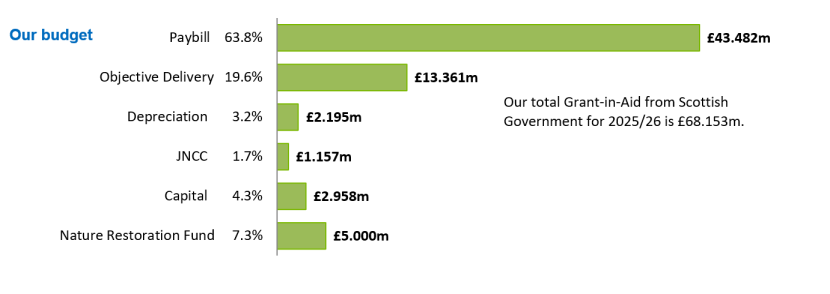
Our funding comprises our Grant-in-Aid of £65.958m plus depreciation. Our balance of time and project spend is presented overleaf. As with previous years, our funding is augmented with additional in year budget revisions which support our ongoing mission to protect, restore and value nature.
Graph
Our budget
Our total Grant-in-Aid from Scottish Government for 2025/26 is £68.153m.

Resourcing Our Plan

Each year we set out to deliver the priorities set out in our Corporate Plan. To do this our resources are allocated through the activities we undertake. These activities provide the conduit for flexible working across the organisation. The tables below show the start-of-year budget and resource allocation by these activities for 2025/26. 

We will retain flexibility throughout the year to deploy extra funds that become available through our efficiency programme and re-prioritisation that we undertake as part of our 90 day business planning process which allows us that flexibility to support our 4 key priority areas.

Protecting Nature
Activity£mFTE
Marine Ecosystems/Sustainable Coasts and Seas1.667101
Protected Areas0.81768
Supporting Good Development0.57164
Wildlife Management2.10387


Restoring Nature
Activity£mFTE
Biodiversity and Geodiversity0.79158
Natural Resource Management0.821103


Valuing Nature
Activity£mFTE
People and Places1.72379


NatureScot Way
Activity£mFTE
Workplace Facilities and Services1.87621
People and Organisational Development0.71327
Finance, Planning and Performance0.09023
Information and Cyber Security0.64427
Technology and Digital Services1.25842
External Funding0.00028
Communications0.24726
Executive Governance0.0408


Totals
-£mFTE
Total13.361762

Document downloads

Business Plan 2025-26 - Final version

pdf,

Feedback
  • Facebook
  • X
  • Whatsapp
  • Email

You may also be interested in

NatureScot's Corporate Plan

An attractive summary of NatureScot's Corporate Plan with a link to the full plan in pdf format

News and Blogs

Agreement for better nature and more secure food in Scotland

Strengthening the link between nature and sustainable farming in Scotland.

News - 19 June

With a Little Help From our Friends

An announcement that celebrates nature-based volunteering and citizen science

Blog - 6 June

New funds for venison supply chain

The third round of the Low Ground Venison Supply Chain Project was launched today (18 June) at the Royal Highland Show at Ingliston.

News - 18 June

Helping Scotland’s Rainforest thrive

Helping to restore Scotland’s precious rainforests by reducing deer grazing pressures.

Blog - 28 May

Crofters invited to share stories

Crofters in the Outer Hebrides are being sought for a new study exploring island crofting life, nature, and personal wellbeing.

News - 12 June

Croitearan gan sireadh airson sgrùdadh ùr

Rannsachadh air beatha croitearachd, nàdar ’s sunnd sna h-Eileanan

News - 12 June

View all news

View all blogs

Back to top Back to top

Quick Links

  • What we do
  • FAQs
  • Contact us
  • Our work
  • Licensing
  • Careers
  • Gaelic
  • Events
  • Sitemap
  • Publications & Documents
  • Board and Committees
  • NatureScot data services
  • Freedom of Information
  • LinkedIn
  • Facebook
  • Instagram
  • YouTube
  • Wordpress
  • Flickr


© NatureScot 2025

  • Privacy policy
  • Cookie policy
  • Accessibility
  • Copyright
  • Links policy
  • Feedback