Planting for Pollinators
Published: November 2022
Why are pollinators important?
- They play a vital role in nature by enabling many flowering plants to reproduce; their pollination service is crucial to agriculture (here in Scotland that can include raspberries, tomatoes, apples and strawberries).
- The seeds and fruit that many wild birds and other animals need rely heavily on the actions of pollinators.
- They contribute to our health and wellbeing by helping maintain a healthy biodiversity for us to enjoy as part of a natural health service, and
- Awareness of the role of pollinators enables future generations to understand more about nature's interwoven links.

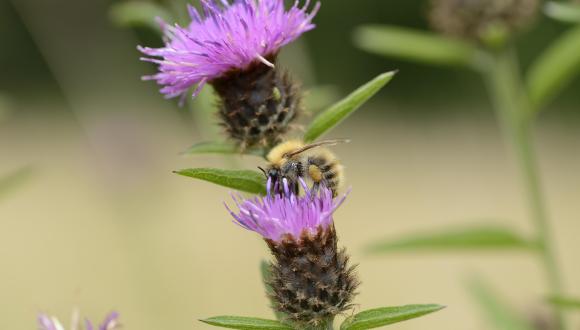
Bumblebee feeding on devil's bit scabious
Pollinator-friendly plants
Pollinators need flowers that produce lots of nectar (for energy) and pollen (for protein). The key period for your garden to be in bloom for pollinators is between March and October.
Spring and autumn are tricky months for pollinators as they emerge from or prepare to enter hibernation. Aim to have pollinator-friendly plants flowering in your garden around March and October.
With bulbs it is worth remembering that daffodils whilst very popular are not the best for pollinators. Why not supplement them with some pollinator friendly bulbs – you might try snowdrop or crocus for example.
Window boxes are very popular as are pots and hanging baskets. Many plants will do well in containers – herbs are very popular for the scent and colour they can provide. Amongst the herbs worth considering are chives, lavender, rosemary, sage and thyme.
The following suggestions in the table below are not exhaustive; and our website carries many more ideas and tips.
| Plant type | Spring | Summer | Autumn |
|---|---|---|---|
| Ornamental plants and herbs | Native Bluebell, Bugle, Comfrey, Crocus, Hellebores, Lungwort, Spring-flowering heather | Aquilegia, Borage, Catmint, Columbine, Cosmos, Delphinium, Foxglove, Globe-thistle, Lavender, Nasturtium, Oregano, Poppy, Scabious, Snapdragon, Sweet pea, Thyme, Verbena, Viper’s bugloss | Aster, Button snakewort, Cornflower, Sedum |
| Flowering trees and shrubs | Berberis, Blackthorn, Broom, Apple, Forsythia, Hawthorn, Hazel, Mahonia, Wild cherry, Rowan, Willow | Bramble, Honeysuckle, Laburnum, Rock rose, Viburnum | Hebe, Ivy |
| Wildflowers in long grass areas | Cowslip, Dandelion, Dead-nettle | Bird’s-foot-trefoil, Clovers, Devil’s Bit Scabious, Geranium, Knapweed, Oxeye daisy, Speedwell, Thistle, Vetch, Yarrow, Yellow Rattle | Autumn hawkbit, Clovers, Vetch |

Oxeye daisies (Leucanthemum vulgare)
Beyond flowers
Mow less
Many of us have been brought up to believe that a tidy garden and a well-clipped lawn are part and parcel of efficient gardening. However, consider reducing mowing to create an undisturbed wildflower patch, strip or meadow for pollinators.
The value of weeds
Weeds have had a bad name. A good example is the much maligned dandelion. If you can avoid cutting your grass until mid-April, after the dandelions have flowered but before they set seed, they will provide an important source of food for all types of pollinators.
Hedge not fence
Hedgerows offer a habitat for wildlife that fences can never match. Bumblebees often nest in the long grass at the base of flowering hedgerows
which are a valuable food source. Consider planting hedgerows made of flowering trees and shrubs such as hazel, willow, blackthorn and hawthorn.
Encourage friends and family
You can encourage others by sharing pollinator friendly plants. Plants and seed can be expensive, but for many pollinator friendly species, existing plants can be divided or new plants can be grown from cuttings.
Helping our pollinators
Scotland’s pollinators are a vital part of our biodiversity. Species such as bees and hoverflies are a familiar sight in our gardens, parks and countryside. They play a crucial role in our food and farming industries, as well as contributing to our enjoyment of the outdoors and our health and wellbeing.
But our wild pollinators are under threat. Faced with pressures that include habitat fragmentation, changes in land use, disease, pesticides and climate change they need our help.
The Pollinator Strategy for Scotland is the work of many partners. Delivering a wide range of activities it draws together the expertise and enthusiasm of a wide range of organisations, government agencies and businesses.
Our main objectives are to:
- Make Scotland more pollinator-friendly.
- Improve our understanding of these vital insects and the services they provide;
- Raise awareness of and encourage action to help bees and other pollinating insects; and
- Monitor and evaluate whether they are thriving.
We have lots of information on how to help pollinators on our website.
Follow us on twitter at ScotPollinators
And read our regular blogs at Scottishpollinators
Last updated: